Chen Haotian, Xu Jianfeng, Mao Yue, Sun Lili, Sun Yujing, Zhou Yuqiu
Nursing Department, The Second Affiliated Hospital Zhejiang University School of Medicine (SAHZU), Hangzhou, China.
School of Nursing, Harbin Medical University, Daqing, China.
Front Psychiatry. 2019 Sep 10;10:641. doi: 10.3389/fpsyt.2019.00641. eCollection 2019.
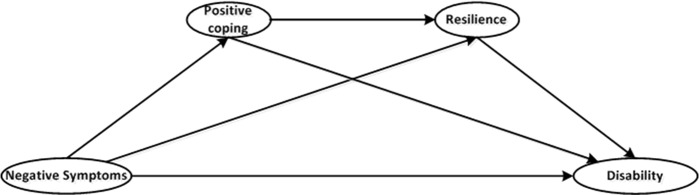
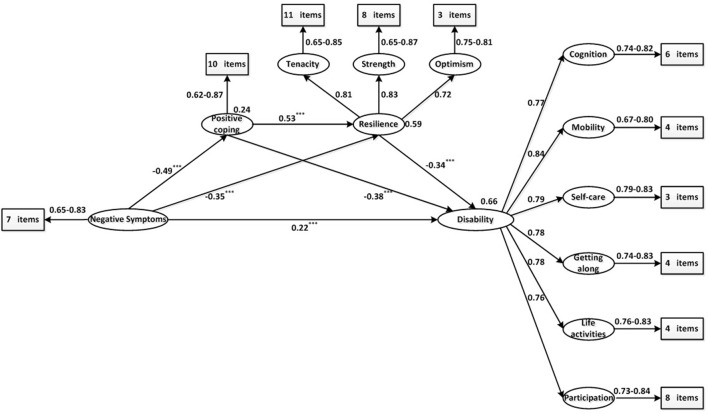
This study proposes a schizophrenia disability model to describe the associations between negative symptoms and disability to test the possible mediating roles of positive coping and resilience and to compare the relative weights of the indirect effects of these two mediators in an integrated whole. A total of 407 hospitalized Han Chinese patients diagnosed with stable schizophrenia or schizoaffective disorder were included. Patients were evaluated using the following scales: the Simplified Coping Style Questionnaire (SCQ) for positive coping, the Connor-Davidson Resilience Scale (CD-RISC) for resilience, the Positive and Negative Syndrome Scale (PANSS) for negative symptoms, and the World Health Organization Disability Assessment Schedule, Version II (WHO-DAS II) for the severity of disability. The schizophrenia disability distal mediation model was constructed using the structural modeling (SEM) approach. Bootstrapping procedures and the PRODCLIN program were used to examine the mediating roles of positive coping and resilience. The schizophrenia disability model was well-fitted to the observed data. Positive coping and resilience together with negative symptoms explained 66% of the variance in disability. Positive coping and resilience partly mediated the negative symptoms-disability relationship. The bootstrapped unstandardized indirect effect was 0.319, and the direct effect was 0.224. Positive coping also has a significant positive effect on resilience. In addition, the ratio of the specific indirect effect of positive coping to the total indirect effect (48%) is higher than that of resilience (30%). Positive coping and resilience are two key causal mediators of the negative symptoms-disability relationship. Positive coping and resilience are important personal resources for patients with schizophrenia. We found that the indirect effect of positive coping was relatively more important than that of resilience. This result suggests that personalized treatments aimed at resilience and positive coping can effectively buffer the impact of negative symptoms for patients with schizophrenia and promote rehabilitation.
本研究提出了一种精神分裂症残疾模型,以描述阴性症状与残疾之间的关联,检验积极应对和心理韧性可能的中介作用,并在一个整合的整体中比较这两种中介的间接效应的相对权重。共纳入407名被诊断为稳定型精神分裂症或精神分裂症情感障碍的汉族住院患者。使用以下量表对患者进行评估:用于评估积极应对的简易应对方式问卷(SCQ)、用于评估心理韧性的Connor-Davidson心理韧性量表(CD-RISC)、用于评估阴性症状的阳性与阴性症状量表(PANSS)以及用于评估残疾严重程度的世界卫生组织残疾评定量表第二版(WHO-DAS II)。采用结构方程模型(SEM)方法构建精神分裂症残疾远端中介模型。使用自抽样程序和PRODCLIN程序来检验积极应对和心理韧性的中介作用。精神分裂症残疾模型与观测数据拟合良好。积极应对、心理韧性以及阴性症状共同解释了残疾差异的66%。积极应对和心理韧性部分介导了阴性症状与残疾之间的关系。自抽样得到的非标准化间接效应为0.319,直接效应为0.224。积极应对对心理韧性也有显著的正向影响。此外,积极应对的特定间接效应占总间接效应的比例(48%)高于心理韧性(30%)。积极应对和心理韧性是阴性症状与残疾关系的两个关键因果中介。积极应对和心理韧性是精神分裂症患者重要的个人资源。我们发现积极应对的间接效应相对比心理韧性更重要。这一结果表明,针对心理韧性和积极应对的个性化治疗可以有效缓冲阴性症状对精神分裂症患者的影响并促进康复。