Zhang Wenpei, De Beuckelaer Alain, Chen Lirong, Zhou Renlai
Department of Psychology, Nanjing University, Nanjing, China.
Department of Business Administration, School of Business, Anhui University of Technology, Maanshan, China.
Front Psychiatry. 2019 Sep 6;10:645. doi: 10.3389/fpsyt.2019.00645. eCollection 2019.
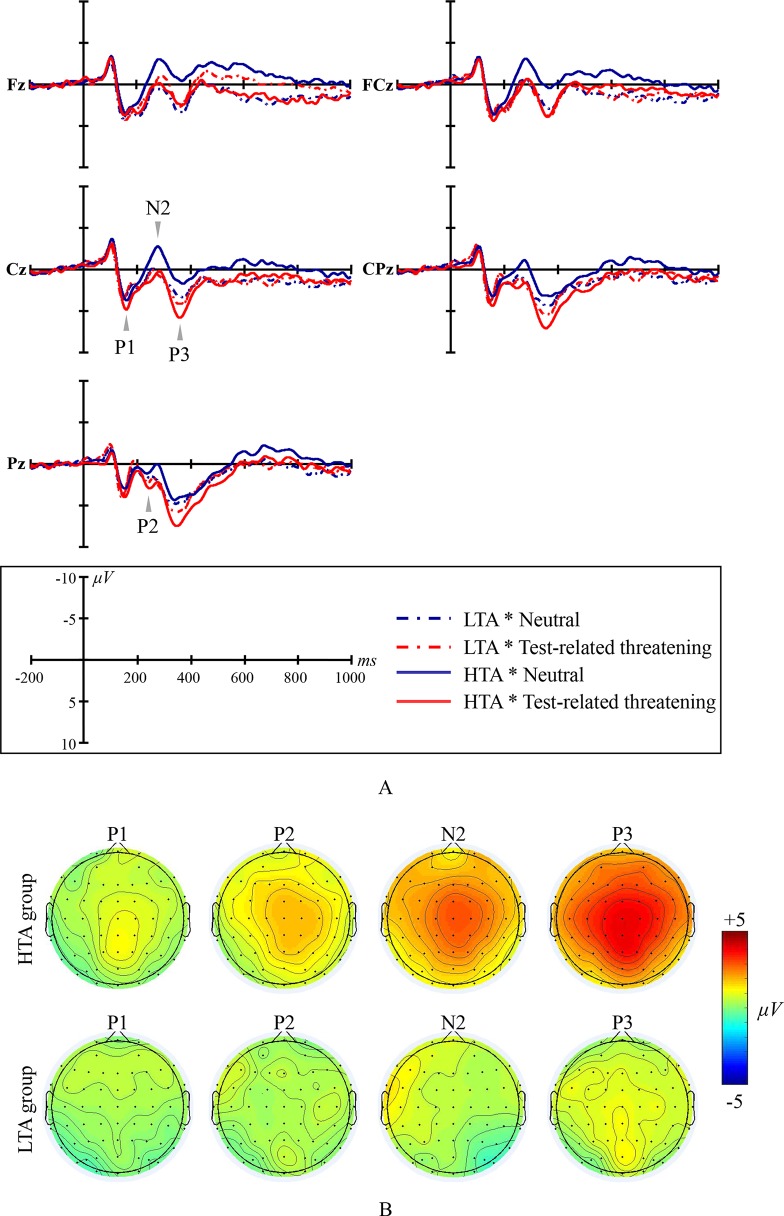
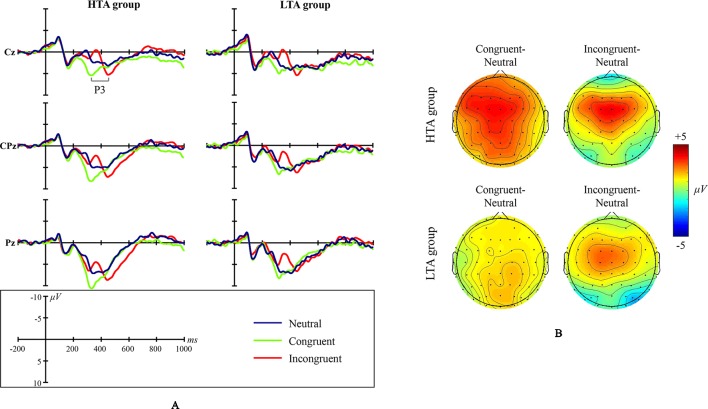
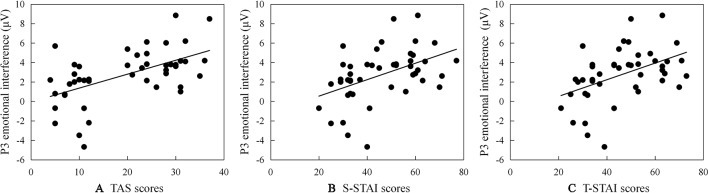
Individuals with test anxiety [i.e., high test anxiety (HTA)] always treat tests/examinations as a potential threat. This cognitive mode impairs these individuals' ability of inhibitory control and leads to a high level of anxiety. However, characterizing aspects of HTA's impaired inhibitory control ability are unclear and need to be studied. Forty-six participants were recruited and divided into a HTA (N = 26) and low test anxiety (LTA; i.e., healthy control; N = 20) group. Self-reports (Test Anxiety Scale, State-Trait Anxiety Inventory for negative emotions) were obtained. An emotional Stroop (ES) task and a numerical Stroop (NS) task, causing different types of interferences, were used for assessing the emotional and cognitive aspects of attentional control ability (behavioral data). Event-related brain potentials (ERPs) were registered to further assess processing stages related to different aspects of attentional control ability. Compared with the LTA group, the HTA group has inhibitory control deficits of both emotional (see ERP components P1-P2-N2 and P3) and cognitive (see ERP component P3) interference. Compared with the LTA group, the HTA doesn't have lower accuracy in neither ES nor NS but displays longer reaction times only in ES. Additionally, the HTA group's ES results also show that (1) the degree of emotional interference indicates the level of an individual's anxiety, and (2) the ERP component P2 may serve as an index of the level of test anxiety. HTA individuals have extensive inhibitory deficits for both emotional and cognitive aspects; however, impairment impacts more on emotional aspects than on cognitive aspects. Additionally, as compared to NS, the negative impact of more impaired processing stages on task performance is more substantial in ES.
患有考试焦虑症的个体(即高考试焦虑症患者)总是将考试视为一种潜在威胁。这种认知模式会损害这些个体的抑制控制能力,并导致高度焦虑。然而,高考试焦虑症受损抑制控制能力的特征尚不明确,需要进行研究。招募了46名参与者,并将其分为高考试焦虑症组(N = 26)和低考试焦虑症组(即健康对照组;N = 20)。获取了自我报告(考试焦虑量表、负性情绪状态-特质焦虑量表)。使用引起不同类型干扰的情绪斯特鲁普(ES)任务和数字斯特鲁普(NS)任务来评估注意力控制能力的情绪和认知方面(行为数据)。记录事件相关脑电位(ERP)以进一步评估与注意力控制能力不同方面相关的加工阶段。与低考试焦虑症组相比,高考试焦虑症组在情绪干扰(见ERP成分P1 - P2 - N2和P3)和认知干扰(见ERP成分P3)方面均存在抑制控制缺陷。与低考试焦虑症组相比,高考试焦虑症组在ES和NS任务中的准确率均没有降低,但仅在ES任务中反应时间更长。此外,高考试焦虑症组的ES结果还表明:(1)情绪干扰程度表明个体的焦虑水平;(2)ERP成分P2可作为考试焦虑水平的指标。高考试焦虑症个体在情绪和认知方面均存在广泛的抑制缺陷;然而,损害对情绪方面的影响比对认知方面的影响更大。此外,与NS任务相比,更多受损加工阶段对任务表现的负面影响在ES任务中更为显著。