Equine Clinic, Chair of Clinical Veterinary Medicine, Estonian University of Life Sciences, Tartu, Estonia.
Chair of Veterinary Bio- and Population Medicine, Estonian University of Life Sciences, Tartu, Estonia.
Vet Med Sci. 2020 Feb;6(1):100-104. doi: 10.1002/vms3.200. Epub 2019 Sep 27.
African swine fever (ASF), a severe multi-systemic disease in pigs, was introduced into Estonia in 2014. The majority of outbreaks have occurred during the summer months. Given that ASFV is transmitted in a sylvatic cycle that includes the transmission by African soft ticks and that mechanical transmission by flying insects was shown, transmission by other arthropod vectors need to be considered.
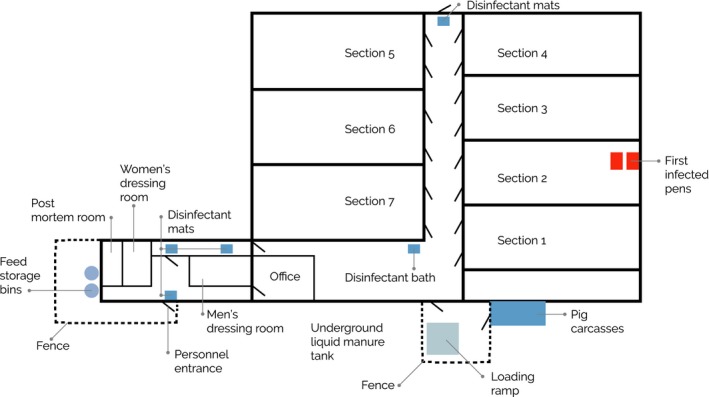
Here, we report the results of a pilot study on flying insects caught on an outbreak farm during epidemiological investigations.
In brief, 15 different insect species (flies and mosquitoes) were collected by random catch using an aerial net. Nucleic acids derived from these samples or their pools were tested for African swine fever virus (ASFV) DNA by real-time PCR.
Viral DNA was detected in small quantities in two samples from flies and mosquitoes. Given the slow spread of virus within the farm, the impact of these findings seems rather low, but a role in local transmission cannot be ruled out. However, given the very low number of insects sampled, and taken into the account that viral isolation was not performed and insects outside the farm were not investigated, future investigations are needed to assess the true impact of insects as mechanical vectors.
非洲猪瘟(ASF)是一种严重的猪多系统疾病,于 2014 年传入爱沙尼亚。大多数疫情发生在夏季。鉴于 ASFV 在包括通过非洲软蜱传播的森林循环中传播,并且已经证明机械传播由飞行昆虫引起,因此需要考虑其他节肢动物载体的传播。
在此,我们报告了在流行病学调查期间在暴发农场捕获的飞行昆虫的初步研究结果。
简而言之,使用空中网通过随机捕获收集了 15 种不同的昆虫物种(苍蝇和蚊子)。从这些样本或其组合中提取的核酸通过实时 PCR 检测非洲猪瘟病毒(ASFV)DNA。
从苍蝇和蚊子的两个样本中检测到了少量的病毒 DNA。鉴于病毒在农场内的传播速度很慢,这些发现的影响似乎相当低,但不能排除其在本地传播中的作用。然而,考虑到采样的昆虫数量非常少,并且没有进行病毒分离以及没有调查农场外的昆虫,因此需要进行未来的研究,以评估昆虫作为机械传播媒介的真正影响。