Kalaiselvam Rajeswari, Soundararajan Karthick, Rajan R Mathan, Deivanayagam Kandaswamy, Arumugam Chakravarthy, Ganesh Arathi
Conservative Dentistry and Endodontics, Faculty of Dental Sciences, Sri Ramachandra University, Chennai, IND.
Cureus. 2019 Jul 24;11(7):e5228. doi: 10.7759/cureus.5228.
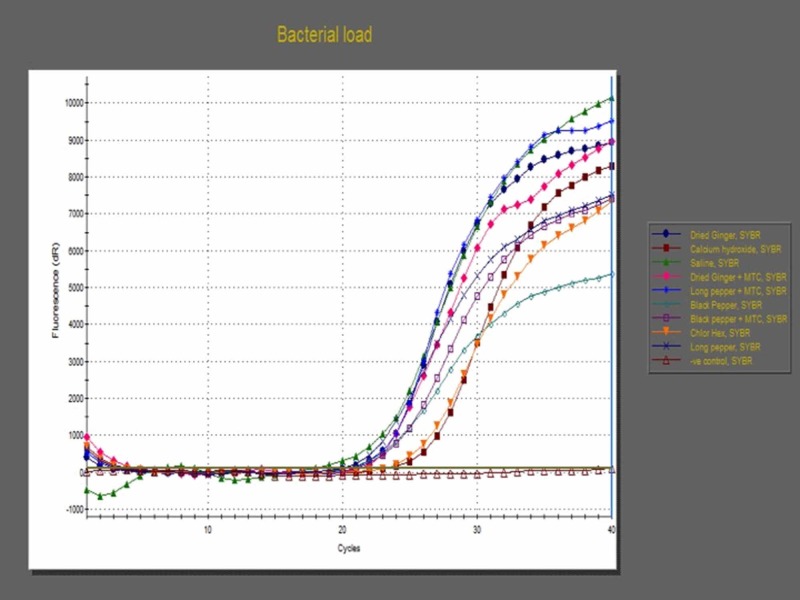
Periradicular bacterial infections are the proven cause of the failure of endodontic treatment. When the pulp canal gets infected or becomes necrotic, bacterial growth takes place in the form of biofilms and aggregates. During the endodontic procedure, bacterial colonies are disrupted, and the microbial load is reduced by biomechanical preparation, cleaning with anti-microbial solutions, and placing anti-bacterial medicaments in the root canal. These anti-microbial substances are synthetic, having a cytotoxicity effect. In recent times, herbal medicines are an alternative medicine being used increasingly as an intra-canal medicament to fight or prevent common endodontic infections. Aim The objective of this study is to compare the anti-bacterial efficacy of herbal medicaments and synthetic medicaments against Enterococcus faecalis (E. faecalis). Materials and methods This was an in-vitro study in which a total of 60 teeth specimens (n=60) were inoculated with E. faecalis for 21 days. Specimens were divided into six groups (Group 1: Piper nigrum (Piperaceae); Group 2: Piper longum (Piperaceae); Group 3: Zingiber officinale Roscoe (Zingiberaceae); Group 4: Calcium hydroxide; Group 5: 2% chlorhexidine gel (CHX); and Group 6: saline (negative control). The intra-canal medicaments were packed inside the tooth. After five days, the remaining microbial load was determined by using real-time PCR. Results The threshold cycle (Ct) values of Piper nigrum, Piper longum, dried ginger extract, 2% CHX, calcium hydroxide, and saline were found to be 21.36, 20.55, 22.14, 22.51, 23.62, and 17.81, respectively. The obtained mean bacterial load of these products was 8.64, 12.52, 7.23, 0.82, 0.14, and 149.49, respectively. Conclusion Two percent CHX showed high antibacterial activity against E. faecalis followed by calcium hydroxide, Zingiber officinale Roscoe, Piper nigrum, Piper longum, and saline.
根尖周细菌感染是牙髓治疗失败的已证实原因。当牙髓腔受到感染或坏死时,细菌以生物膜和聚集体的形式生长。在牙髓治疗过程中,细菌菌落被破坏,通过生物力学预备、用抗菌溶液冲洗以及在根管内放置抗菌药物来降低微生物负荷。这些抗菌物质是合成的,具有细胞毒性作用。近年来,草药作为一种替代药物越来越多地被用作根管内药物来对抗或预防常见的牙髓感染。目的本研究的目的是比较草药药物和合成药物对粪肠球菌(E. faecalis)的抗菌效果。材料和方法这是一项体外研究,总共60颗牙齿标本(n = 60)接种粪肠球菌21天。标本分为六组(第1组:胡椒(胡椒科);第2组:荜茇(胡椒科);第3组:生姜(姜科);第4组:氢氧化钙;第5组:2%氯己定凝胶(CHX);第6组:生理盐水(阴性对照)。根管内药物被填充到牙齿内部。五天后,通过实时聚合酶链反应测定剩余的微生物负荷。结果发现胡椒、荜茇、干姜提取物、2% CHX、氢氧化钙和生理盐水的阈值循环(Ct)值分别为21.36、20.55、22.14、22.51、23.62和17.81。这些产品获得的平均细菌负荷分别为8.64、12.52、7.23、0.82、0.14和149.49。结论2% CHX对粪肠球菌显示出高抗菌活性,其次是氢氧化钙、生姜、胡椒、荜茇和生理盐水。