Université de Poitiers, UMR CNRS 7267, EBI "Ecologie et Biologie des Interactions", Poitiers, France.
PLoS One. 2019 Sep 30;14(9):e0223173. doi: 10.1371/journal.pone.0223173. eCollection 2019.
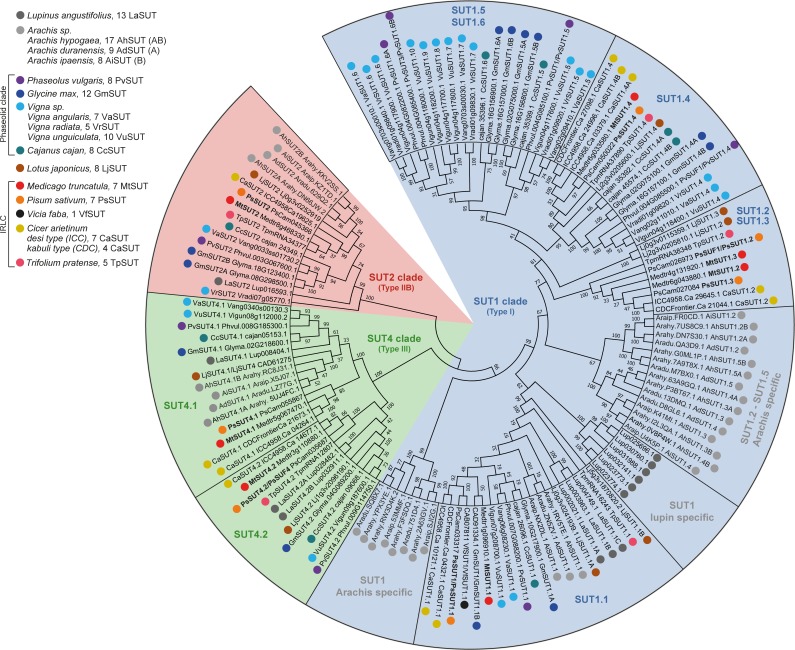
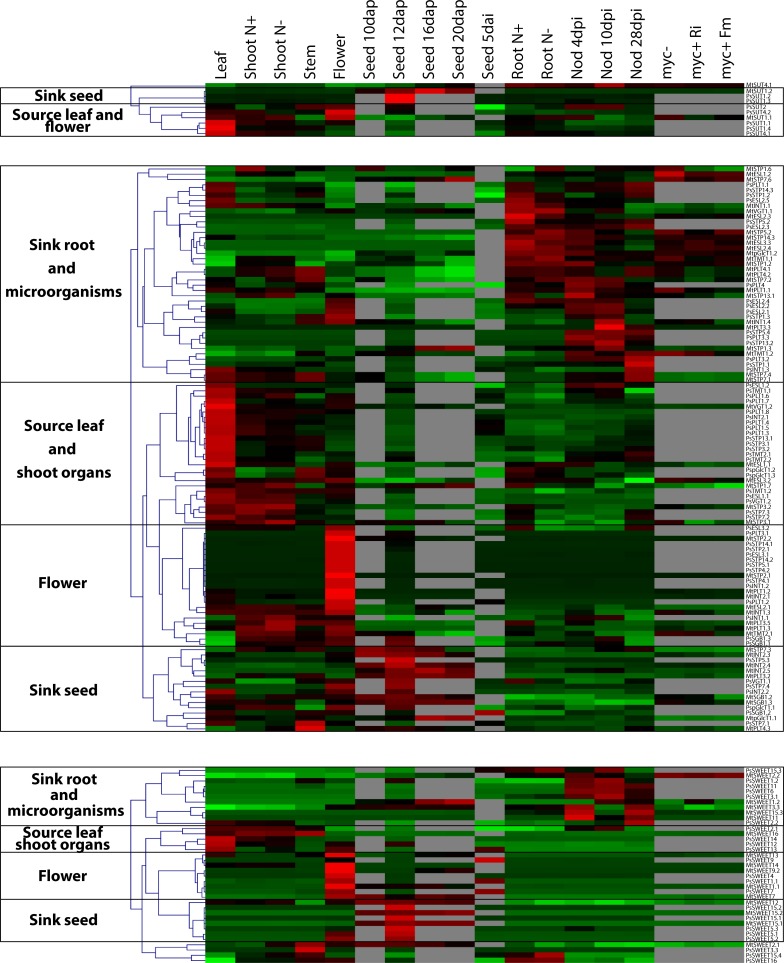
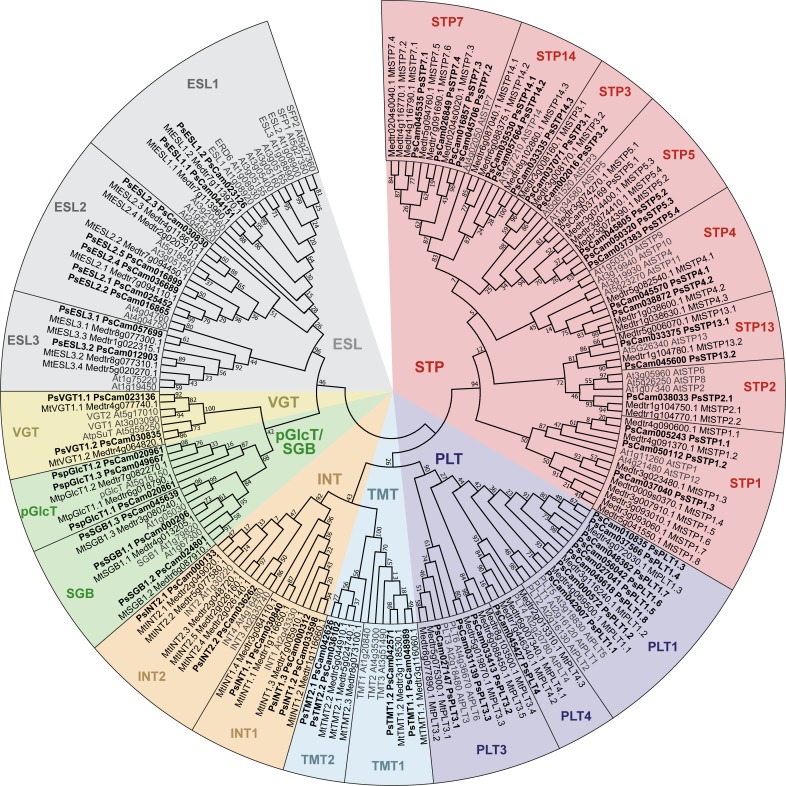
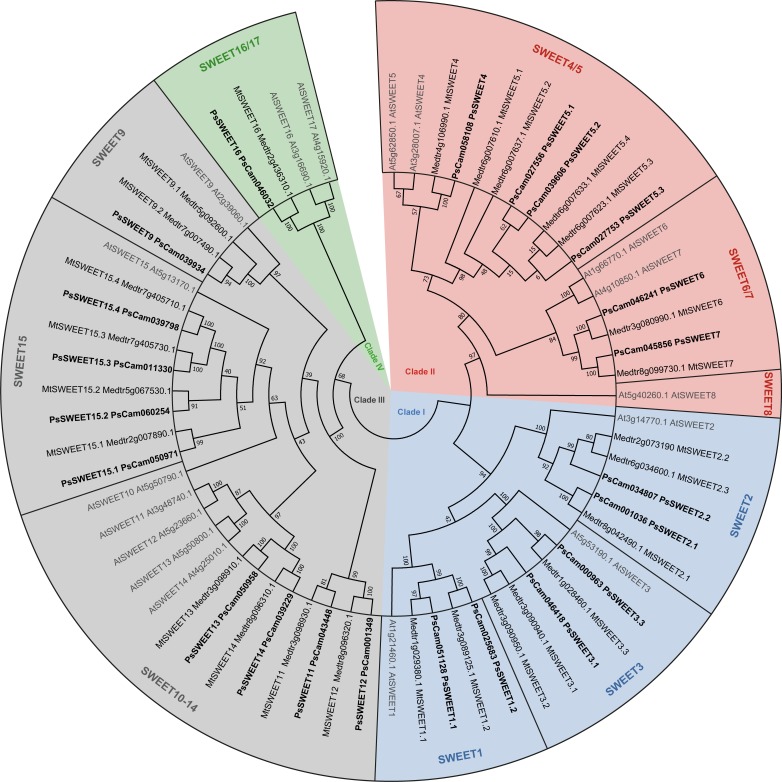
Sugar transporters play a crucial role for plant productivity, as they coordinate sugar fluxes from source leaf towards sink organs (seed, fruit, root) and regulate the supply of carbon resources towards the microorganisms of the rhizosphere (bacteria and fungi). Thus, sugar fluxes mediated by SUT (sucrose transporters), MST (monosaccharide transporters) and SWEET (sugar will eventually be exported transporters) families are key determinants of crop yield and shape the microbial communities living in the soil. In this work, we performed a systematic search for sugar transporters in Fabaceae genomes, focusing on model and agronomical plants. Here, we update the inventory of sugar transporter families mining the latest version of the Medicago truncatula genome and identify for the first time SUT MST and SWEET families of the agricultural crop Pisum sativum. The sugar transporter families of these Fabaceae species comprise respectively 7 MtSUT 7 PsSUT, 72 MtMST 59 PsMST and 26 MtSWEET 22 PsSWEET. Our comprehensive phylogenetic analysis sets a milestone for the scientific community, as we propose a new and simple nomenclature to correctly name SUT MST and SWEET families. Then, we searched for transcriptomic data available for our gene repertoire. We show that several clusters of homologous genes are co-expressed in different organs, suggesting that orthologous sugar transporters may have a conserved function. We focused our analysis on gene candidates that may be involved in remobilizing resources during flowering, grain filling and in allocating carbon towards roots colonized by arbuscular mycorrhizal fungi and Rhizobia. Our findings open new perspectives for agroecological applications in legume crops, as for instance improving the yield and quality of seed productions and promoting the use of symbiotic microorganisms.
糖转运蛋白在植物生产力中起着至关重要的作用,因为它们协调源叶向汇器官(种子、果实、根)的糖通量,并调节碳资源向根际微生物(细菌和真菌)的供应。因此,SUT(蔗糖转运蛋白)、MST(单糖转运蛋白)和 SWEET(糖最终将被输出转运蛋白)家族介导的糖通量是作物产量的关键决定因素,并塑造了生活在土壤中的微生物群落。在这项工作中,我们系统地搜索了豆科基因组中的糖转运蛋白,重点是模式植物和农业植物。在这里,我们更新了挖掘最新版本的 Medicago truncatula 基因组的糖转运蛋白家族清单,并首次鉴定了农业作物豌豆的 SUT MST 和 SWEET 家族。这些豆科物种的糖转运蛋白家族分别包括 7 个 MtSUT、7 个 PsSUT、72 个 MtMST、59 个 PsMST 和 26 个 MtSWEET、22 个 PsSWEET。我们全面的系统发育分析为科学界设立了一个里程碑,因为我们提出了一种新的简单命名法来正确命名 SUT MST 和 SWEET 家族。然后,我们搜索了可用于我们基因库的转录组数据。我们表明,不同器官中存在多个同源基因簇的共表达,表明直系同源糖转运蛋白可能具有保守功能。我们的分析重点是候选基因,这些基因可能参与开花、灌浆期间资源的再动员以及向被丛枝菌根真菌和根瘤菌定殖的根分配碳。我们的研究结果为豆科作物的农业生态应用开辟了新的前景,例如提高种子产量和质量,并促进共生微生物的利用。