European Molecular Biology Laboratory, European Bioinformatics Institute, Wellcome Genome Campus, Hinxton, Cambridge CB10 1SD, UK.
Institute of Molecular Life Sciences, University of Zurich, Zurich, Switzerland; Life Science Zurich Graduate School, ETH Zurich and University of Zurich, Zurich, Switzerland.
Cell Rep. 2019 Oct 1;29(1):202-211.e6. doi: 10.1016/j.celrep.2019.08.077.
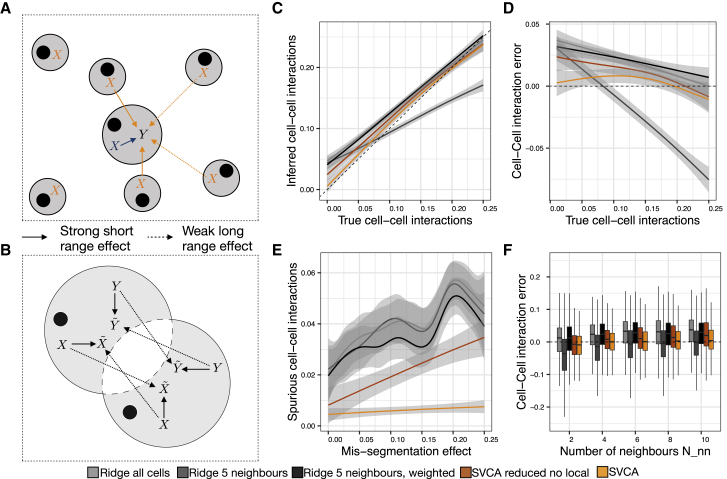
Technological advances enable assaying multiplexed spatially resolved RNA and protein expression profiling of individual cells, thereby capturing molecular variations in physiological contexts. While these methods are increasingly accessible, computational approaches for studying the interplay of the spatial structure of tissues and cell-cell heterogeneity are only beginning to emerge. Here, we present spatial variance component analysis (SVCA), a computational framework for the analysis of spatial molecular data. SVCA enables quantifying different dimensions of spatial variation and in particular quantifies the effect of cell-cell interactions on gene expression. In a breast cancer Imaging Mass Cytometry dataset, our model yields interpretable spatial variance signatures, which reveal cell-cell interactions as a major driver of protein expression heterogeneity. Applied to high-dimensional imaging-derived RNA data, SVCA identifies plausible gene families that are linked to cell-cell interactions. SVCA is available as a free software tool that can be widely applied to spatial data from different technologies.
技术进步使得能够对单个细胞的多重空间分辨 RNA 和蛋白质表达谱进行分析,从而捕捉生理环境下的分子变化。虽然这些方法越来越容易获得,但研究组织的空间结构和细胞间异质性相互作用的计算方法才刚刚开始出现。在这里,我们提出了空间方差成分分析(SVCA),这是一种用于分析空间分子数据的计算框架。SVCA 能够量化不同维度的空间变化,特别是量化细胞间相互作用对基因表达的影响。在乳腺癌成像质谱细胞计数数据集上,我们的模型产生了可解释的空间方差特征,这些特征揭示了细胞间相互作用是蛋白质表达异质性的主要驱动因素。将其应用于高维成像衍生的 RNA 数据,SVCA 确定了与细胞间相互作用相关的合理基因家族。SVCA 作为一个免费的软件工具,可以广泛应用于来自不同技术的空间数据。