Department of Radiology | E.01.132, Utrecht University Medical Center, Heidelberglaan 100, 3584CX, Utrecht, The Netherlands.
Biomedical Image Analysis Group, Department of Computing, Imperial College, London, UK.
J Cardiovasc Magn Reson. 2019 Oct 7;21(1):61. doi: 10.1186/s12968-019-0575-y.
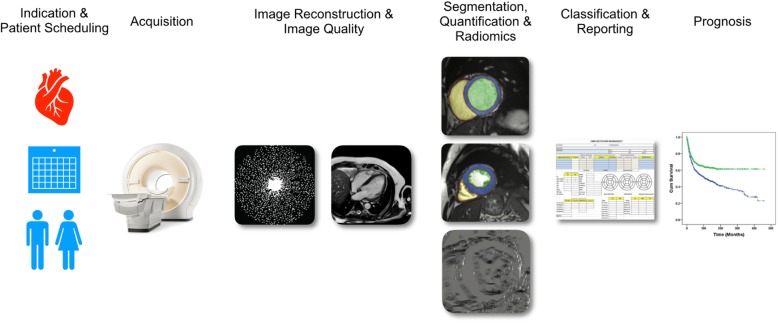
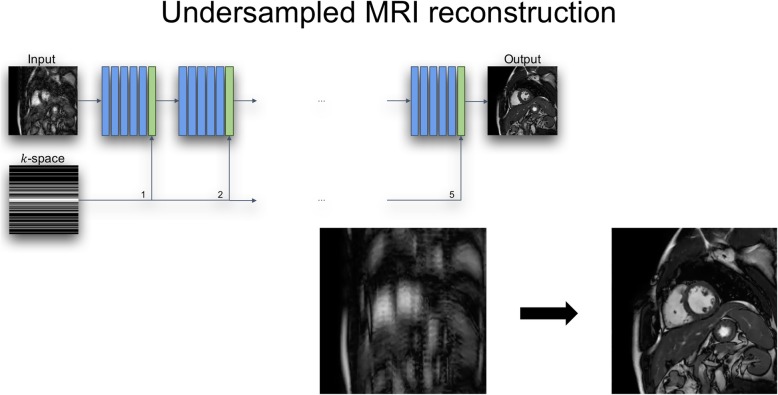
Machine learning (ML) is making a dramatic impact on cardiovascular magnetic resonance (CMR) in many ways. This review seeks to highlight the major areas in CMR where ML, and deep learning in particular, can assist clinicians and engineers in improving imaging efficiency, quality, image analysis and interpretation, as well as patient evaluation. We discuss recent developments in the field of ML relevant to CMR in the areas of image acquisition & reconstruction, image analysis, diagnostic evaluation and derivation of prognostic information. To date, the main impact of ML in CMR has been to significantly reduce the time required for image segmentation and analysis. Accurate and reproducible fully automated quantification of left and right ventricular mass and volume is now available in commercial products. Active research areas include reduction of image acquisition and reconstruction time, improving spatial and temporal resolution, and analysis of perfusion and myocardial mapping. Although large cohort studies are providing valuable data sets for ML training, care must be taken in extending applications to specific patient groups. Since ML algorithms can fail in unpredictable ways, it is important to mitigate this by open source publication of computational processes and datasets. Furthermore, controlled trials are needed to evaluate methods across multiple centers and patient groups.
机器学习(ML)正在通过多种方式对心血管磁共振(CMR)产生重大影响。本文旨在重点介绍 ML,特别是深度学习在提高成像效率、质量、图像分析和解释以及患者评估方面可以协助临床医生和工程师的主要领域。我们讨论了与 CMR 相关的 ML 领域的最新发展,包括图像采集和重建、图像分析、诊断评估和预后信息的推导。迄今为止,ML 在 CMR 中的主要影响是大大减少了图像分割和分析所需的时间。现在,商业产品中提供了左心室和右心室质量和容积的准确且可重复的全自动定量。正在积极研究的领域包括减少图像采集和重建时间、提高空间和时间分辨率,以及分析灌注和心肌映射。尽管大型队列研究为 ML 培训提供了有价值的数据集,但在将应用扩展到特定患者群体时必须谨慎。由于 ML 算法可能以不可预测的方式失败,因此通过公开计算过程和数据集来减轻这种情况非常重要。此外,需要进行对照试验来评估跨多个中心和患者群体的方法。