Department of Genetics, Yale Stem Cell Center, Yale School of Medicine, New Haven, CT, USA.
Department of Anesthesiology, Yale School of Medicine, New Haven, CT, USA.
Nat Methods. 2019 Nov;16(11):1169-1175. doi: 10.1038/s41592-019-0586-5. Epub 2019 Oct 7.
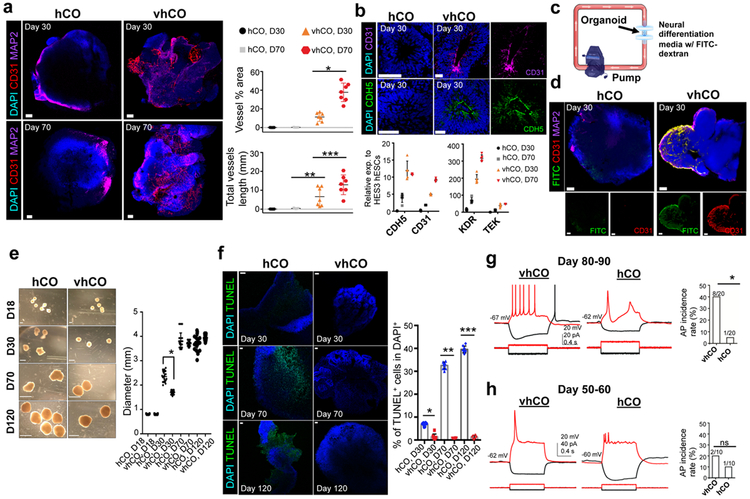
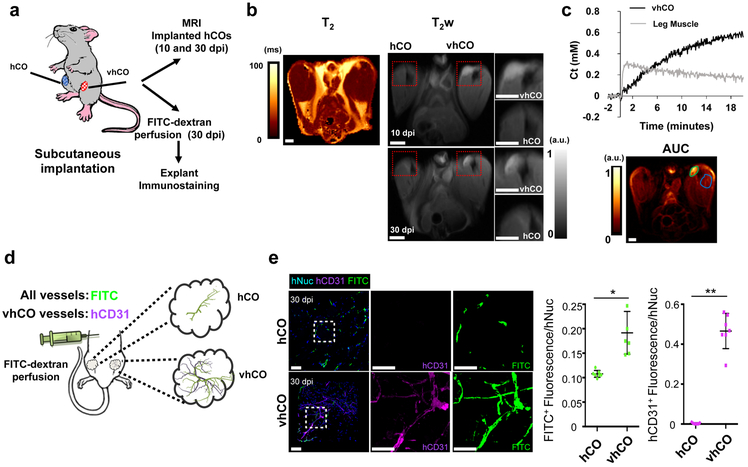
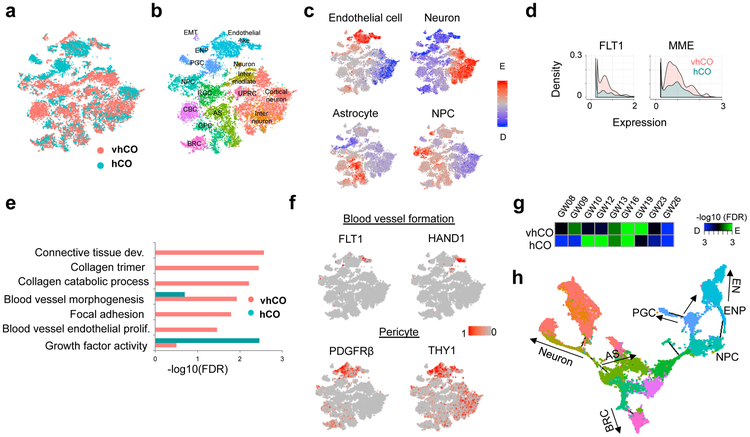
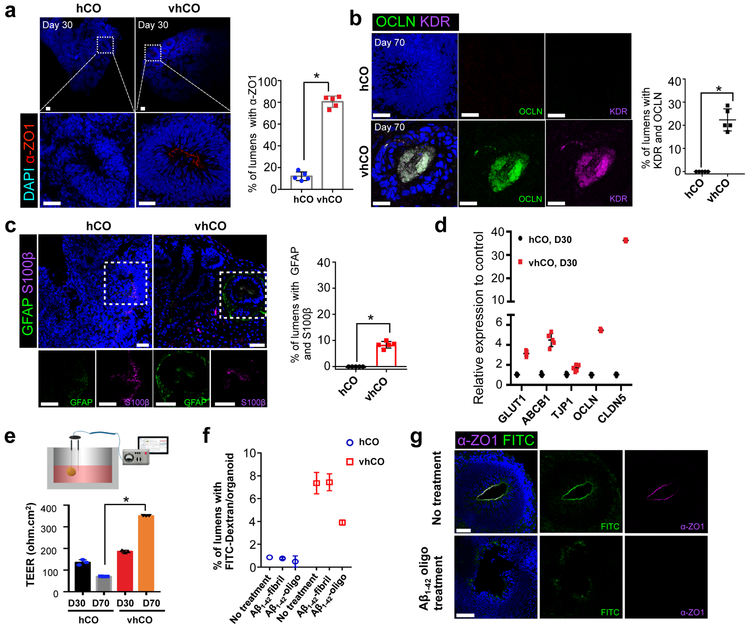
Human cortical organoids (hCOs), derived from human embryonic stem cells (hESCs), provide a platform to study human brain development and diseases in complex three-dimensional tissue. However, current hCOs lack microvasculature, resulting in limited oxygen and nutrient delivery to the inner-most parts of hCOs. We engineered hESCs to ectopically express human ETS variant 2 (ETV2). ETV2-expressing cells in hCOs contributed to forming a complex vascular-like network in hCOs. Importantly, the presence of vasculature-like structures resulted in enhanced functional maturation of organoids. We found that vascularized hCOs (vhCOs) acquired several blood-brain barrier characteristics, including an increase in the expression of tight junctions, nutrient transporters and trans-endothelial electrical resistance. Finally, ETV2-induced endothelium supported the formation of perfused blood vessels in vivo. These vhCOs form vasculature-like structures that resemble the vasculature in early prenatal brain, and they present a robust model to study brain disease in vitro.
人类皮质类器官(hCOs)来源于人类胚胎干细胞(hESCs),为研究人类大脑发育和复杂三维组织中的疾病提供了一个平台。然而,目前的 hCOs 缺乏微血管,导致 hCOs 内部的氧气和营养物质输送受到限制。我们通过工程改造 hESCs 使其异位表达人类 ETS 变体 2(ETV2)。在 hCOs 中表达 ETV2 的细胞有助于在 hCOs 中形成复杂的血管样网络。重要的是,血管样结构的存在促进了类器官的功能成熟。我们发现,血管化 hCOs(vhCOs)获得了几个血脑屏障特征,包括紧密连接、营养转运体和跨内皮电阻的表达增加。最后,ETV2 诱导的内皮支持体内灌流血管的形成。这些 vhCOs 形成了类似于早期产前大脑血管的血管样结构,为体外研究大脑疾病提供了一个强大的模型。