Departments of Neurobiology, Care Sciences and Society, Division of Pjhysiotherapy, Karolinska Institutet, Huddinge, Sweden.
Allied Health Professionals Function, Karolinska University Hospital, Stockholm, Sweden.
BMC Musculoskelet Disord. 2019 Oct 12;20(1):444. doi: 10.1186/s12891-019-2856-x.
Musculoskeletal disorders (MSD) are common among soldiers and constitute the most common reason for discontinuing military service within different military populations worldwide. The aims of this study were to investigate the prevalence of musculoskeletal disorders in two cohorts, 10 years apart, in the Swedish Armed Forces, to explore differences between these cohorts and to determine associated factors with MSD.
Comparative cross-sectional study. Participants were recruited from the Swedish Armed Forces, i.e. soldiers preparing for international missions in 2002 and 2012. A total of 961 soldiers, 7% women, participated in the study. Data were collected using the Musculoskeletal Screening Protocol (MSP), which includes questions regarding prevalence of MSD in ten anatomical locations (neck, upper back, low back, shoulders, elbow, hand, hip, knee, lower limb and foot). An additional five questions concern perceived self-rated health, i.e. how the respondent perceives their own physical body, mental health, social environment, physical environment and work ability.
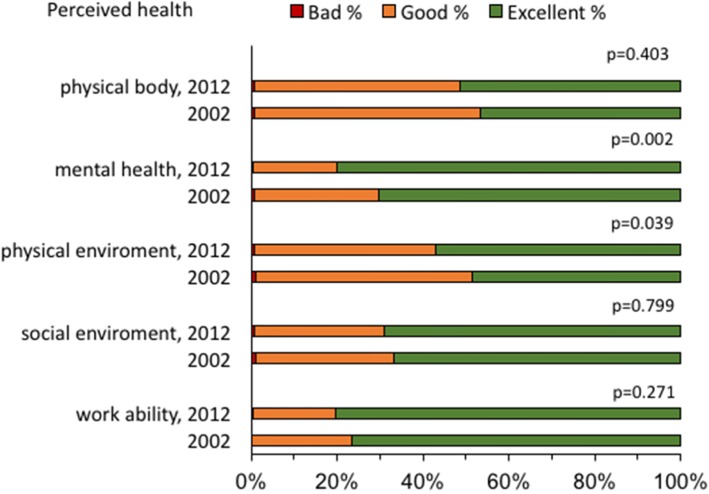
Over a ten-year period, both point prevalence and one-year prevalence of MSD in any body part increased significantly, with point prevalence increasing from 7.1 to 35.2% (p < 0.001) and one-year prevalence from 27.9 to 67.9% (p < 0.001). The knee was the most common anatomic location for MSD in both cohorts. Across each anatomical location (neck, upper back, low back, shoulders, elbow, hand, hip, knee, lower leg and foot), both point prevalence (p < 0.039) and one-year prevalence (p < 0.005) increased significantly from 2002 to 2012. Most soldiers reported good to excellent perceived health, i.e. self-perception of their physical body, mental health, physical and social environments, and work ability. The odds of reporting one-year prevalence of MSD in any body part was 5.28 times higher for soldiers in Cohort 2012, 1.91 times higher in age group 31-40 and 2.84 times higher in age group 41 and above.
The prevalence of MSD increased remarkably over a ten-year period among Swedish soldiers preparing for international missions. With increasing age as one risk factor, systematic monitoring of MSD throughout the soldiers' careers and implementation of targeted primary-to-tertiary preventive programs are thus important.
肌肉骨骼疾病(MSD)在士兵中很常见,是全球不同军事人群中停止兵役的最常见原因。本研究的目的是调查瑞典武装部队中两个队列的肌肉骨骼疾病的患病率,探讨这些队列之间的差异,并确定与 MSD 相关的因素。
比较性横断面研究。参与者来自瑞典武装部队,即 2002 年和 2012 年准备参加国际任务的士兵。共有 961 名士兵(7%为女性)参加了这项研究。使用肌肉骨骼筛查方案(MSP)收集数据,该方案包括十个解剖部位(颈部、上背部、下背部、肩部、肘部、手部、臀部、膝盖、下肢和足部)的 MSD 患病率问题。另外五个问题涉及自我评估的健康状况,即被调查者如何看待自己的身体、心理健康、社会环境、物理环境和工作能力。
在十年期间,任何身体部位的点患病率和一年患病率均显著增加,点患病率从 7.1%增加到 35.2%(p<0.001),一年患病率从 27.9%增加到 67.9%(p<0.001)。膝关节是两个队列中最常见的肌肉骨骼疾病解剖部位。在每个解剖部位(颈部、上背部、下背部、肩部、肘部、手部、臀部、膝盖、小腿和足部),2002 年至 2012 年,点患病率(p<0.039)和一年患病率(p<0.005)均显著增加。大多数士兵报告了良好到极好的自我感知健康,即对自己的身体、心理健康、身体和社会环境以及工作能力的自我感知。报告任何身体部位一年患病率的士兵中,队列 2012 年的士兵的可能性是队列 2002 年的士兵的 5.28 倍,年龄在 31-40 岁的士兵的可能性是队列 2002 年的士兵的 1.91 倍,年龄在 41 岁及以上的士兵的可能性是队列 2002 年的士兵的 2.84 倍。
在准备参加国际任务的瑞典士兵中,肌肉骨骼疾病的患病率在十年内显著增加。随着年龄成为一个风险因素,系统监测士兵职业生涯中的肌肉骨骼疾病并实施有针对性的初级至三级预防计划非常重要。