Kim Cheol-Han, Yoon Da-Eun, Lee Ye-Seul, Jung Won-Mo, Kim Joo-Hee, Chae Younbyoung
Acupuncture & Meridian Science Research Center, College of Korean Medicine, Kyung Hee University, Seoul 02447, Korea.
Department of Anatomy and Acupoint, College of Korean Medicine, Gachon University, Seongnam 13120, Korea.
J Clin Med. 2019 Oct 11;8(10):1663. doi: 10.3390/jcm8101663.
The optimal acupoints for a particular disease can be determined by analysis of diagnosis patterns. The objective of this study was to reveal the association between such patterns and the acupoints prescribed in clinical practice using medical data extracted from case reports.
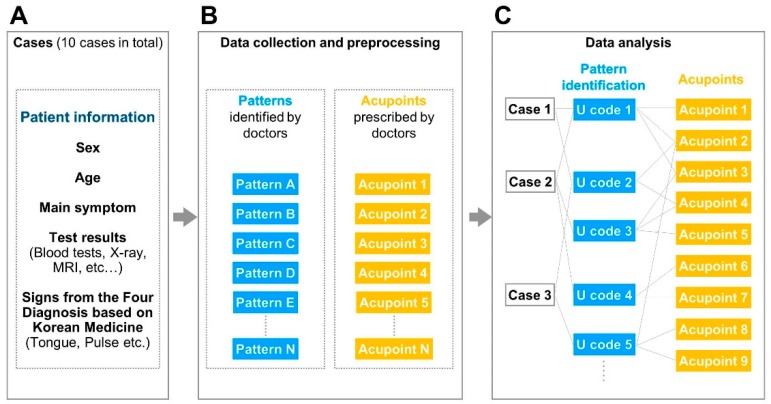
This study evaluated online virtual diagnoses made by currently practicing Korean medical doctors (N = 80). The doctors were presented with 10 case reports published in Korean medical journals and were asked to diagnose the patients and prescribe acupoints accordingly. A network analysis and the term frequency-inverse document frequency (tf-idf) method were used to analyse and quantify the relationship between diagnosis patterns and prescribed acupoints.
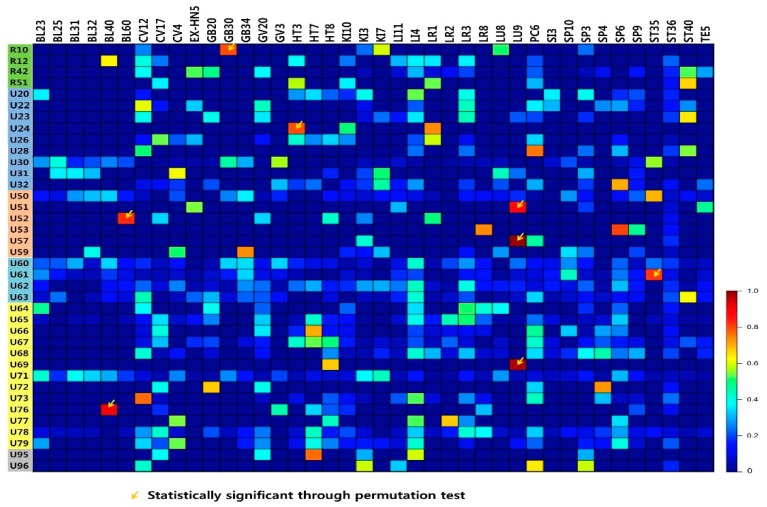
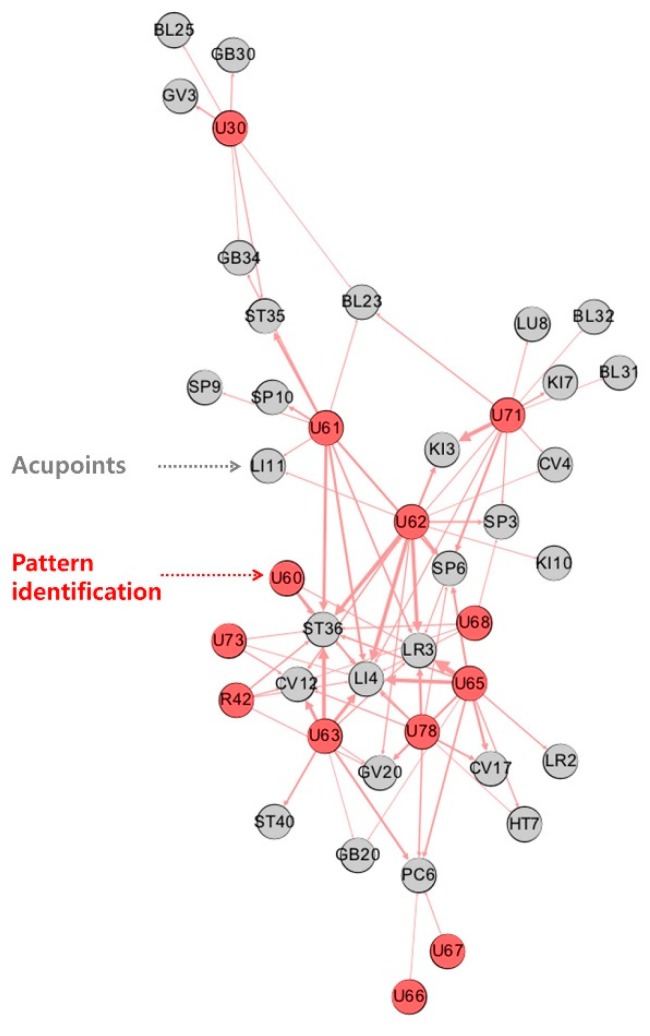
The network analysis showed that ST36, LI4, LR3, and SP6 were the most frequently used acupoints across all diagnoses. The tf-idf values showed the acupoints used for specific diseases, such as BL40 for bladder disease and LU9 for lung disease.
The associations between diagnosis patterns and prescribed acupoints were identified using an online virtual diagnosis modality. Network and text mining analyses revealed commonly applied and disease-specific acupoints in both qualitative and quantitative terms.
特定疾病的最佳穴位可通过对诊断模式的分析来确定。本研究的目的是利用从病例报告中提取的医学数据,揭示这些模式与临床实践中所开穴位之间的关联。
本研究评估了目前执业的韩医(N = 80)进行的在线虚拟诊断。向医生展示了发表在韩医期刊上的10例病例报告,并要求他们对患者进行诊断并相应地开出穴位。采用网络分析和词频-逆文档频率(tf-idf)方法来分析和量化诊断模式与所开穴位之间的关系。
网络分析表明,ST36、LI4、LR3和SP6是所有诊断中最常用的穴位。tf-idf值显示了用于特定疾病的穴位,如用于膀胱疾病的BL40和用于肺部疾病的LU9。
使用在线虚拟诊断方式确定了诊断模式与所开穴位之间的关联。网络和文本挖掘分析从定性和定量方面揭示了常用穴位和特定疾病的穴位。