Chen Jun, Xue Rui, Li Li, Xiao Li Li, Shangguan Jiahong, Zhang Wenjing, Bai Xueyang, Liu Gangqiong, Li Ling
Vasculocardiology Department, The First Affiliated Hospital of Zhengzhou University, Zhengzhou, China.
Medical Research Center, The First Affiliated Hospital of Zhengzhou University, Zhengzhou, China.
Front Pharmacol. 2019 Sep 20;10:1013. doi: 10.3389/fphar.2019.01013. eCollection 2019.
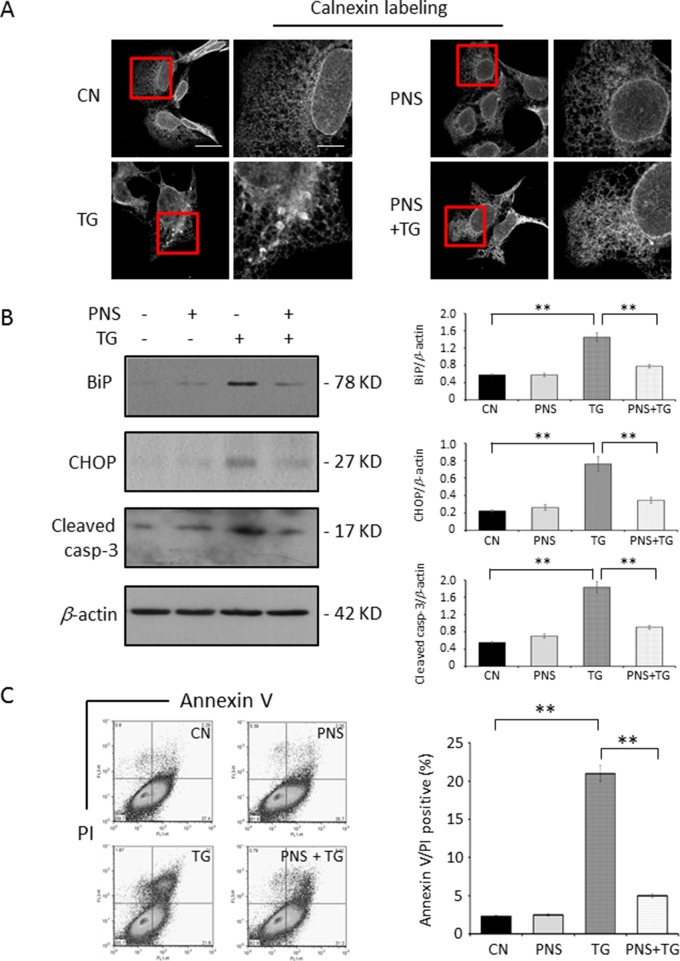
Endoplasmic reticulum (ER) stress has been demonstrated to play important roles in the pathogenesis of various cardiovascular diseases. The ER stress pathway is therefore a promising therapeutic target in cardiovascular disease. Although saponins (PNS) are one of the patent medicines that are traditionally used to treat cardiovascular disorders, their effects on ER stress in cardiac myocytes remain unexploited so far. This study investigates the effects of PNS on ER stress and its associated cell apoptosis along with the related mechanism in cardiac myocytes. PNS compounds were identified high-performance liquid chromatograph (HPLC) assay. PNS-pretreated H9c2 cells, HL-1 cells, and primary cultured neonatal rat cardiomyocytes were stimulated with thapsigargin (TG) to induce ER stress response and apoptosis. ER stress response was tested by immunofluorescence or immunoblot of the ER protein chaperones-calnexin, binding immunoglobulin protein (BiP) and the C/EBP homologous protein (CHOP). Cell viability was tested by methyl thiazolyl tetrazolium (MTT) assay. Cell apoptosis was detected by immunoblot of Cleaved caspase-3 and flow cytometry analysis of Annexin V/propidium iodide (PI) staining. Cytosolic, mitochondrial, and ER calcium dynamics were investigated by calcium imaging. Moreover, a ryanodine receptor type-2 (RyR) overexpression stable cell line was generated to verify the mechanism of RyR involved in PNS in the inhibition of ER stress and cell apoptosis. We demonstrate here that PNS protected cardiac myocytes from ER stress response and associated cell death in a concentration-dependent manner. Importantly, PNS reduced the elevation of cytosolic calcium, mitochondria calcium, as well as ER calcium in response to either TG or histamine treatment. PNS protection in ER stress was regulated by RyR expression. In summary, PNS protection against TG-induced ER stress response and its associated cell apoptosis in cardiac myocytes is calcium dependent. Through the regulation of ER calcium release mediated by RyR, a novel mechanism for PNS in the prevention of cardiovascular diseases is thereby identified.
内质网(ER)应激已被证明在多种心血管疾病的发病机制中起重要作用。因此,ER应激途径是心血管疾病中一个有前景的治疗靶点。虽然三七总皂苷(PNS)是传统上用于治疗心血管疾病的专利药物之一,但迄今为止,其对心肌细胞内质网应激的影响尚未得到充分研究。本研究探讨了PNS对心肌细胞内质网应激及其相关细胞凋亡的影响以及相关机制。通过高效液相色谱(HPLC)分析鉴定PNS化合物。用毒胡萝卜素(TG)刺激经PNS预处理的H9c2细胞、HL-1细胞和原代培养的新生大鼠心肌细胞,以诱导内质网应激反应和细胞凋亡。通过对内质网蛋白伴侣钙连接蛋白、结合免疫球蛋白蛋白(BiP)和C/EBP同源蛋白(CHOP)进行免疫荧光或免疫印迹检测内质网应激反应。通过甲基噻唑基四氮唑(MTT)法检测细胞活力。通过对裂解的半胱天冬酶-3进行免疫印迹和膜联蛋白V/碘化丙啶(PI)染色的流式细胞术分析检测细胞凋亡。通过钙成像研究细胞质、线粒体和内质网的钙动力学。此外,构建了2型兰尼碱受体(RyR)过表达稳定细胞系,以验证RyR参与PNS抑制内质网应激和细胞凋亡的机制。我们在此证明,PNS以浓度依赖的方式保护心肌细胞免受内质网应激反应和相关细胞死亡。重要的是,PNS降低了因TG或组胺处理而导致的细胞质钙、线粒体钙以及内质网钙的升高。PNS对内质网应激的保护作用受RyR表达的调节。总之,PNS对TG诱导的心肌细胞内质网应激反应及其相关细胞凋亡的保护作用是钙依赖性的。通过调节由RyR介导的内质网钙释放,从而确定了PNS预防心血管疾病的新机制。