Ito Satoshi, Jurado Cristina, Bosch Jaime, Ito Mitsugi, Sánchez-Vizcaíno José Manuel, Isoda Norikazu, Sakoda Yoshihiro
Research Center for Zoonosis Control, Hokkaido University, Kita 20, Nishi 10, Kita-ku, Sapporo, Hokkaido, 001-0020, Japan.
VISAVET Center and Animal Health Department, University Complutense of Madrid, 28040 Madrid, Spain.
Pathogens. 2019 Oct 24;8(4):206. doi: 10.3390/pathogens8040206.
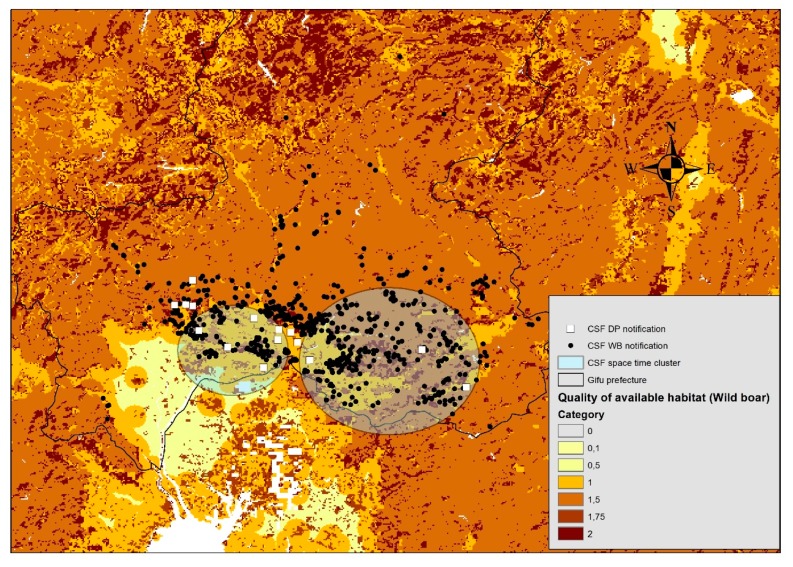
Since September 2018, nearly 900 notifications of classical swine fever (CSF) have been reported in Gifu Prefecture (Japan) affecting domestic pig and wild boar by the end of August 2019. To determine the epidemiological characteristics of its spread, a spatio-temporal analysis was performed using actual field data on the current epidemic. The spatial study, based on standard deviational ellipses of official CSF notifications, showed that the disease likely spread to the northeast part of the prefecture. A maximum significant spatial association estimated between CSF notifications was 23 km by the multi-distance spatial cluster analysis. A space-time permutation analysis identified two significant clusters with an approximate radius of 12 and 20 km and 124 and 98 days of duration, respectively. When the area of the identified clusters was overlaid on a map of habitat quality, approximately 82% and 75% of CSF notifications, respectively, were found in areas with potential contact between pigs and wild boar. The obtained results provide information on the current CSF epidemic, which is mainly driven by wild boar cases with sporadic outbreaks on domestic pig farms. These findings will help implement control measures in Gifu Prefecture.
自2018年9月以来,截至2019年8月底,日本岐阜县已报告近900起经典猪瘟(CSF)疫情通报,涉及家猪和野猪。为确定其传播的流行病学特征,利用当前疫情的实际现场数据进行了时空分析。基于官方CSF通报的标准差椭圆进行的空间研究表明,该病可能已传播至该县东北部。通过多距离空间聚类分析,估计CSF通报之间的最大显著空间关联为23公里。时空置换分析确定了两个显著聚类,半径分别约为12公里和20公里,持续时间分别为124天和98天。当将识别出的聚类区域叠加在栖息地质量地图上时,分别约82%和75%的CSF通报出现在猪与野猪可能接触的区域。所获结果提供了有关当前CSF疫情的信息,该疫情主要由野猪病例引发,家养猪场有零星疫情爆发。这些发现将有助于岐阜县实施防控措施。