Clemente Filipe Manuel, Sarmento Hugo, Costa Israel Teoldo, Enes Ana Rita, Lima Ricardo
Polytechnic Institute of Viana do Castelo, School of Sport and Leisure, Melgaço, Portugal.
Instituto de Telecomunicações, Delegação da Covilhã, Portugal.
J Hum Kinet. 2019 Oct 18;69:201-212. doi: 10.2478/hukin-2019-0013. eCollection 2019 Oct.
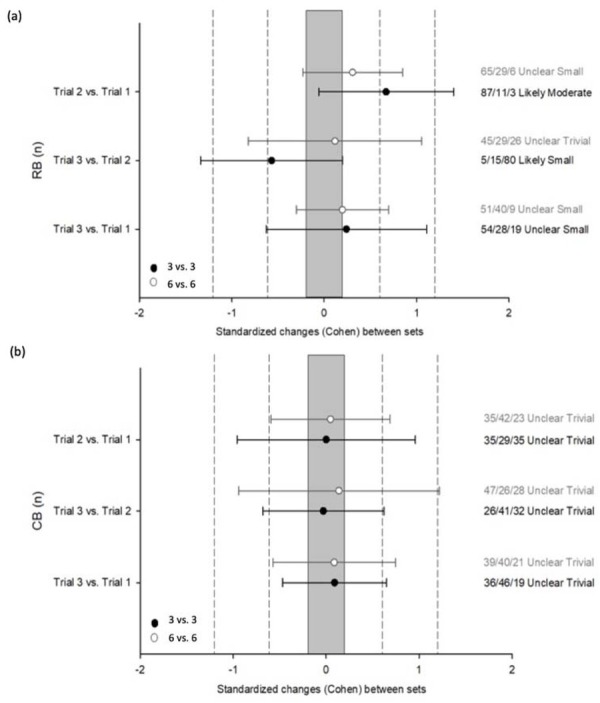
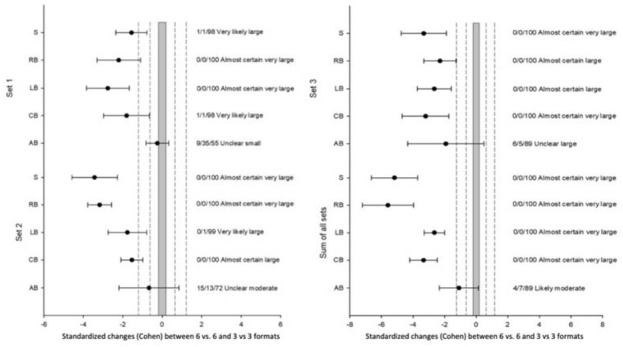
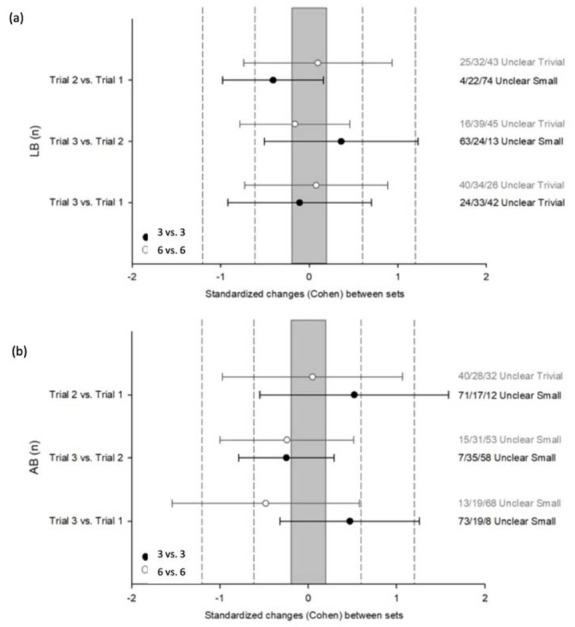
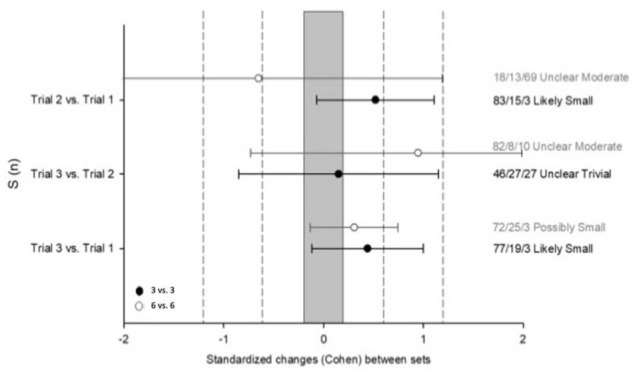
The purpose of this study was three-fold: (i) to test the between-sessions variability of 3 vs. 3 and 6 vs. 6 formats in under-11 players, (ii) to assess the within-session variability of 3 vs. 3 and 6 vs. 6 formats, and (iii) to investigate the variations of technical actions between formats. Sixteen soccer players (10.1 ± 0.3 years old) participated in this study. Both formats of play were played twice within an interval of one week to test the between-session variability and the variables of conquered balls (CBs), received balls (RBs), lost balls (LBs), attacking balls/passes (ABs) and shots (Ss) were analyzed using the Performance Assessment in Team Sports instrument in all matches. Moderate variations on the sum of sets during the 3 vs. 3 and 6 vs. 6 formats were observed in all variables. Considering the variations of technical actions made between sets in the 3 vs. 3 format, likely moderate increases were found in set 2 vs. 1 in terms of RB (37.5%, [-2.7;94.2]), and likely small decreases were found in set 3 vs. 2 for the same variable (-18.3%, [-37.8;7.3]). In the 6 vs. 6 format, only possibly small increases were found for set 3 vs. 1 in S (22.5%, [-7.0;61.3]). Generally (sum of sets), the variables standardized per minute revealed almost certain very large decreases in the 6 vs. 6 vs. the 3 vs. 3 format in the variables of CB (-67.9%, [-75.3;-55.9]), LB (-66.0%, [-73.9;-55.7]), RB (-65.6%, [-74.8;- 53.1]) and S (-87.6%, [-93.1;-77.7]). The results of this study suggest that both formats of play are too noisy to be reproducible. The 3 vs. 3 format largely increased the number of individual technical actions.
(i)测试11岁以下球员3对3和6对6比赛形式的场次间变异性;(ii)评估3对3和6对6比赛形式的场次内变异性;(iii)研究不同比赛形式间技术动作的变化。16名足球运动员(10.1±0.3岁)参与了本研究。两种比赛形式均在一周的间隔内进行了两次,以测试场次间变异性,并在所有比赛中使用团队运动表现评估工具分析了争球(CBs)、接球(RBs)、失球(LBs)、进攻球/传球(ABs)和射门(Ss)等变量。在所有变量中,均观察到3对3和6对6比赛形式中各局总和的适度变化。考虑到3对3比赛形式中各局间技术动作的变化,在第2局与第1局相比,接球(RB)方面可能有适度增加(37.5%,[-2.7;94.2]),而在同一变量的第3局与第2局相比可能有小幅下降(-18.3%,[-37.8;7.3])。在6对6比赛形式中,仅在第3局与第1局相比时,射门(S)可能有小幅增加(22.5%,[-7.0;61.3])。总体而言(各局总和),每分钟标准化的变量显示,在6对6比赛形式与3对3比赛形式相比时,争球(CB)、失球(LB)、接球(RB)和射门(S)变量几乎肯定有非常大的下降,分别为-67.9%,[-75.3;-55.9]、-66.0%,[-73.9;-55.7]、-65.6%,[-74.8;-53.1]和-87.6%,[-93.1;-77.7]。本研究结果表明,两种比赛形式的噪声都太大,难以重复。3对3比赛形式大大增加了个人技术动作的数量。