Teikyo University of Science, 2-2-1 Senju, Sakuragi, Adachi- ku, 120-0045 Tokyo,, Japan.
International Christian University.
Cardiol J. 2021;28(3):446-452. doi: 10.5603/CJ.a2019.0108. Epub 2019 Nov 8.
Post-prandial hyperglycemia is associated with higher cardiovascular risk, which causes arterial stiffening and impaired function. Although post-prandial increases in blood glucose are proportional to the level of intake, the acute effects of different glucose intakes on arterial stiffness have not been fully characterized. The present study aimed to determine the acute effects of differences in glucose intake on arterial stiffness.
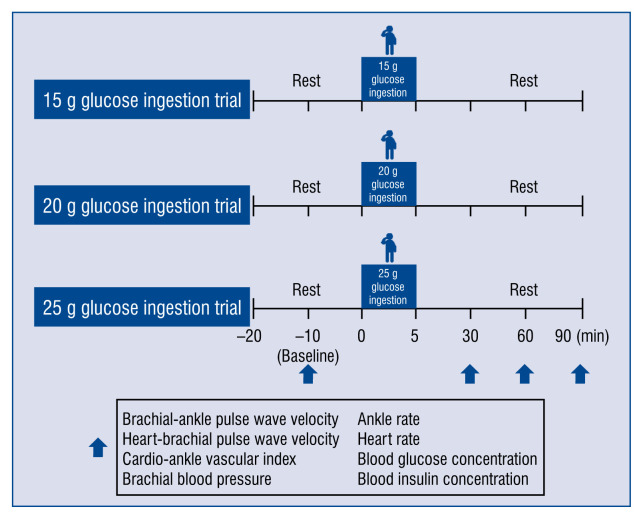
Six healthy middle-aged and elderly individuals (mean age, 60.0 ± 12.1 years) were orally administered 15, 20, and 25 g of glucose on separate days in a randomized, controlled, cross-over fashion. Brachial-ankle pulse wave velocity, heart-brachial pulse wave velocity, cardio-ankle vascular index, brachial and ankle blood pressure, heart rate, and blood glucose and serum insulin concentrations before and 30, 60, and 90 min after glucose ingestion were measured.
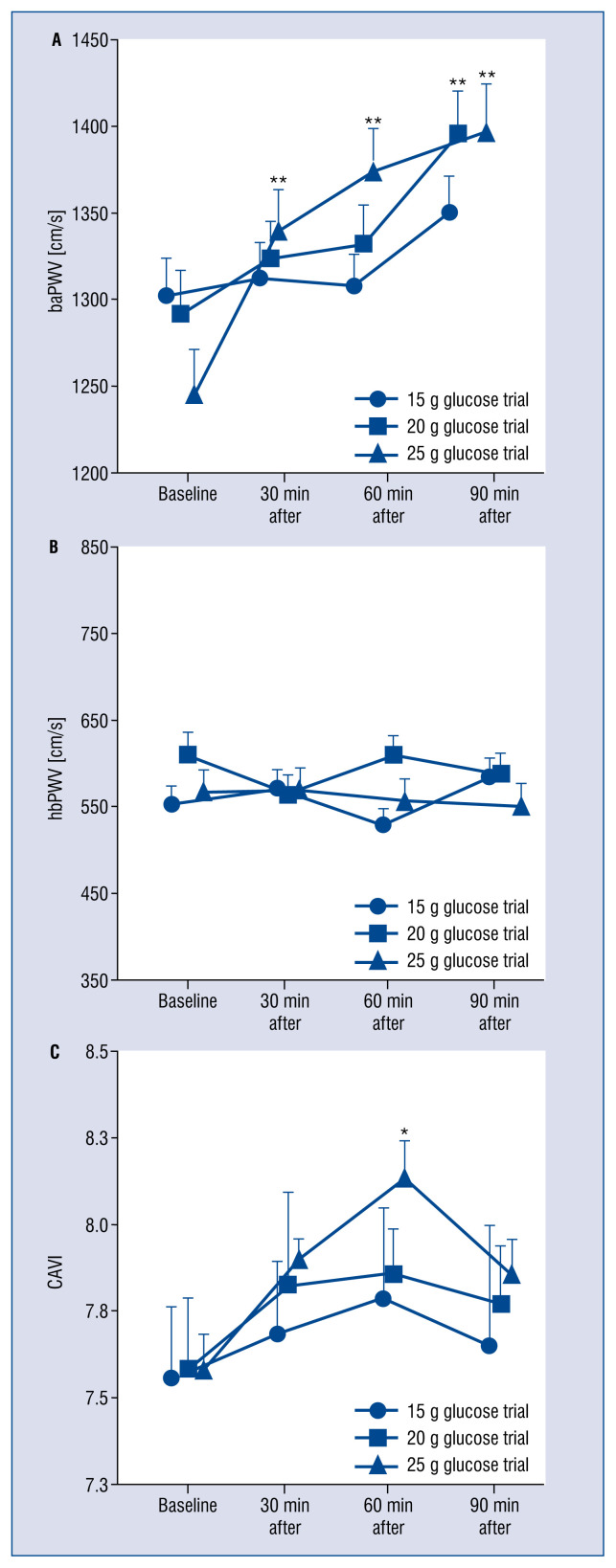
Compared to baseline, brachial-ankle pulse wave velocity was higher at 30, 60 and 90 min after ingestion of 25 g glucose, and higher at 90 min after ingestion of 20 g glucose, but at no time points after ingestion of 15 g. Cardio-ankle vascular index was higher at 60 min than at baseline after ingestion of 25 g glucose, but not after ingestion of 15 or 20 g.
These results suggest that brachial-ankle pulse wave velocity and cardio-ankle vascular index is affected by the quantity of glucose ingested. Proposed presently is that glucose intake should be reduced at each meal to avoid increases in brachial-ankle pulse wave velocity and cardio-ankle vascular index during acute hyperglycemia.
餐后高血糖与更高的心血管风险相关,这会导致动脉僵硬和功能受损。尽管餐后血糖升高与摄入水平成正比,但不同葡萄糖摄入量对动脉僵硬的急性影响尚未得到充分描述。本研究旨在确定不同葡萄糖摄入量对动脉僵硬的急性影响。
6 名健康的中老年个体(平均年龄,60.0±12.1 岁)以随机、对照、交叉的方式分别在 3 天内口服 15、20 和 25 g 的葡萄糖。在口服葡萄糖之前和之后的 30、60 和 90 分钟测量肱踝脉搏波速度、心-肱脉搏波速度、心踝血管指数、肱动脉和踝动脉血压、心率以及血糖和血清胰岛素浓度。
与基线相比,25 g 葡萄糖摄入后 30、60 和 90 分钟时肱踝脉搏波速度更高,20 g 葡萄糖摄入后 90 分钟时更高,但 15 g 葡萄糖摄入后没有任何时间点更高。心踝血管指数在 25 g 葡萄糖摄入后 60 分钟时高于基线,但在 15 或 20 g 葡萄糖摄入后没有高于基线。
这些结果表明,肱踝脉搏波速度和心踝血管指数受摄入葡萄糖量的影响。本研究提出,每餐应减少葡萄糖的摄入,以避免在急性高血糖期间肱踝脉搏波速度和心踝血管指数升高。