Department of Microbiology, University of Granada, Campus Fuentenueva, 18071 Granada, Spain.
Institute of Resource Ecology, Helmholtz-Zentrum Dresden-Rossendorf, Bautzner Landstraße 400, 01328 Dresden, Germany.
ACS Appl Mater Interfaces. 2023 Jun 28;15(25):29958-29970. doi: 10.1021/acsami.3c05100. Epub 2023 Jun 9.
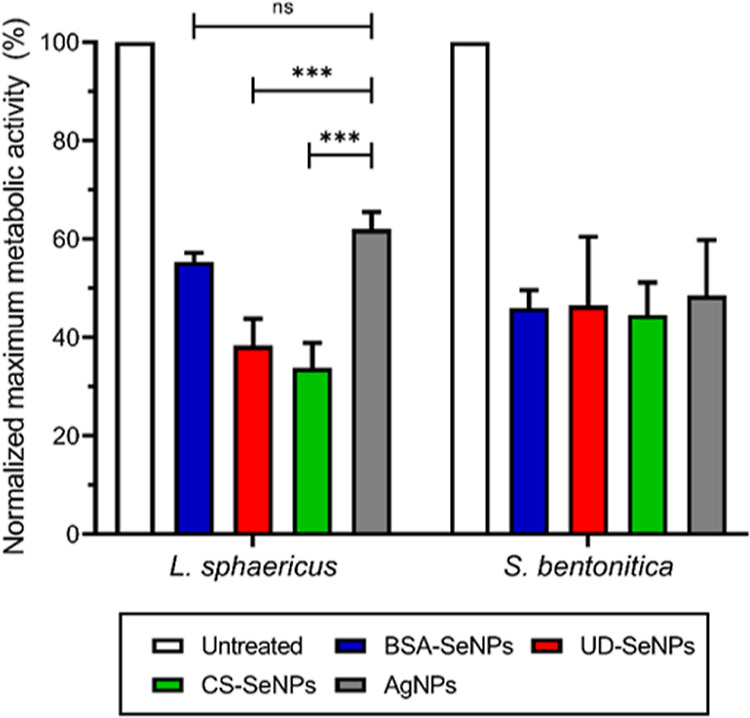
The use of metal nanoparticles (NPs) as antimicrobial agents has become a promising alternative to the problem of antibiotic-resistant bacteria and other applications. Silver nanoparticles (AgNPs) are well-known as one of the most universal biocide compounds. However, selenium nanoparticles (SeNPs) recently gained more attention as effective antimicrobial agents. This study aims to investigate the antibacterial activity of SeNPs with different surface coatings (BSA-coated, chitosan-coated, and undefined coating) on the Gram-negative and the Gram-positive in comparison to AgNPs. The tested NPs had similar properties, including shape (spheres), structure (amorphous), and size (50-90 nm), but differed in their surface charge. Chitosan SeNPs exhibited a positive surface charge, while the remaining NPs assayed had a negative surface charge. We have found that cell growth and viability of both bacteria were negatively affected in the presence of the NPs, as indicated by microcalorimetry and flow cytometry. Specifically, undefined coating SeNPs displayed the highest percentage values of dead cells for both bacteria (85-91%). An increase in reactive oxygen species (ROS) production was also detected. Chitosan-coated and undefined SeNPs caused the highest amount of ROS (299.7 and 289% over untreated controls) for and , respectively. Based on DNA degradation levels, undefined-SeNPs were found to be the most hazardous, causing nearly 80% DNA degradation. Finally, electron microscopy revealed the ability of the cells to transform the different SeNP types (amorphous) to crystalline SeNPs (trigonal/monoclinical Se), which could have environmentally positive implications for bioremediation purposes and provide a novel green method for the formation of crystalline SeNPs. The results obtained herein demonstrate the promising potential of SeNPs for their use in medicine as antimicrobial agents, and we propose and as candidates for new bioremediation strategies and NP synthesis with potential applications in many fields.
金属纳米粒子(NPs)作为抗菌剂的应用已经成为解决抗生素耐药菌等问题的一种有前途的替代方法。银纳米粒子(AgNPs)作为最通用的杀菌化合物之一而广为人知。然而,硒纳米粒子(SeNPs)最近作为有效的抗菌剂引起了更多的关注。本研究旨在研究具有不同表面涂层(BSA 涂层、壳聚糖涂层和无定形涂层)的 SeNPs 对革兰氏阴性菌和革兰氏阳性菌的抗菌活性,并与 AgNPs 进行比较。测试的 NPs 具有相似的特性,包括形状(球体)、结构(无定形)和尺寸(50-90nm),但表面电荷不同。壳聚糖 SeNPs 呈现正表面电荷,而其余的 NPs 则带有负表面电荷。我们发现,微热量法和流式细胞术表明,在 NPs 的存在下,两种细菌的细胞生长和活力都受到了负面影响。具体来说,无定形涂层 SeNPs 对两种细菌的死亡细胞百分比值最高(85-91%)。还检测到活性氧物质(ROS)的产生增加。壳聚糖涂层和无定形 SeNPs 分别导致 和 的 ROS 产生量最高(分别为未处理对照的 299.7%和 289%)。根据 DNA 降解水平,无定形-SeNPs 被发现是最危险的,导致近 80%的 DNA 降解。最后,电子显微镜显示细胞有能力将不同类型的 SeNP(无定形)转化为结晶 SeNPs(三角/单斜 Se),这对生物修复目的具有环境积极意义,并为结晶 SeNPs 的形成提供了一种新颖的绿色方法。本研究结果表明,SeNPs 作为抗菌剂在医学上具有很大的应用潜力,我们建议 和 作为新的生物修复策略的候选物,并具有在许多领域应用的潜力。