Faculty of BioMedicine, Università della Svizzera italiana, Lugano, Switzerland.
Faculty of Medicine, University of Geneva, Geneva, Switzerland.
Res Synth Methods. 2020 Mar;11(2):227-236. doi: 10.1002/jrsm.1385. Epub 2020 Jan 5.
There is an agreement that the methodological quality of randomized trials should be assessed in systematic reviews, but there is a debate on how this should be done. We conducted a construct validation study of the Physiotherapy Evidence Database (PEDro) scale, which is widely used to assess the quality of trials in physical therapy and rehabilitation.
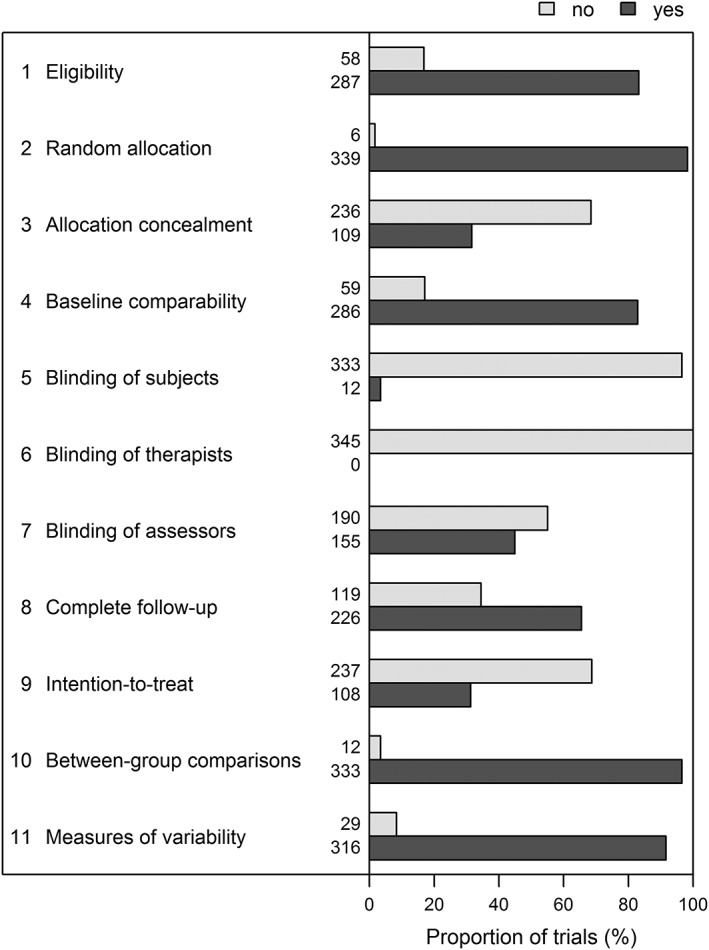
We analyzed 345 trials that were included in Cochrane reviews and for which a PEDro summary score was available. We used one- and two-parameter logistic item response theory (IRT) models to study the psychometric properties of the PEDro scale and assessed the items' difficulty and discrimination parameters. We ran goodness of fit post estimations and examined the IRT unidimensionality assumption with a multidimensional IRT (MIRT) model.
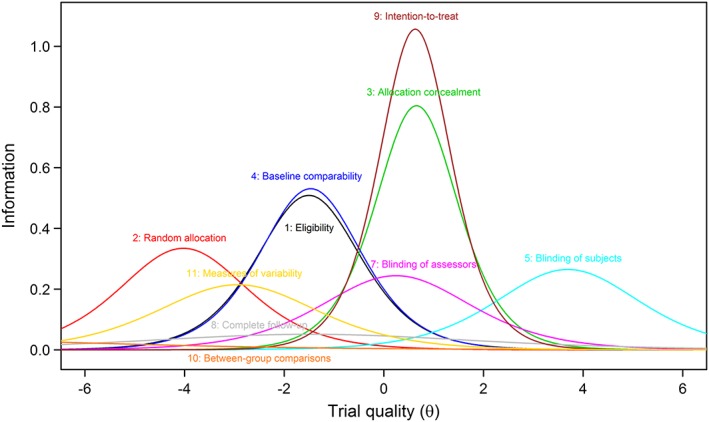
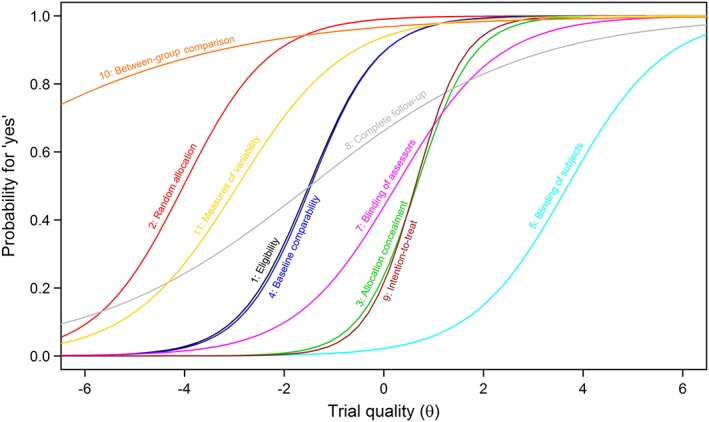
Out of a maximum of 10, the mean PEDro summary score was 5.46 (SD = 1.51). The allocation concealment and intention-to-treat scale items contributed most of the information on the underlying construct (with discriminations of 1.79 and 2.05, respectively) at similar difficulties (0.63 and 0.65, respectively). The other items provided little additional information and did not distinguish trials of different quality. There was substantial evidence of departure from the unidimensionality assumption, suggesting that the PEDro items relate to more than one latent trait.
Our findings question the construct validity of the PEDro scale to assess the methodological quality of clinical trials. PEDro summary scores should not be used; rather, the physiotherapy community should consider working with the individual items of the scale.
人们普遍认为,系统评价应评估随机试验的方法学质量,但对于应如何进行评估存在争议。我们对广泛用于评估物理治疗和康复试验质量的 Physiotherapy Evidence Database(PEDro)量表进行了结构验证研究。
我们分析了纳入 Cochrane 综述且可获得 PEDro 总结评分的 345 项试验。我们使用单参数和双参数逻辑项目反应理论(IRT)模型来研究 PEDro 量表的心理测量特性,并评估项目的难度和区分参数。我们进行了拟合优度后估计,并使用多维IRT(MIRT)模型检验了 IRT 单维性假设。
PEDro 总结评分的平均得分为 5.46(SD = 1.51),满分 10 分。分配隐藏和意向治疗量表项目对潜在结构的信息贡献最大(区分度分别为 1.79 和 2.05),难度相似(分别为 0.63 和 0.65)。其他项目提供的信息较少,无法区分不同质量的试验。有大量证据表明偏离了单维性假设,表明 PEDro 项目与一个以上的潜在特征有关。
我们的研究结果对 PEDro 量表评估临床试验方法学质量的结构有效性提出了质疑。不应使用 PEDro 总结评分,而是应考虑让物理治疗社区使用该量表的个别项目。