Department of Orthopaedics and traumatology, Central Finland Hospital, Keskussairaalantie 19, 40620, Jyväskylä, Finland.
School of Medicine, University of Oulu, Oulu, Finland.
BMC Geriatr. 2019 Nov 19;19(1):315. doi: 10.1186/s12877-019-1320-y.
Research on mortality and comorbidity associated with pelvic fractures in older patients is scarce. We aimed to determine the short- and long-term mortality rates of older patients with a pelvic ring fracture compared with both an age-matched cohort of patients with a femoral neck fracture and a general population, and to investigate 30- and 60-day readmission rates after pelvic fracture.
This was a retrospective cohort study done in an emergency department of a level II/III trauma center. All patients aged over 70 years diagnosed with a pelvic or acetabular fracture between January 2010 and December 2016 in our ED were identified. Two reference populations were used: patients operated due to femoral neck fracture in our institution between 2007 and 2008 and a general population aged 70 years or more.
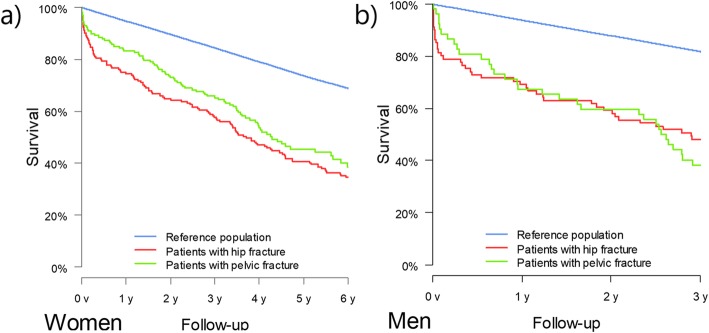
Two hundred nineteen patients were identified. 30- and 90-day mortality was 7.3 and 11.4%, respectively. Compared to the general population, a pelvic fracture was associated with an 8.5-fold (95% CI: 5.2-13.9) and 11.0-fold (95% CI: 5.4-22.3) 90-day mortality risk in females and males, respectively. We could not observe a difference in the risk of 90-day mortality between femoral neck fracture patients and patients with a pelvic fracture. Within 30 days, 28 (12.8%) pelvic fracture patients were readmitted for in-patient care in our hospital.
The mortality of older patients with pelvic ring fractures resembles that after hip fracture. Although older patients with a pelvic ring fracture rarely require operative treatment, the severity of the injury should not be considered as a class apart from hip fracture.
关于老年骨盆骨折患者的死亡率和合并症的研究很少。我们旨在确定与年龄匹配的股骨颈骨折患者队列和一般人群相比,老年骨盆环骨折患者的短期和长期死亡率,并调查骨盆骨折后 30 天和 60 天的再入院率。
这是一项在二级/三级创伤中心急诊科进行的回顾性队列研究。我们确定了 2010 年 1 月至 2016 年 12 月期间在我们急诊科诊断为骨盆或髋臼骨折且年龄超过 70 岁的所有患者。使用了两个参考人群:2007 年至 2008 年在我院因股骨颈骨折而接受手术的患者和年龄在 70 岁或以上的一般人群。
共确定了 219 名患者。30 天和 90 天的死亡率分别为 7.3%和 11.4%。与一般人群相比,女性和男性骨盆骨折的 90 天死亡率风险分别为 8.5 倍(95%CI:5.2-13.9)和 11.0 倍(95%CI:5.4-22.3)。我们未观察到股骨颈骨折患者和骨盆骨折患者 90 天死亡率风险的差异。在 30 天内,28 名(12.8%)骨盆骨折患者因住院治疗而再次入院。
老年骨盆骨折患者的死亡率与髋部骨折相似。尽管老年骨盆环骨折患者很少需要手术治疗,但不应将损伤的严重程度视为与髋部骨折不同的类别。