Faict Sylvia, Oudaert Inge, D'Auria Ludovic, Dehairs Jonas, Maes Ken, Vlummens Philip, De Veirman Kim, De Bruyne Elke, Fostier Karel, Vande Broek Isabelle, Schots Rik, Vanderkerken Karin, Swinnen Johannes V, Menu Eline
Department of Hematology and Immunology, Myeloma Center Brussels, Vrije Universiteit Brussel, UZ Brussel, B-1090 Brussels, Belgium.
Neurochemistry Unit, Institute of Neuroscience, Université Catholique de Louvain, B-1200 Brussels, Belgium.
Cancers (Basel). 2019 Nov 20;11(12):1823. doi: 10.3390/cancers11121823.
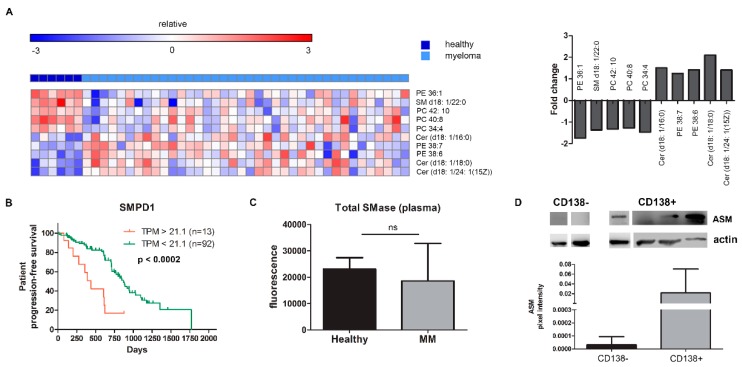
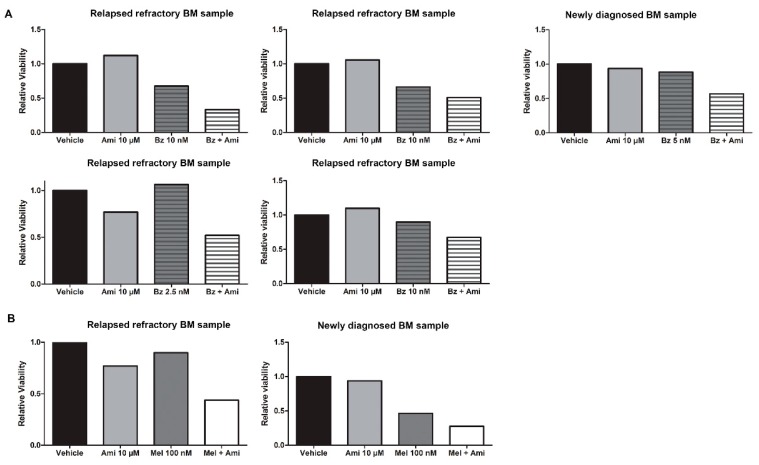
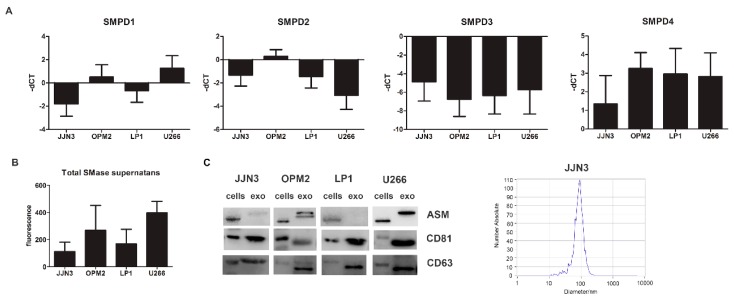
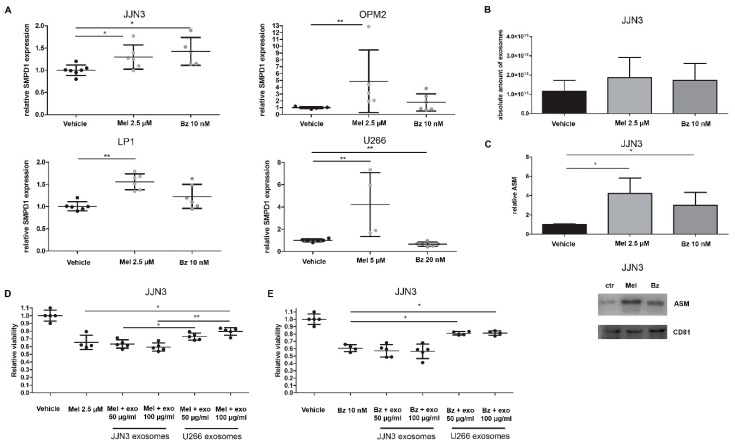
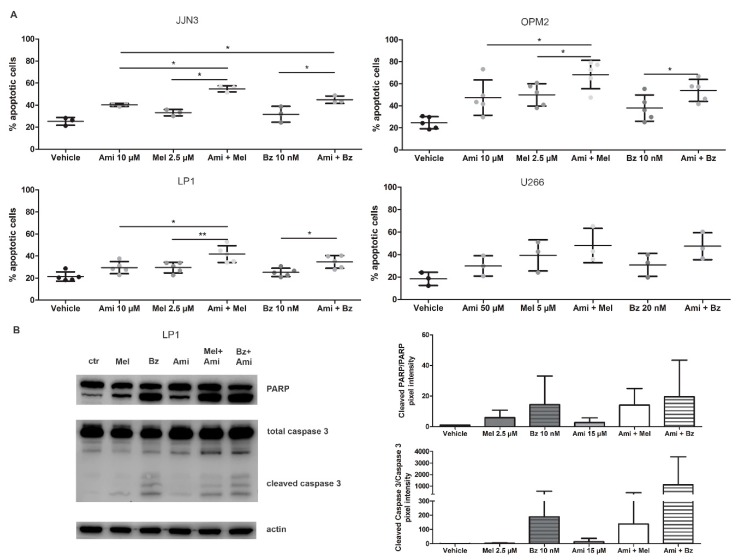
Multiple myeloma (MM) is well-known for the development of drug resistance, leading to relapse. Therefore, finding novel treatment strategies remains necessary. By performing a lipidomics assay on MM patient plasma, we aimed to identify new targets. We observed a dysregulation in the sphingolipid metabolism, with the upregulation of several ceramides and downregulation of sphingomyelin. This imbalance suggests an increase in sphingomyelinase, the enzyme responsible for hydrolyzing sphingomyelin into ceramide. We confirmed the upregulation of acid sphingomyelinase (ASM) in primary MM cells. Furthermore, we observed an increase in ASM expression in MM cell lines treated with melphalan or bortezomib, as well as in their exosomes. Exosomes high in ASM content were able to transfer the drug-resistant phenotype to chemosensitive cells, hereby suggesting a tumor-protective role for ASM. Finally, inhibition of ASM by amitriptyline improved drug sensitivity in MM cell lines and primary MM cells. In summary, this study is the first to analyze differences in plasma lipid composition of MM patients and match the observed differences to an upregulation of ASM. Moreover, we demonstrate that amitriptyline is able to inhibit ASM and increase sensitivity to anti-myeloma drugs. This study, therefore, provides a rational to include ASM-targeting-drugs in combination strategies in myeloma patients.
多发性骨髓瘤(MM)因产生耐药性导致复发而广为人知。因此,寻找新的治疗策略仍然很有必要。通过对MM患者血浆进行脂质组学分析,我们旨在确定新的靶点。我们观察到鞘脂代谢失调,几种神经酰胺上调,鞘磷脂下调。这种失衡表明鞘磷脂酶增加,该酶负责将鞘磷脂水解为神经酰胺。我们证实了原代MM细胞中酸性鞘磷脂酶(ASM)上调。此外,我们观察到用美法仑或硼替佐米治疗的MM细胞系及其外泌体中ASM表达增加。ASM含量高的外泌体能够将耐药表型转移至化疗敏感细胞,由此表明ASM具有肿瘤保护作用。最后,阿米替林抑制ASM可提高MM细胞系和原代MM细胞的药物敏感性。总之,本研究首次分析了MM患者血浆脂质组成的差异,并将观察到的差异与ASM上调相匹配。此外,我们证明阿米替林能够抑制ASM并增加对抗骨髓瘤药物的敏感性。因此,本研究为在骨髓瘤患者的联合治疗策略中纳入靶向ASM的药物提供了理论依据。