Glass Daniel, Cortés Emiliano, Ben-Jaber Sultan, Brick Thomas, Peveler William J, Blackman Christopher S, Howle Christopher R, Quesada-Cabrera Raul, Parkin Ivan P, Maier Stefan A
The Blackett Laboratory Department of Physics Imperial College London London SW7 2AZ UK.
Department of Chemistry University College London 20 Gordon St London WC1H 0AJ UK.
Adv Sci (Weinh). 2019 Sep 30;6(22):1901841. doi: 10.1002/advs.201901841. eCollection 2019 Nov.
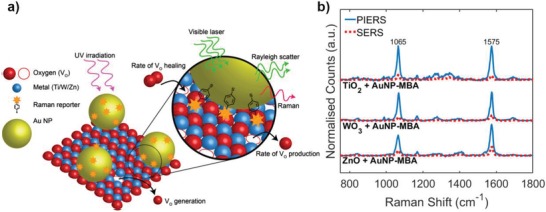
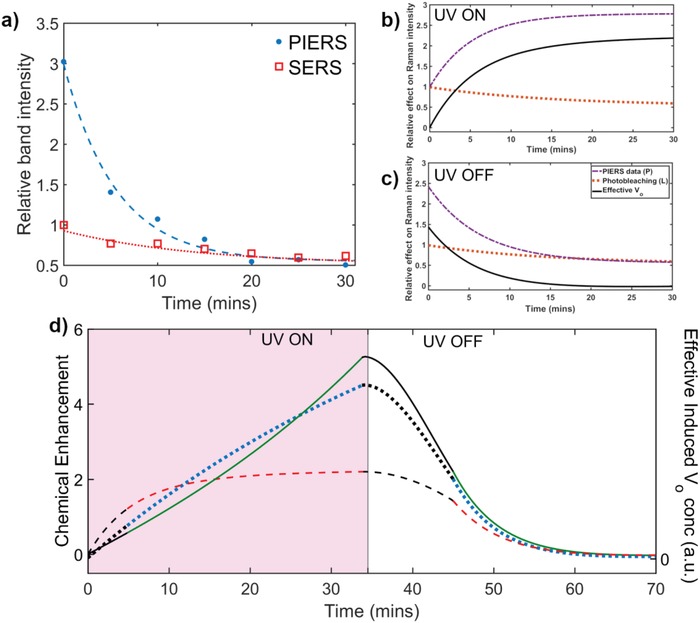
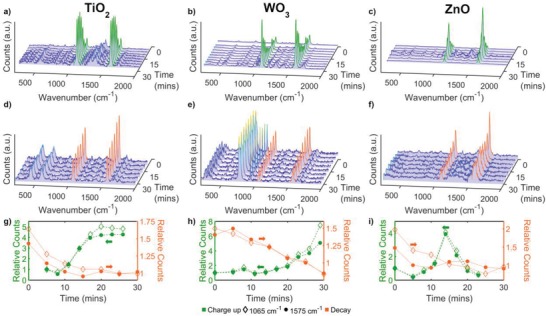
Surface-enhanced Raman spectroscopy (SERS) is a powerful analytical technique commonly used in the detection of traces of organic molecules. The mechanism of SERS is of a dual nature, with Raman scattering enhancements due to a combination of electromagnetic (EM) and chemical contributions. In conventional SERS, the EM component is largely responsible for the enhancement, with the chemical contribution playing a less significant role. An alternative technique, called photo-induced enhanced Raman spectroscopy (PIERS) has been recently developed, using a photo-activated semiconductor substrate to give additional chemical enhancement of Raman bands over traditional SERS. This enhancement is assigned to surface oxygen vacancies ( ) formed upon pre-irradiation of the substrate. In this work, the exceptional chemical contribution in PIERS allows for the evaluation of atomic dynamics in metal oxide surfaces. This technique is applied to study the formation and healing rates of surface-active in archetypical metal-oxide semiconductors, namely, TiO, WO, and ZnO. Contrary to conventional analytical tools, PIERS provides intuitive and valuable information about surface stability of atomic defects at ambient pressure and under operando conditions, which has important implications in a wide range of applications including catalysis and energy storage materials.
表面增强拉曼光谱(SERS)是一种强大的分析技术,常用于痕量有机分子的检测。SERS的机制具有双重性质,由于电磁(EM)和化学作用的结合导致拉曼散射增强。在传统的SERS中,EM成分在很大程度上负责增强作用,而化学作用的贡献较小。最近开发了一种称为光诱导增强拉曼光谱(PIERS)的替代技术,它使用光激活半导体衬底,相对于传统SERS,能对拉曼谱带进行额外的化学增强。这种增强归因于衬底预辐照时形成的表面氧空位( )。在这项工作中,PIERS中特殊的化学作用使得评估金属氧化物表面的原子 动力学成为可能。该技术被应用于研究典型金属氧化物半导体(即TiO、WO和ZnO)中表面活性 的形成和修复速率。与传统分析工具不同,PIERS能在环境压力和操作条件下提供关于原子缺陷表面稳定性的直观且有价值的信息,这在包括催化和储能材料在内的广泛应用中具有重要意义。