Departamento de Genética, Faculdade de Medicina de Ribeirão Preto, Universidade de São Paulo, Ribeirão Preto, SP, Brazil.
Instituto de Ciências Biomédicas, Universidade Federal de Alfenas, Alfenas, MG, Brazil.
Sci Rep. 2019 Nov 27;9(1):17692. doi: 10.1038/s41598-019-53544-0.
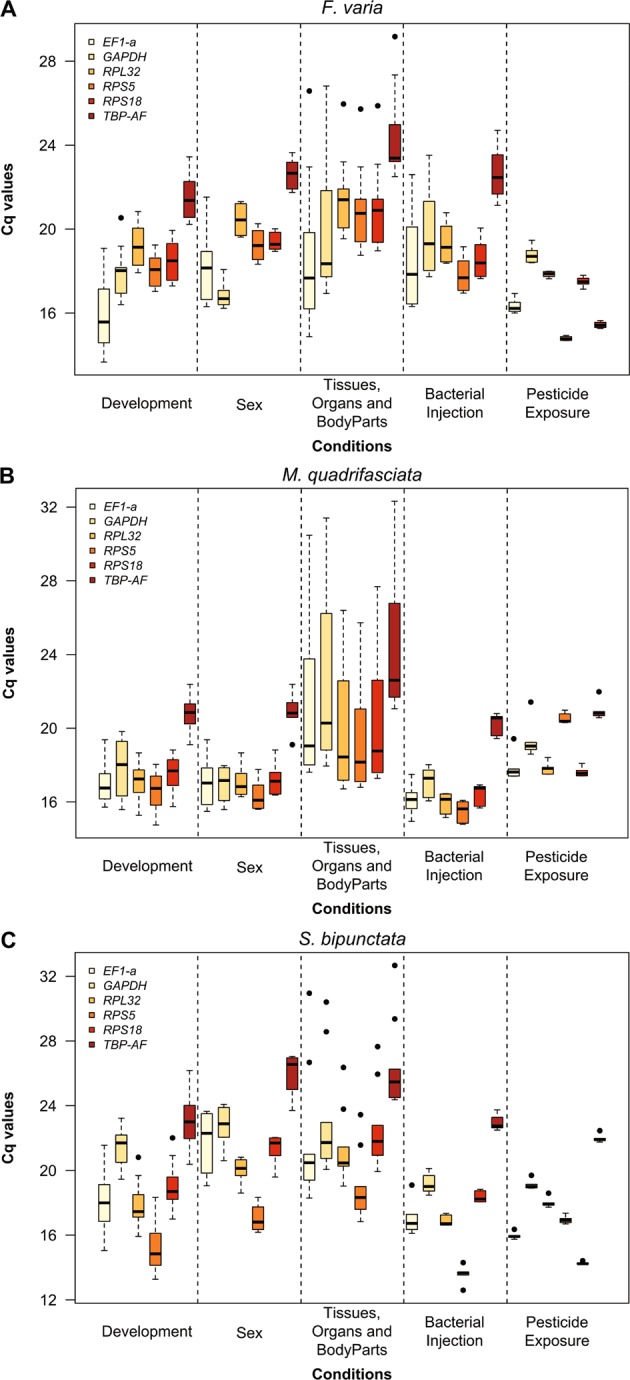
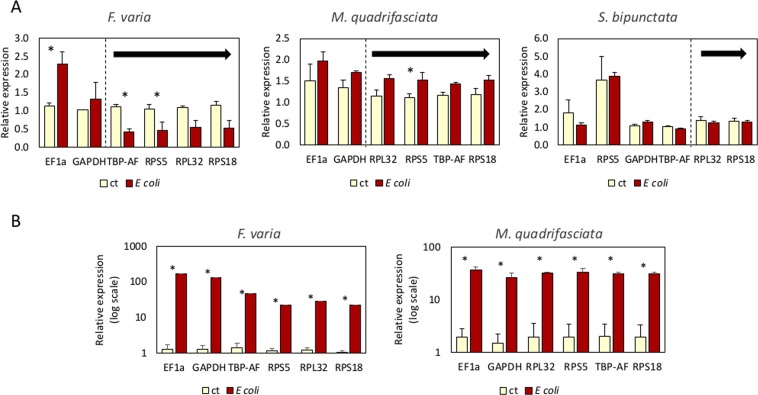
Stingless bees are generalist pollinators distributed through the pantropical region. There is growing evidence that their wild populations are experiencing substantial decline in response to habitat degradation and pesticides. Policies for conservation of endangered species will benefit from studies focusing on genetic and molecular aspects of their development and behavior. The most common method for looking at gene expression is real-time quantitative polymerase chain reaction preceded by reverse transcription (RT-qPCR) of the mRNA of interest. This method requires the identification of reliable reference genes to correctly estimate fluctuations in transcript levels. To contribute to molecular studies on stingless bees, we used Frieseomelitta varia, Melipona quadrifasciata, and Scaptotrigona bipunctata species to test the expression stability of eight reference genes (act, ef1-α, gapdh, rpl32, rps5, rps18, tbp, and tbp-af) in RT-qPCR procedures in five physiological and experimental conditions (development, sex, tissues, bacteria injection, and pesticide exposure). In general, the rpl32, rps5 and rps18 ribosomal protein genes and tpb-af gene showed the highest stability, thus being identified as suitable reference genes for the three stingless bee species and defined conditions. Our results also emphasized the need to evaluate the stability of candidate genes for any designed experimental condition and stingless bee species.
无刺蜜蜂是分布在泛热带地区的多面手传粉者。越来越多的证据表明,由于栖息地退化和杀虫剂的使用,它们的野生种群数量正在大幅减少。保护濒危物种的政策将受益于专注于其发育和行为的遗传和分子方面的研究。研究基因表达最常见的方法是在反转录(RT-qPCR)之前对感兴趣的 mRNA 进行实时定量聚合酶链反应(RT-qPCR)。该方法需要鉴定可靠的参考基因,以正确估计转录本水平的波动。为了促进对无刺蜜蜂的分子研究,我们使用 Frieseomelitta varia、Melipona quadrifasciata 和 Scaptotrigona bipunctata 物种来测试 8 个参考基因(act、ef1-α、gapdh、rpl32、rps5、rps18、tbp 和 tbp-af)在五个生理和实验条件(发育、性别、组织、细菌注射和农药暴露)下的 RT-qPCR 程序中的表达稳定性。总体而言,核糖体蛋白基因 rpl32、rps5 和 rps18 以及 tbp-af 基因表现出最高的稳定性,因此被确定为三种无刺蜜蜂物种和定义条件下的合适参考基因。我们的结果还强调了需要针对任何设计的实验条件和无刺蜜蜂物种评估候选基因的稳定性。