Cardiovascular Division, Department of Medicine, University of Minnesota Medical School, Minneapolis, Minnesota, USA.
Biostatistics, Epidemiology and Research Design (BERD), University of Minnesota, Minneapolis, Minnesota, USA.
Sci Rep. 2019 Dec 5;9(1):18415. doi: 10.1038/s41598-019-54932-2.
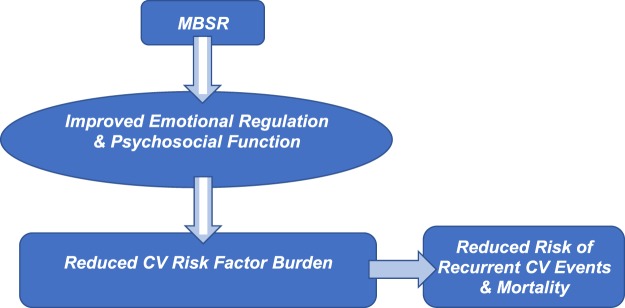
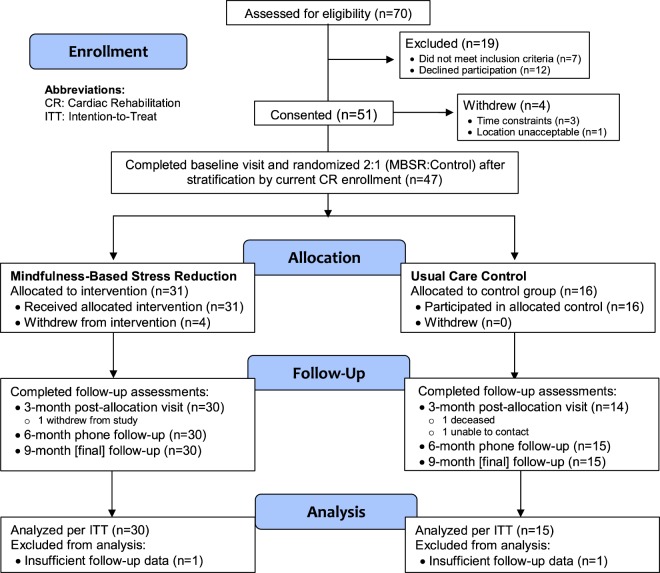
Currently, exercise-based cardiac rehabilitation (CR) is the only recommended secondary prevention strategy for cardiac patients that attempts to tackle stress and psychosocial wellbeing, but it is under-utilized and lacks a comprehensive curriculum for this purpose; hence there is a critical gap to address psychosocial needs of cardiac patients after an event. Mindfulness-based stress reduction (MBSR) has shown benefits in the general population but its role in cardiac patients is not clear. We conducted a pilot randomized controlled trial (RCT) of MBSR in CR-eligible cardiac patients during their initial year of recovery. Patients were allocated 2:1 (intervention:control) to an 8-week MBSR group intervention or usual care. Standard measures of depression, anxiety, perceived stress, health related quality of life (HRQOL), blood pressure, biomarkers (lipids, HbA1c, CRP) and 24-hour Holter monitoring were obtained at baseline, 3- and 9-months post-randomization. Sub-group analyses were performed for participants with at least mild depression (PHQ-9 ≥ 5). 47 patients [mean age 58.6 years; 38% female; 77% white] were enrolled in 2 cohorts. 87% of MBSR patients completed the intervention; study retention was >95% at each follow-up visit. At 3 months, compared to controls, MBSR patients showed improvements in depression [p = 0.01] and anxiety [p = 0.04] with a similar trend in HRQOL [p = 0.06]. The MBSR group showed greater improvement or less worsening of most CV risk factors, with an attenuation of treatment effects at 9 months. Participants with at PHQ-9 scores ≥5 at baseline showed greater improvement in psychosocial and CV outcomes, that persisted at 9 months. MBSR is a safe and well received secondary prevention strategy. This pilot RCT provides preliminary evidence of MBSR's potential to improve short term psychosocial well-being in cardiac patients during their first year of recovery.
目前,基于运动的心脏康复(CR)是唯一被推荐用于治疗心脏病患者压力和心理社会健康问题的二级预防策略,但该策略并未得到充分利用,也缺乏针对这一目的的综合课程;因此,需要解决心脏病患者发病后的心理社会需求。基于正念的减压(MBSR)已在普通人群中显示出益处,但它在心脏病患者中的作用尚不清楚。我们对符合 CR 条件的心脏病患者在康复初始一年内进行了 MBSR 随机对照试验(RCT)。患者按 2:1(干预:对照)的比例分为 8 周 MBSR 组干预或常规护理。在基线、3 个月和 9 个月随机分组后,使用抑郁、焦虑、感知压力、健康相关生活质量(HRQOL)、血压、生物标志物(血脂、HbA1c、CRP)和 24 小时动态心电图监测等标准措施进行测量。对于至少有轻度抑郁(PHQ-9≥5)的参与者进行了亚组分析。共纳入 2 个队列的 47 名患者[平均年龄 58.6 岁;38%为女性;77%为白人]。87%的 MBSR 患者完成了干预;每次随访的研究保留率均超过 95%。与对照组相比,MBSR 组在 3 个月时抑郁[p=0.01]和焦虑[p=0.04]得到改善,HRQOL 也有类似趋势[p=0.06]。MBSR 组大多数心血管风险因素的改善或恶化程度较小,治疗效果在 9 个月时减弱。基线 PHQ-9 评分≥5 的患者在心理社会和心血管结局方面的改善更大,并且在 9 个月时仍持续存在。MBSR 是一种安全且备受欢迎的二级预防策略。这项初步 RCT 提供了初步证据,表明 MBSR 有可能改善心脏病患者在康复的第一年中的短期心理社会健康。