
系统评价与Meta分析:幽门螺杆菌感染与食管癌的关联
Systematic Review with Meta-analysis: Association of Helicobacter pylori Infection with Esophageal Cancer.
作者信息
Gao Huiqin, Li Lunan, Zhang Chenjing, Tu Jiangfeng, Geng Xiaoge, Wang Jingya, Zhou Xiaolu, Jing Jiyong, Pan Wensheng
机构信息
Department of Gastroenterology, Zhejiang Provincial People's Hospital, People's Hospital of Hangzhou Medical College, Hangzhou, Zhejiang, China.
Bengbu Medical College, Bengbu, Anhui, China.
出版信息
Gastroenterol Res Pract. 2019 Dec 1;2019:1953497. doi: 10.1155/2019/1953497. eCollection 2019.
BACKGROUND
Helicobacter pylori is an important carcinogenic factor in gastric cancer. Studies have shown that Helicobacter pylori infection is inversely associated with certain diseases such as esophageal cancer and whose infection appears to have a "protective effect." At present, the relationship between Helicobacter pylori infection and esophageal cancer remains controversial. This study was designed to investigate the relationship between Helicobacter pylori infection and the risk of esophageal cancer in different regions and ethnicities.
METHODS
Systematic search of the articles on the relationship between Helicobacter pylori infection and esophageal cancer from the database with the duration time up to December 2018. This systematic review was performed under the MOOSE guidelines.
RESULTS
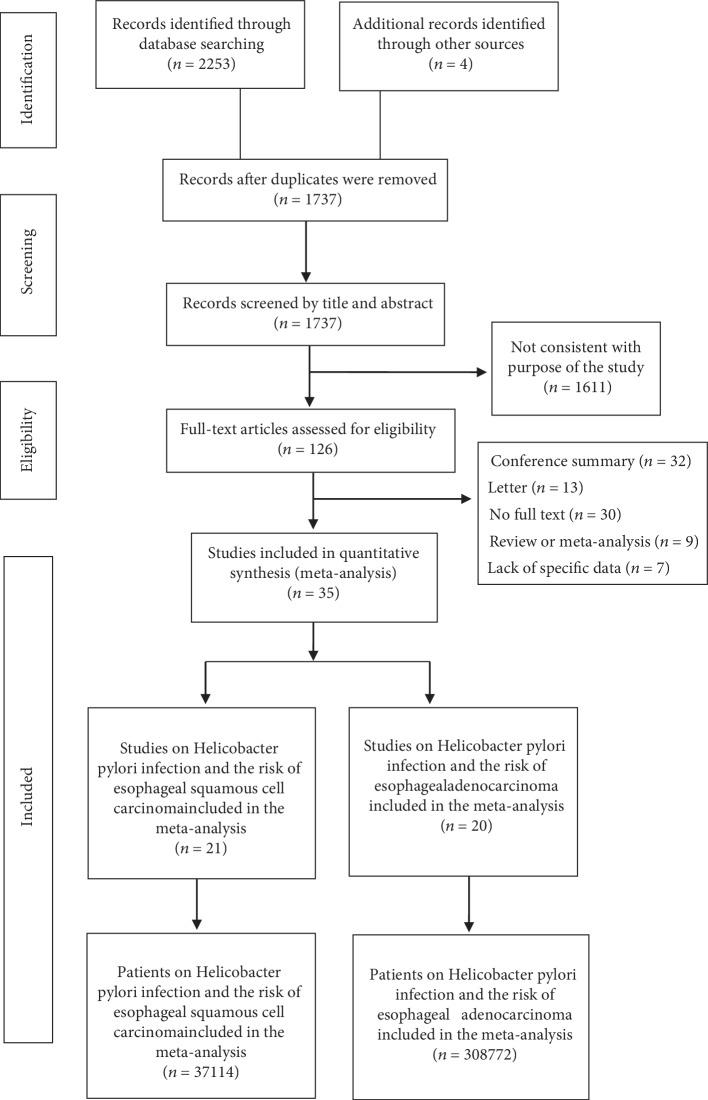
This meta-analysis included 35 studies with 345,886 patients enrolled. There was no significant correlation between Helicobacter pylori infection and esophageal squamous cell carcinoma in the general population (OR: 0.84; 95% CI: 0.64-1.09/OR: 0.74; 95% CI: 0.54-0.97). However, a significant correlation was found in the Middle East (OR: 0.34; 95% CI: 0.22-0.52/95% CI: 0.26-0.44). There was no significant difference in the prevalence of Helicobacter pylori between the case group and the control group in esophageal adenocarcinoma (8.87% vs. 9.67%). The pooled OR was 0.55 (95% CI: 0.43-0.70) or 0.23 (95% CI: 0.15-0.36). When grouped by match or not, the pooled OR of the nonmatching group and the matching group was 0.48/0.21 (95% CI: 0.36-0.65/95% CI: 0.13-0.36) and 0.73/0.71 (95% CI: 0.57-0.92/95% CI: 0.60-0.84), respectively.
CONCLUSION
In the general populations, no significant association was found between Helicobacter pylori infection and the risk of esophageal squamous cell carcinoma. However, lower risk was found in the Middle East. Helicobacter pylori infection may reduce the risk of esophageal adenocarcinoma, but such "protection effect" may be overestimated.
背景
幽门螺杆菌是胃癌的重要致癌因素。研究表明,幽门螺杆菌感染与某些疾病如食管癌呈负相关,其感染似乎具有“保护作用”。目前,幽门螺杆菌感染与食管癌之间的关系仍存在争议。本研究旨在探讨幽门螺杆菌感染与不同地区和种族食管癌风险之间的关系。
方法
系统检索截至2018年12月数据库中关于幽门螺杆菌感染与食管癌关系的文章。本系统评价按照MOOSE指南进行。
结果
该荟萃分析纳入35项研究,共345,886例患者。在普通人群中,幽门螺杆菌感染与食管鳞状细胞癌之间无显著相关性(比值比:0.84;95%置信区间:0.64 - 1.09/比值比:0.74;95%置信区间:0.54 - 0.97)。然而,在中东地区发现显著相关性(比值比:0.34;95%置信区间:0.22 - 0.52/95%置信区间:0.26 - 0.44)。食管腺癌病例组和对照组之间幽门螺杆菌感染率无显著差异(8.87%对9.67%)。合并比值比为0.55(95%置信区间:0.43 - 0.70)或0.23(95%置信区间:0.15 - 0.36)。按匹配与否分组时,非匹配组和匹配组合并比值比分别为0.48/0.21(95%置信区间:0.36 - 0.65/95%置信区间:0.13 - 0.36)和0.73/0.71(95%置信区间:0.57 - 0.92/95%置信区间:0.60 - 0.84)。
结论
在普通人群中,未发现幽门螺杆菌感染与食管鳞状细胞癌风险之间存在显著关联。然而,在中东地区风险较低。幽门螺杆菌感染可能降低食管腺癌风险,但这种“保护作用”可能被高估。



 Zotero 插件