Department of Neurobiology and Evelyn F. McKnight Brain Institute, University of Alabama at Birmingham, Birmingham, AL 35294.
Behavioral Neuroscience Research Branch, Intramural Research Program, National Institute on Drug Abuse, NIH/DHHS, Baltimore, MD 21224.
eNeuro. 2020 Jan 6;7(1). doi: 10.1523/ENEURO.0386-19.2019. Print 2020 Jan/Feb.
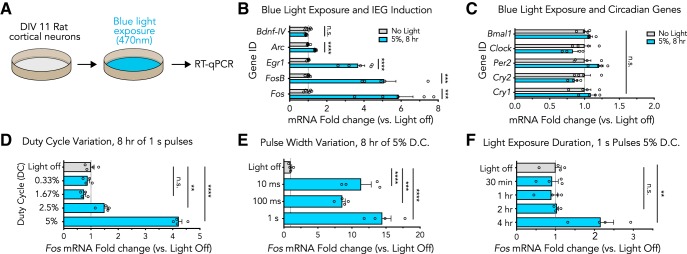
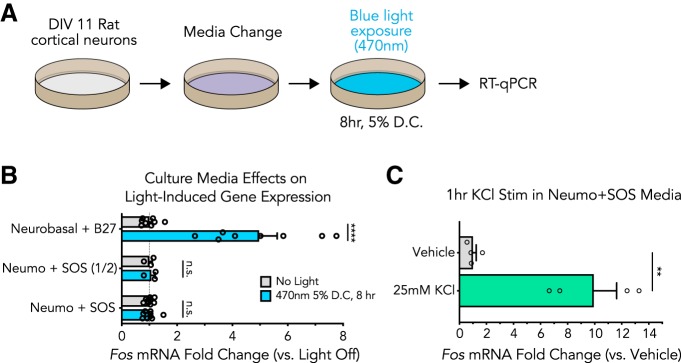
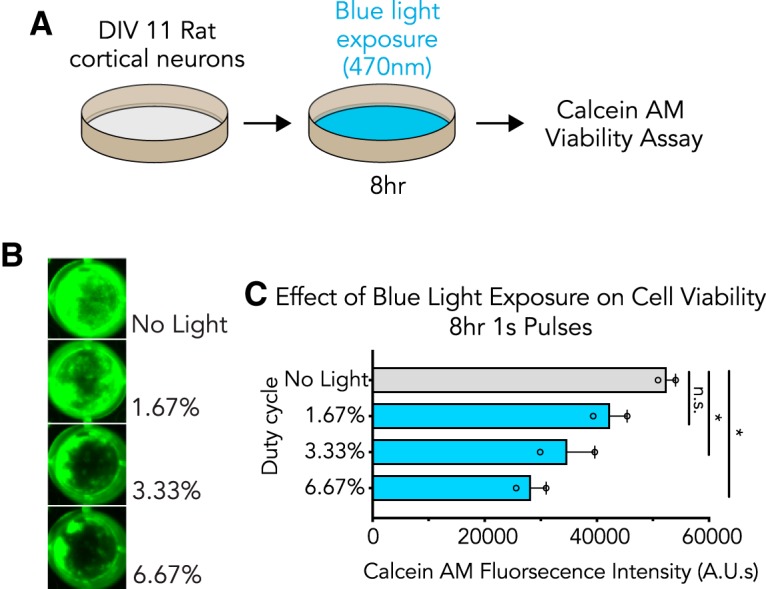
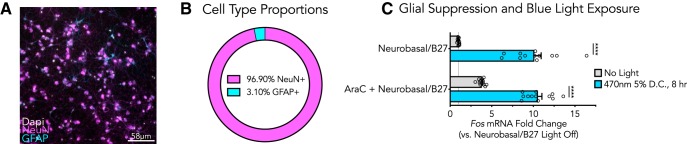
Blue wavelength light is used as an optical actuator in numerous optogenetic technologies employed in neuronal systems. However, the potential side effects of blue light in neurons has not been thoroughly explored, and recent reports suggest that neuronal exposure to blue light can induce transcriptional alterations and Here, we examined the effects of blue wavelength light in cultured primary rat cortical cells. Exposure to blue light (470 nm) resulted in upregulation of several immediate early genes (IEGs) traditionally used as markers of neuronal activity, including and , but did not alter the expression of circadian clock genes , , , , or IEG expression was increased following 4 h of 5% duty cycle light exposure, and IEG induction was not dependent on light pulse width. Elevated levels of blue light exposure induced a loss of cell viability , suggestive of overt phototoxicity. Induction of IEGs by blue light was maintained in cortical cultures treated with AraC to block glial proliferation, indicating that induction occurred selectively in postmitotic neurons. Importantly, changes in gene expression induced by blue wavelength light were prevented when cultures were maintained in a photoinert media supplemented with a photostable neuronal supplement instead of commonly utilized neuronal culture media and supplements. Together, these findings suggest that light-induced gene expression alterations observed stem from a phototoxic interaction between commonly used media and neurons, and offer a solution to prevent this toxicity when using photoactivatable technology .
蓝色波长光被用作许多用于神经元系统的光遗传学技术中的光学致动器。然而,神经元中蓝光的潜在副作用尚未得到彻底探索,最近的报告表明,神经元暴露于蓝光会诱导转录改变。在这里,我们检查了培养的原代大鼠皮质细胞中蓝色波长光的作用。暴露于蓝光(470nm)导致几个即时早期基因(IEGs)的上调,这些基因通常被用作神经元活动的标志物,包括 和 ,但不改变生物钟基因的表达 、 、 、 或 。IEG 的表达在 5%占空比光暴露 4 小时后增加,IEG 诱导不依赖于光脉冲宽度。高水平的蓝光暴露诱导细胞活力丧失,提示明显的光毒性。蓝光诱导的 IEG 表达在用 AraC 处理以阻断神经胶质增殖的皮质培养物中得以维持,表明诱导选择性地发生在有丝分裂后的神经元中。重要的是,当培养物在补充有光稳定神经元补充剂而不是常用神经元培养基和补充剂的光惰性培养基中维持时,蓝色波长光诱导的基因表达变化被阻止。这些发现表明,观察到的光诱导基因表达改变源于常用培养基和神经元之间的光毒性相互作用,并提供了一种在使用光激活技术时防止这种毒性的解决方案。