Hochheiser Katharina, Aw Yeang Han Xian, Wagner Teagan, Tutuka Candani, Behren Andreas, Waithman Jason, Angel Christopher, Neeson Paul J, Gebhardt Thomas, Gyorki David E
Peter MacCallum Cancer Centre Melbourne VIC Australia.
Department of Microbiology & Immunology The University of Melbourne at the Peter Doherty Institute for Infection & Immunity Melbourne VIC Australia.
Clin Transl Immunology. 2019 Dec 25;8(12):e1100. doi: 10.1002/cti2.1100. eCollection 2019.
The immune system can halt cancer progression by suppressing outgrowth of clinically occult micrometastases in a state of cancer-immune equilibrium. Cutaneous melanoma provides a unique opportunity to study the immune contexture of such lesions, as miniscule skin metastases are accessible to clinical inspection and diagnostic biopsy.
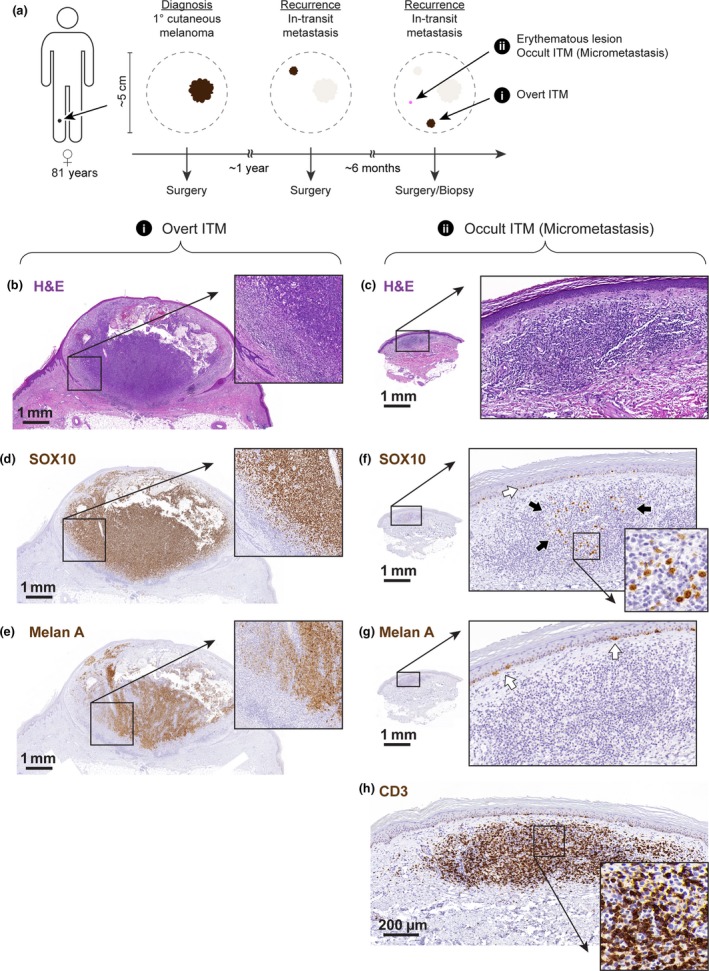
Here, we analysed by multiplex immunofluorescence microscopy samples from a melanoma patient presenting with an overt and an occult in-transit metastasis (ITM), the latter of which appeared as a small erythematous papule.
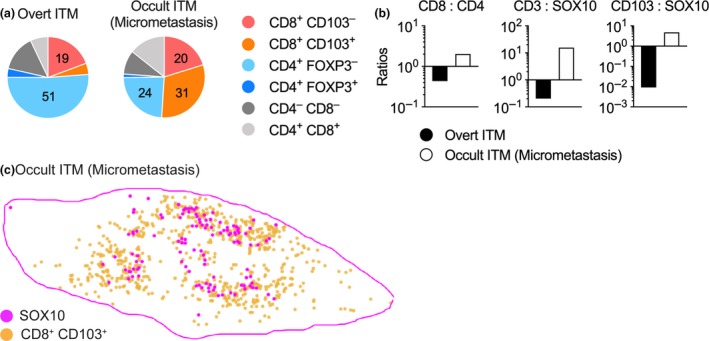
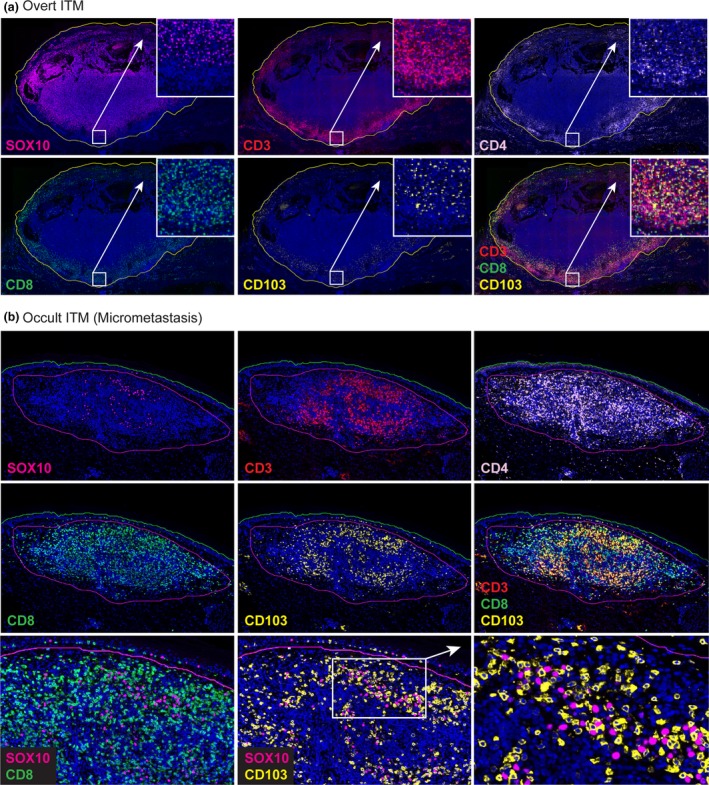
Microarchitecture and immune composition in the two lesions were vastly different. CD4 and CD8 T cells accumulated around the margin of the overt SOX10 Melan A ITM but were largely excluded from the tumor centre. By contrast, the occult micrometastasis contained only few SOX10 Melan A melanoma cells which were scattered within a dense infiltrate of T cells, including a prominent population of CD103 CD8 T cells resembling tissue-resident memory T (T) cells. Notably, almost every single melanoma cell in the micrometastasis was in close proximity to these T-like cells.
Such results support the emerging concept that CD103 CD8 T cells are key mediators of cancer surveillance and imply an important function of these cells in controlling clinically occult micrometastases in humans.
免疫系统可通过抑制处于癌症 - 免疫平衡状态下临床隐匿性微转移灶的生长来阻止癌症进展。皮肤黑色素瘤为研究此类病灶的免疫微环境提供了独特契机,因为微小的皮肤转移灶可通过临床检查和诊断性活检获取。
在此,我们通过多重免疫荧光显微镜分析了一名黑色素瘤患者的样本,该患者出现了一个明显的和一个隐匿的卫星转移灶(ITM),后者表现为一个小的红斑丘疹。
两个病灶的微观结构和免疫组成差异极大。CD4和CD8 T细胞在明显的SOX10黑色素A卫星转移灶边缘聚集,但在肿瘤中心基本没有。相比之下,隐匿性微转移灶仅含有少量SOX10黑色素A黑色素瘤细胞,这些细胞散布在密集的T细胞浸润中,包括一群突出的CD103 CD8 T细胞,类似于组织驻留记忆T(T)细胞。值得注意的是,微转移灶中几乎每一个黑色素瘤细胞都与这些T样细胞紧密相邻。
这些结果支持了新出现的概念,即CD103 CD8 T细胞是癌症监测的关键介质,并暗示了这些细胞在控制人类临床隐匿性微转移灶方面的重要功能。