Department of Medical Ethics and Health Policy, Perelman School of Medicine, University of Pennsylvania, Philadelphia.
Leonard Davis Institute of Health Economics, University of Pennsylvania, Philadelphia.
JAMA Intern Med. 2020 Feb 1;180(2):254-262. doi: 10.1001/jamainternmed.2019.5686.
Fading economic opportunity has been hypothesized to be an important factor associated with the US opioid overdose crisis. Automotive assembly plant closures are culturally significant events that substantially erode local economic opportunities.
To estimate the extent to which automotive assembly plant closures were associated with increasing opioid overdose mortality rates among working-age adults.
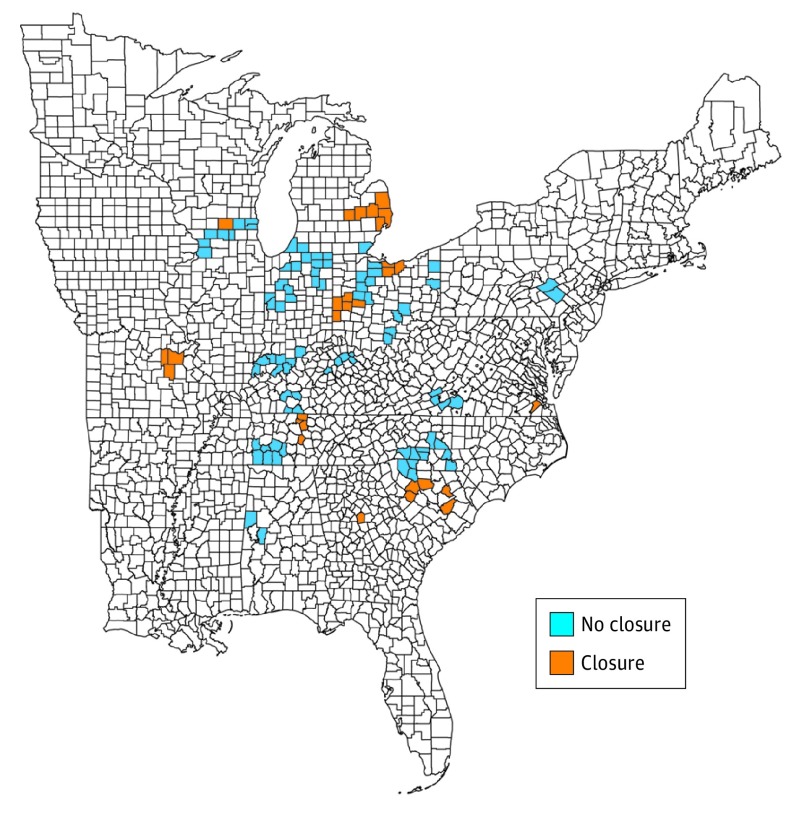
DESIGN, SETTING, AND PARTICIPANTS: A county-level difference-in-differences study was conducted among adults aged 18 to 65 years in 112 manufacturing counties located in 30 commuting zones (primarily in the US South and Midwest) with at least 1 operational automotive assembly plant as of 1999. The study analyzed county-level changes from January 1, 1999, to December 31, 2016, in age-adjusted, county-level opioid overdose mortality rates before vs after automotive assembly plant closures in manufacturing counties affected by plant closures compared with changes in manufacturing counties unaffected by plant closures. Data analyses were performed between April 1, 2018, and July 20, 2019.
Closure of automotive assembly plants in the commuting zone of residence.
The primary outcome was the county-level age-adjusted opioid overdose mortality rate. Secondary outcomes included the overall drug overdose mortality rate and prescription vs illicit drug overdose mortality rates.
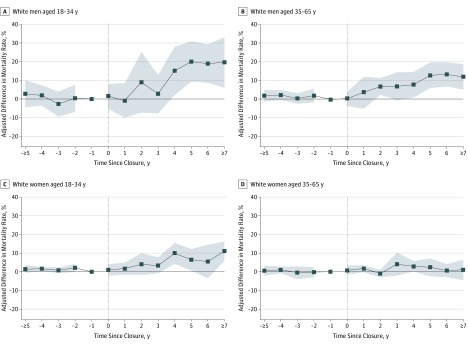
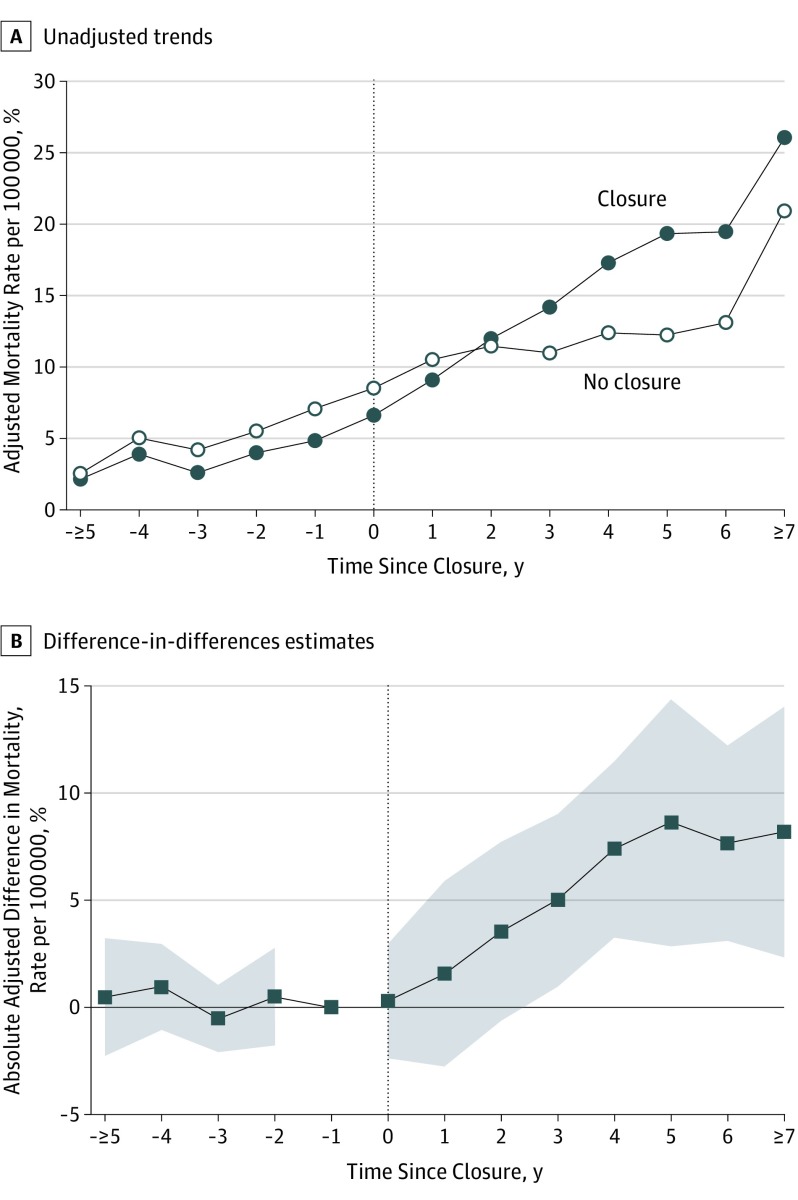
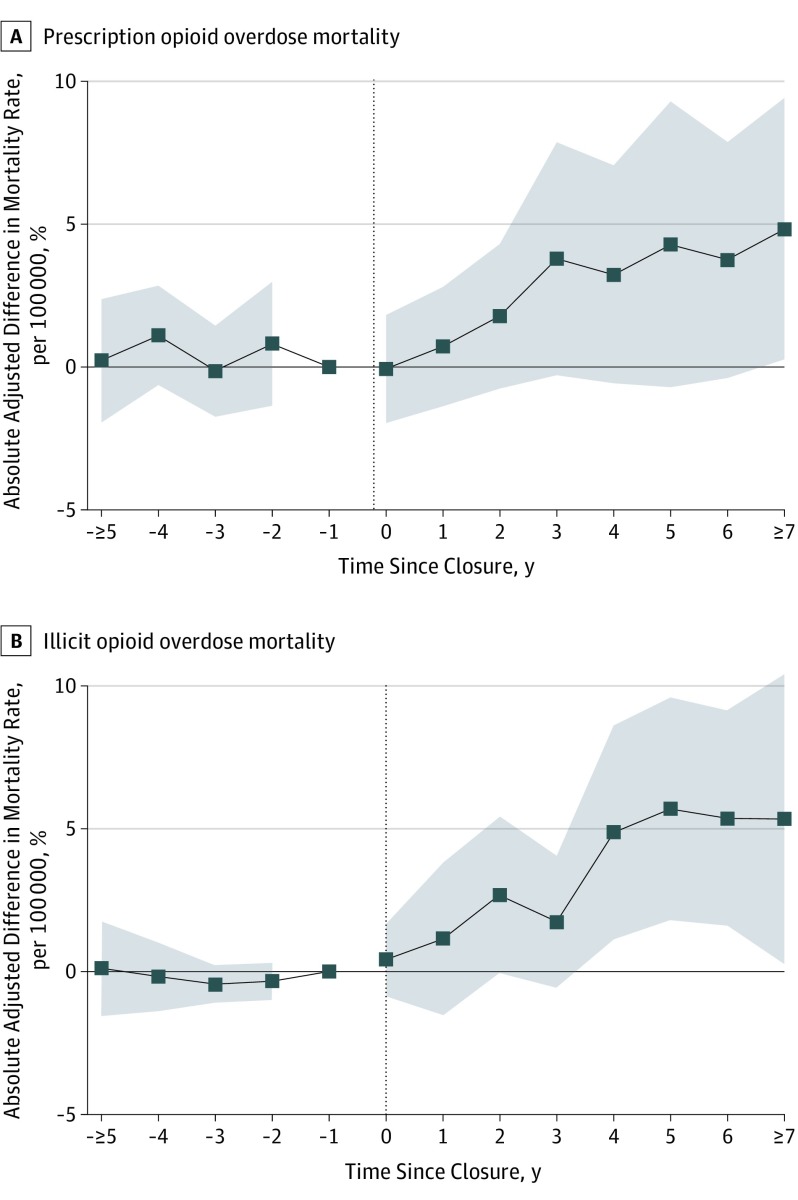
During the study period, 29 manufacturing counties in 10 commuting zones were exposed to an automotive assembly plant closure, while 83 manufacturing counties in 20 commuting zones remained unexposed. Mean (SD) baseline opioid overdose rates per 100 000 were similar in exposed (0.9 [1.4]) and unexposed (1.0 [2.1]) counties. Automotive assembly plant closures were associated with statistically significant increases in opioid overdose mortality. Five years after a plant closure, mortality rates had increased by 8.6 opioid overdose deaths per 100 000 individuals (95% CI, 2.6-14.6; P = .006) in exposed counties compared with unexposed counties, an 85% higher increase relative to the mortality rate that would have been expected had exposed counties followed the same outcome trends as unexposed counties. In analyses stratified by age, sex, and race/ethnicity, the largest increases in opioid overdose mortality were observed among non-Hispanic white men aged 18 to 34 years (20.1 deaths per 100 000; 95% CI, 8.8-31.3; P = .001) and aged 35 to 65 years (12.8 deaths per 100 000; 95% CI, 5.7-20.0; P = .001). We observed similar patterns of prescription vs illicit drug overdose mortality. Estimates for opioid overdose mortality in nonmanufacturing counties were not statistically significant.
From 1999 to 2016, automotive assembly plant closures were associated with increases in opioid overdose mortality. These findings highlight the potential importance of eroding economic opportunity as a factor in the US opioid overdose crisis.
重要性:经济机会减少被假设是与美国阿片类药物过量危机相关的一个重要因素。汽车装配厂关闭是具有文化意义的事件,它们极大地削弱了当地的经济机会。
目的:评估汽车装配厂关闭与工作年龄成年人阿片类药物过量死亡率上升之间的关联程度。
设计、地点和参与者:在 1999 年至少有一家汽车装配厂运营的 30 个通勤区的 112 个制造业县中,对 18 至 65 岁的成年人进行了县一级的差分差异研究。研究分析了自 1999 年 1 月 1 日至 2016 年 12 月 31 日,在汽车装配厂关闭影响的制造业县中,与未受汽车装配厂关闭影响的制造业县相比,县一级年龄调整后阿片类药物过量死亡率在汽车装配厂关闭前后的变化。数据分析于 2018 年 4 月 1 日至 2019 年 7 月 20 日进行。
暴露:居住地通勤区汽车装配厂关闭。
主要结果和测量:主要结果是县一级年龄调整后的阿片类药物过量死亡率。次要结果包括总体药物过量死亡率以及处方与非法药物过量死亡率。
结果:在研究期间,10 个通勤区的 29 个制造业县受到了汽车装配厂关闭的影响,而 20 个通勤区的 83 个制造业县未受到影响。暴露(0.9 [1.4])和未暴露(1.0 [2.1])县的基线阿片类药物过量率的平均值(SD)相似。汽车装配厂关闭与阿片类药物过量死亡率的显著增加有关。在工厂关闭后的五年内,与未关闭的县相比,暴露县的阿片类药物过量死亡率每 10 万人增加了 8.6 例(95%CI,2.6-14.6;P=0.006),与未关闭的县相比,死亡率增加了 85%,这是因为如果暴露县遵循与未暴露县相同的结果趋势,预期的死亡率会更高。在按年龄、性别和种族/族裔划分的分析中,在 18 至 34 岁的非西班牙裔白人男性(20.1 例/10 万人;95%CI,8.8-31.3;P=0.001)和 35 至 65 岁的男性(12.8 例/10 万人;95%CI,5.7-20.0;P=0.001)中,阿片类药物过量死亡率的增加最大。我们观察到了类似的处方与非法药物过量死亡率模式。非制造业县的阿片类药物过量死亡率估计值没有统计学意义。
结论和相关性:从 1999 年到 2016 年,汽车装配厂的关闭与阿片类药物过量死亡率的上升有关。这些发现强调了经济机会减少作为美国阿片类药物过量危机因素的潜在重要性。