West China School of Public Health and West China Fourth Hospital, Sichuan University, Chengdu, 610041, Sichuan, China.
School of Public Health, Li Ka Shing Faculty of Medicine, The University of Hong Kong, 21 Sassoon Road, Hong Kong, 999077, Pokfulam, China.
BMC Geriatr. 2020 Jan 2;20(1):2. doi: 10.1186/s12877-019-1408-4.
The study aimed to examine the association between daytime napping and successful aging (including its five dimensions, "low probability of disease," "no disease-related disability," "high cognitive functioning," "high physical functioning," and "active engagement with life") among China's older adults using data from the Chinese Health and Retirement Longitudinal Study conducted in 2015.
Cross-sectional data were used in the analysis. Multivariable logistic regressions were conducted to investigate the association between daytime napping and successful aging, and stratified analyses were performed to explore differences in nighttime sleep duration.
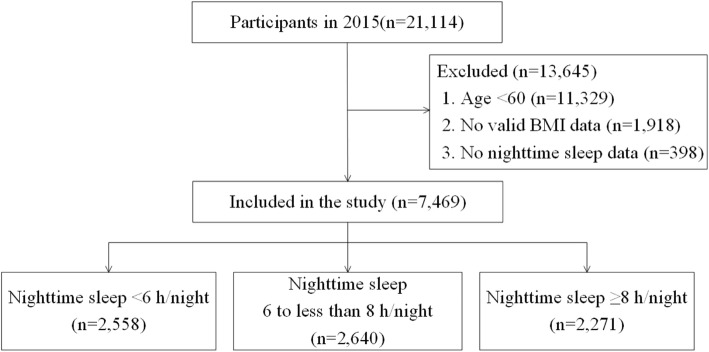
A total of 7469 participants were included in the analysis. Daytime napping was prevalent in China's older adults (59.3%). The proportion of study participants with "successful aging" was 13.7%. Additionally, 48.6, 91.7, 54.1, 78.5, and 49.1% participants achieved "low probability of disease," "no disease-related disability," "high cognitive functioning," "high physical functioning," and "active engagement with life," respectively. Compared with the 0 min/day napping group, the > 60 min/day napping group was associated with a lower probability of achieving successful aging (OR, 0.762; 95% CI, 0.583-0.996). In the nighttime sleep duration stratification, the findings showed that in the ≥8 h/night group, napping > 60 min per day was associated with a lower likelihood of aging successfully (OR, 0.617; 95% CI, 0.387-0.984). Considering the five dimensions of successful aging, moderate and long daytime napping were negatively associated with "low probability of disease"; long daytime napping had negative associations with "no disease-related disability" and "high physical functioning"; moderate daytime napping had positive associations with "high cognitive functioning" and "active engagement with life."
Long daytime napping showed a lower likelihood of successful aging among the elderly in China. Special attention is necessary for elderly people who sleep for longer duration both during day and night. Biological and social factors affecting the relationship between daytime napping and successful aging need to be explored in depth in the future.
本研究旨在利用 2015 年中国健康与退休纵向研究的数据,考察中国老年人日间小睡与成功老龄化(包括五个维度,“疾病发生率低”、“无疾病相关残疾”、“认知功能高”、“身体功能高”和“积极参与生活”)之间的关联。
分析采用横断面数据。多变量逻辑回归用于调查日间小睡与成功老龄化之间的关联,并进行分层分析以探索夜间睡眠时间的差异。
共纳入 7469 名参与者。日间小睡在中国老年人中很普遍(59.3%)。研究参与者中“成功老龄化”的比例为 13.7%。此外,分别有 48.6%、91.7%、54.1%、78.5%和 49.1%的参与者达到了“疾病发生率低”、“无疾病相关残疾”、“认知功能高”、“身体功能高”和“积极参与生活”。与 0 分钟/天小睡组相比,>60 分钟/天小睡组成功老龄化的可能性较低(OR,0.762;95%CI,0.583-0.996)。在夜间睡眠时间分层中,结果表明在≥8 小时/夜组中,每天小睡>60 分钟与成功老龄化的可能性较低相关(OR,0.617;95%CI,0.387-0.984)。考虑到成功老龄化的五个维度,中度和长时间日间小睡与“疾病发生率低”呈负相关;长时间日间小睡与“无疾病相关残疾”和“身体功能高”呈负相关;中度日间小睡与“认知功能高”和“积极参与生活”呈正相关。
中国老年人中,长时间日间小睡与成功老龄化的可能性较低相关。对于日间和夜间睡眠时间较长的老年人,需要特别关注。未来需要深入探讨影响日间小睡与成功老龄化之间关系的生物和社会因素。