Department of Structural Biology, Stanford University School of Medicine, Stanford, CA 94305-5126, USA.
Department of Applied Physics, Stanford University, Stanford, CA 94305-4090, USA.
Sci Adv. 2020 Jan 1;6(1):eaax6969. doi: 10.1126/sciadv.aax6969. eCollection 2020 Jan.
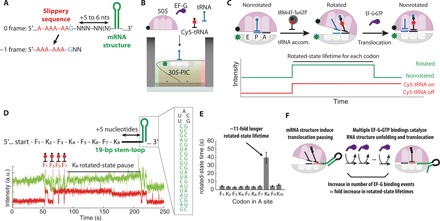
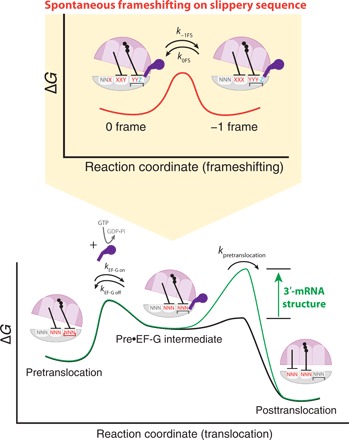
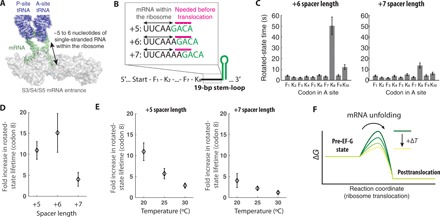
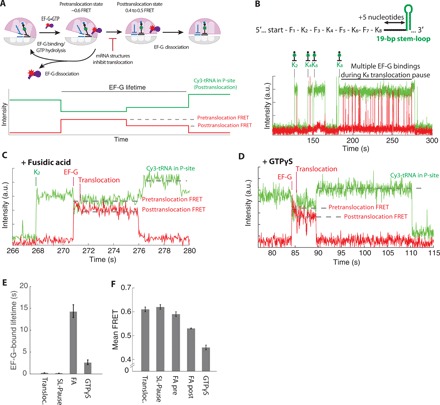
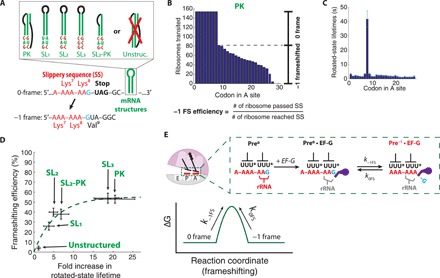
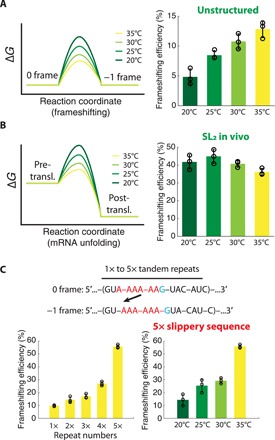
Maintenance of translational reading frame ensures the fidelity of information transfer during protein synthesis. Yet, programmed ribosomal frameshifting sequences within the coding region promote a high rate of reading frame change at predetermined sites thus enriching genomic information density. Frameshifting is typically stimulated by the presence of 3' messenger RNA (mRNA) structures, but how these mRNA structures enhance -1 frameshifting remains debatable. Here, we apply single-molecule and ensemble approaches to formulate a mechanistic model of ribosomal -1 frameshifting. Our model suggests that the ribosome is intrinsically susceptible to frameshift before its translocation and this transient state is prolonged by the presence of a precisely positioned downstream mRNA structure. We challenged this model using temperature variation in vivo, which followed the prediction made based on in vitro results. Our results provide a quantitative framework for analyzing other frameshifting enhancers and a potential approach to control gene expression dynamically using programmed frameshifting.
维持翻译阅读框架可确保在蛋白质合成过程中信息传递的保真度。然而,编码区内的有义核糖体移码序列在预定位置促进了高频率的阅读框变化,从而丰富了基因组信息密度。移码通常受到 3'信使 RNA(mRNA)结构的刺激,但这些 mRNA 结构如何增强 -1 移码仍存在争议。在这里,我们应用单分子和整体方法来构建核糖体 -1 移码的机制模型。我们的模型表明,核糖体在易位之前就固有地容易发生移码,而这种瞬时状态会因存在精确定位的下游 mRNA 结构而延长。我们通过体内的温度变化来挑战这个模型,这与基于体外结果的预测相符。我们的研究结果为分析其他移码增强子提供了一个定量框架,并为使用有义移码动态控制基因表达提供了一种潜在方法。