Biswas Saumik, Chen Shali, Liang Guang, Feng Biao, Cai Lu, Khan Zia A, Chakrabarti Subrata
Department of Pathology and Laboratory Medicine, Western University, London, ON, Canada.
Chemical Biology Research Centre, School of Pharmaceutical Science, Wenzhou Medical University, Wenzhou, China.
Front Endocrinol (Lausanne). 2019 Dec 18;10:887. doi: 10.3389/fendo.2019.00887. eCollection 2019.
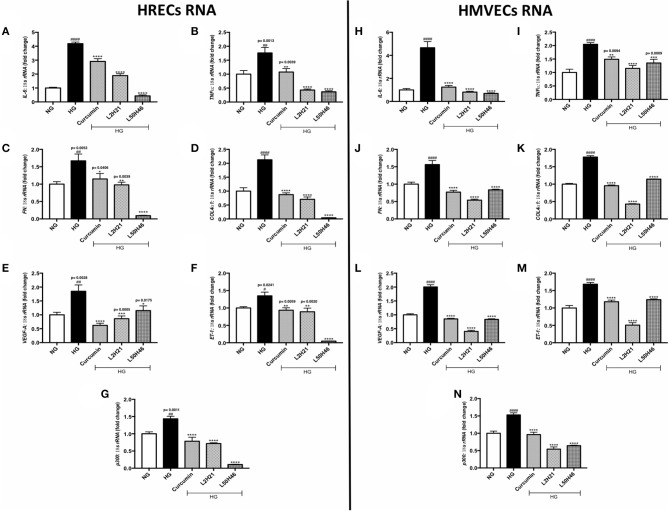
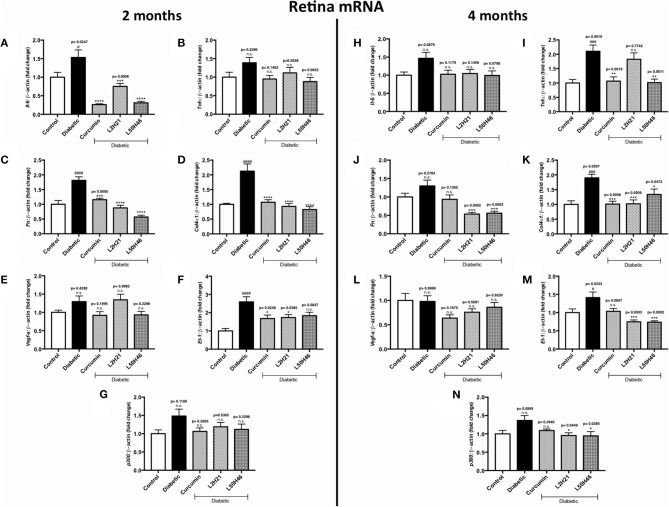
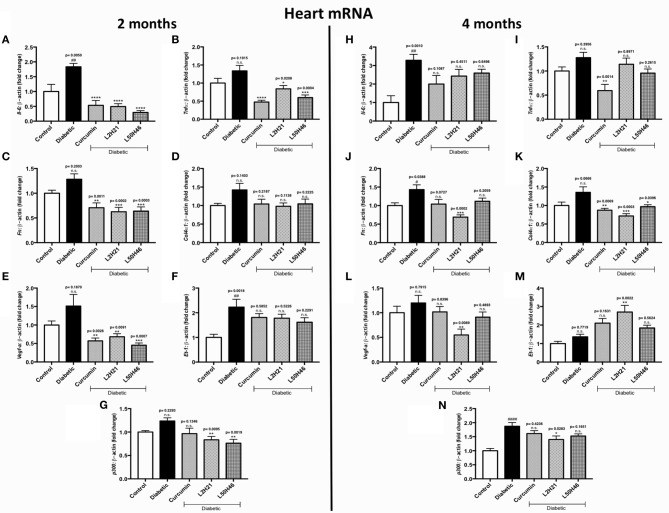
Chronic inflammation and oxidative stress lead to a multitude of adverse cellular responses in target organs of chronic diabetic complications. Curcumin, a highly investigated phytochemical, has been shown to exhibit both anti-inflammatory and antioxidant activities. However, the clinical application of curcumin has been greatly limited due to a poor pharmacokinetic profile. To overcome these limitations, we have generated analogs of curcumin to enhance bioavailability and offer a preferable pharmacokinetic profile. Here, we explored the effects of two mono-carbonyl curcumin analogs, L2H21 and L50H46, in alleviating indices of inflammation and oxidative stress in cell culture and mouse model of diabetic complications. Our results show that L2H21 and L50H46 normalize inflammatory mediators ( and α), extracellular matrix proteins ( and α), vasoactive factors ( and ) and a key transcriptional coactivator () in cultured human retinal microvascular endothelial cells (HRECs) and dermal-derived microvascular endothelial cells (HMVECs) challenged with high levels of glucose. These curcumin analogs also reduced glucose-induced oxidative DNA damage as evidenced by 8-OHdG labeling. We further show that treatment of streptozotocin-induced diabetic mice with curcumin analogs prevents cardiac and renal dysfunction. The preservation of target tissue function was associated with normalization of pro-inflammatory cytokines and matrix proteins. Collectively, our results show that L2H21 and L50H46 offer the anti-inflammatory and antioxidant activities as has been reported for curcumin, and may provide a clinically applicable therapeutic option for the treatment of diabetic complications.
慢性炎症和氧化应激会导致慢性糖尿病并发症靶器官出现多种不良细胞反应。姜黄素是一种经过大量研究的植物化学物质,已被证明具有抗炎和抗氧化活性。然而,由于药代动力学特性不佳,姜黄素的临床应用受到极大限制。为克服这些限制,我们合成了姜黄素类似物以提高生物利用度并提供更优的药代动力学特性。在此,我们探究了两种单羰基姜黄素类似物L2H21和L50H46在细胞培养和糖尿病并发症小鼠模型中减轻炎症和氧化应激指标的作用。我们的结果表明,L2H21和L50H46可使在高糖环境下培养的人视网膜微血管内皮细胞(HRECs)和真皮来源的微血管内皮细胞(HMVECs)中的炎症介质( 和α)、细胞外基质蛋白( 和α)、血管活性因子( 和 )以及一种关键转录共激活因子()恢复正常。这些姜黄素类似物还减少了葡萄糖诱导的氧化DNA损伤,8-羟基脱氧鸟苷(8-OHdG)标记证明了这一点。我们进一步表明,用姜黄素类似物治疗链脲佐菌素诱导的糖尿病小鼠可预防心脏和肾脏功能障碍。靶组织功能的保留与促炎细胞因子和基质蛋白的正常化有关。总体而言,我们的结果表明L2H21和L50H46具有如报道的姜黄素那样的抗炎和抗氧化活性,并可能为糖尿病并发症的治疗提供一种临床适用的治疗选择。