Mohr Teresa, Infantes Alba, Biebinger Lars, de Maayer Pieter, Neumann Anke
Technical Biology, Institute of Process Engineering in Life Science, Karlsruhe Institute of Technology, Karlsruhe, Germany.
Faculty of Science, School of Molecular & Cell Biology, University of the Witwatersrand, Johannesburg, South Africa.
Front Bioeng Biotechnol. 2019 Dec 20;7:433. doi: 10.3389/fbioe.2019.00433. eCollection 2019.
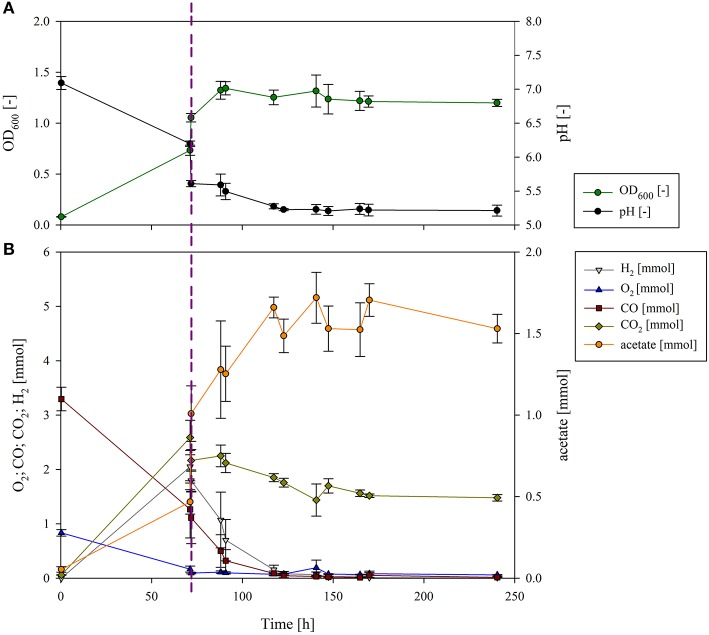
The microbial production of bulk chemicals from waste gas is becoming a pertinent alternative to industrial strategies that rely on fossil fuels as substrate. Acetogens can use waste gas substrates or syngas (CO, CO, H) to produce chemicals, such as acetate or ethanol, but as the feed gas often contains oxygen, which inhibits acetogen growth and product formation, a cost-prohibitive chemical oxygen removal step is necessary. Here, we have developed a two-phase microbial system to facilitate acetate production using a gas mixture containing CO and O. In the first phase the facultative anaerobic carboxydotroph was used to consume residual O and produce H and CO, which was subsequently utilized by the acetogen for the production of acetate. From a starting amount of 3.3 mmol of CO, 0.52 mmol acetate was produced in the second phase by . In this set-up, the yield achieved was 0.16 mol acetate/mol CO, a 63% of the theoretical maximum. This system has the potential to be developed for the production of a broad range of bulk chemicals from oxygen-containing waste gas by using as an oxygen scrubbing tool.
利用废气进行微生物生产大宗化学品正成为一种有针对性的替代方案,以取代那些依赖化石燃料作为底物的工业策略。产乙酸菌可以利用废气底物或合成气(CO、CO₂、H₂)来生产化学品,如乙酸盐或乙醇,但由于进料气中通常含有氧气,这会抑制产乙酸菌的生长和产物形成,因此需要一个成本高昂的化学除氧步骤。在此,我们开发了一种两相微生物系统,以促进使用含有CO和O₂的气体混合物生产乙酸盐。在第一阶段,兼性厌氧羧基营养菌用于消耗残留的O₂并产生H₂和CO₂,随后产乙酸菌利用这些物质来生产乙酸盐。从3.3 mmol的CO起始量来看,第二阶段由[具体菌种]产生了0.52 mmol乙酸盐。在这种设置下,实现的产率为0.16 mol乙酸盐/mol CO,为理论最大值的63%。该系统有潜力通过将[具体菌种]用作氧气洗涤工具,从含氧化废气中开发生产多种大宗化学品。