School of labor and human resources, Renmin University of China, Beijing 100872, China.
School of public administration, Yan'an University, Shanxi 716000, China.
Int J Environ Res Public Health. 2020 Jan 9;17(2):437. doi: 10.3390/ijerph17020437.
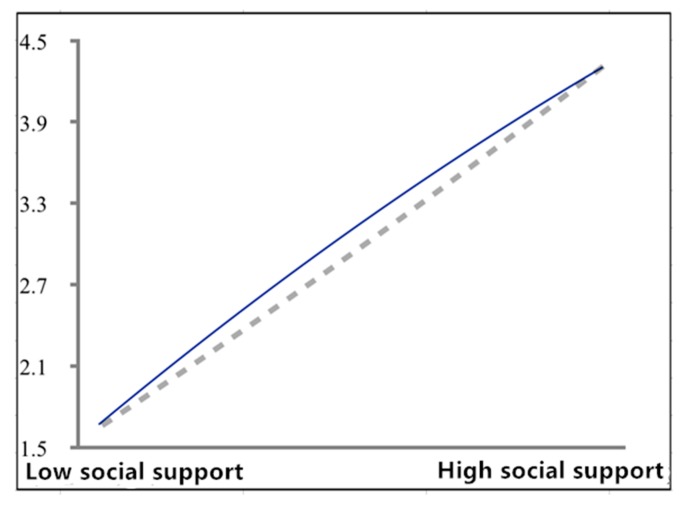
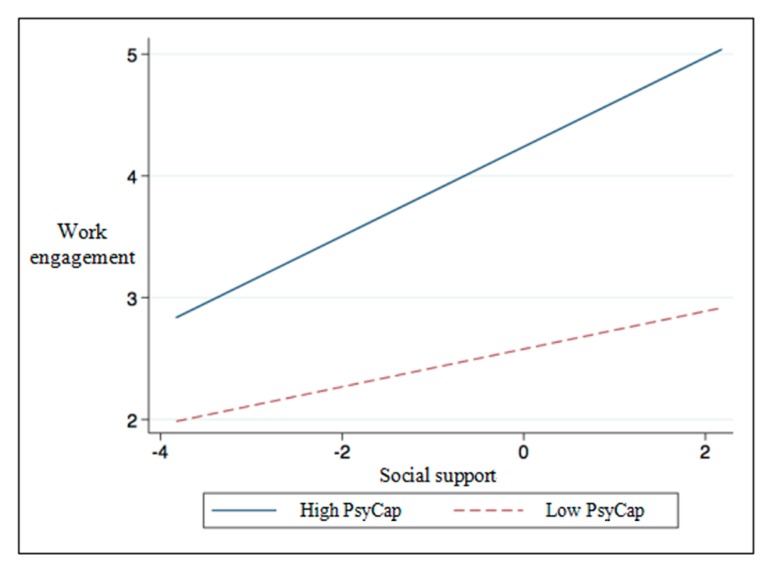
Built on the job demands-resources model (JD-R) and self-determination theory, the present research proposed that the relationship between work resources (social support) and employees' work engagement takes on an inverted U-shaped curve, and presents a model of the moderation of personal resources (psychological capital) on the relationship. The hypotheses were tested by hierarchical regression analysis and path analysis with 535 surveys collected in 19 enterprises. The findings demonstrated an inverted U-shaped curve relationship between enterprises' social support and employees' work engagement and further suggested that the predicting effect of social support on work engagement is influenced by employees' psychological capital, that is to say, the transformation from social support to work engagement bears higher efficiency in employees with high psychological capital than in those with low psychological capital. However, psychological capital fails to display a moderating effect on the curve relationship between social support and work engagement. The present study, casting doubt on the assumption that enterprise supply must meet the needs of employees, argued that the effectiveness of enterprises' resource support is influenced by the individual needs of employees.
本研究基于工作要求-资源模型(JD-R)和自我决定理论,提出工作资源(社会支持)与员工工作投入之间的关系呈倒 U 型曲线,并提出个人资源(心理资本)对关系的调节模型。通过对 19 家企业的 535 份调查进行层次回归分析和路径分析,检验了假设。研究结果表明,企业的社会支持与员工的工作投入之间存在倒 U 型曲线关系,进一步表明,社会支持对工作投入的预测作用受到员工心理资本的影响,即社会支持向工作投入的转化在心理资本较高的员工中比在心理资本较低的员工中效率更高。然而,心理资本并没有显示出对社会支持与工作投入之间的曲线关系的调节作用。本研究对企业供应必须满足员工需求的假设提出质疑,认为企业资源支持的有效性受到员工个人需求的影响。