Szymura Jadwiga, Kubica Jadwiga, Wiecek Magdalena, Pera Joanna
Department of Clinical Rehabilitation, Faculty of Motor Rehabilitation, University of Physical Education in Krakow, 31-571 Krakow, Poland.
Institute of Physiotherapy, Faculty of Health Science, Jagiellonian University Medical College, 31-126 Krakow, Poland.
J Clin Med. 2020 Jan 9;9(1):184. doi: 10.3390/jcm9010184.
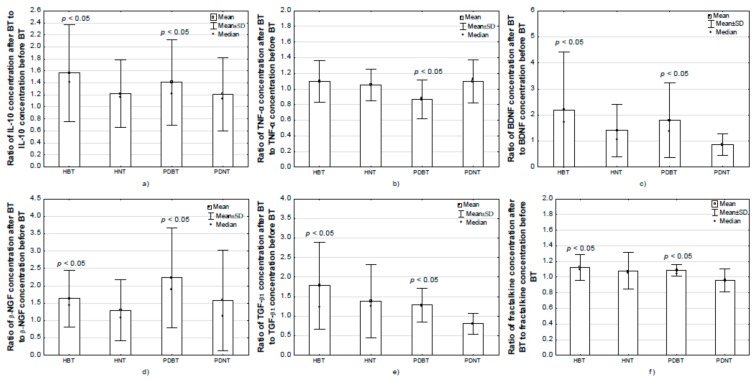
We sought to investigate whether regular balance training of moderate intensity (BT) has an effect on changes in selected cytokines, neurotrophic factors, CD200 and fractalkine in healthy older adults and participants with Parkinson's disease (PD). Sixty-two subjects were divided into groups depending on experimental intervention: (1) group of people with PD participating in BT (PDBT), (2) group of healthy older people participating in BT (HBT), (3,4) control groups including healthy individuals (HNT) and people with PD (PDNT). Blood samples were collected twice: before and after 12 weeks of balance exercise (PDBT, HBT), or 12 weeks apart (PDNT, HNT). The study revealed significant increase of interleukin10 (PDBT, = 0.026; HBT, = 0.011), β-nerve growth factor (HBT, = 0.002; PDBT, = 0.016), transforming growth factor-β1 (PDBT, = 0.018; HBT, < 0.004), brain-derived neurotrophic factor (PDBT, = 0.011; HBT, < 0.001) and fractalkine (PDBT, p = 0.045; HBT, p < 0.003) concentration only in training groups. In PDBT, we have found a significant decrease of tumor necrosis factor alpha. No training effect on concentration of interleukin6, insulin-like growth factor 1 and CD200 was observed in both training and control groups. Regular training can modulate level of inflammatory markers and induce neuroprotective mechanism to reduce the inflammatory response.
我们试图研究中等强度的定期平衡训练(BT)是否会对健康老年人和帕金森病(PD)患者体内某些细胞因子、神经营养因子、CD200和趋化因子的变化产生影响。62名受试者根据实验干预被分为几组:(1)参与平衡训练的帕金森病患者组(PDBT),(2)参与平衡训练的健康老年人组(HBT),(3,4)包括健康个体(HNT)和帕金森病患者(PDNT)的对照组。血液样本采集两次:平衡训练12周之前和之后(PDBT、HBT),或间隔12周(PDNT、HNT)。研究显示,仅在训练组中,白细胞介素10(PDBT,P = 0.026;HBT,P = 0.011)、β-神经生长因子(HBT,P = 0.002;PDBT,P = 0.016)、转化生长因子-β1(PDBT,P = 0.018;HBT,P < 0.004)、脑源性神经营养因子(PDBT,P = 0.011;HBT,P < 0.001)和趋化因子(PDBT,P = 0.045;HBT,P < 0.003)的浓度显著增加。在PDBT组中,我们发现肿瘤坏死因子α显著降低。在训练组和对照组中均未观察到训练对白细胞介素6、胰岛素样生长因子1和CD200浓度的影响。定期训练可以调节炎症标志物水平并诱导神经保护机制以减轻炎症反应。