Miyashiro Daisuke, Hamano Ryo, Umemura Kazuo
Department of Physics, Tokyo University of Science, 1-3 Kagurazaka, Shinjuku-ku, Tokyo 162-8601, Japan.
ESTECH CORP., 2-7-31 Fukuura, Kanazawa-ku, Yokohama, 236-0004, Japan.
Nanomaterials (Basel). 2020 Jan 21;10(2):186. doi: 10.3390/nano10020186.
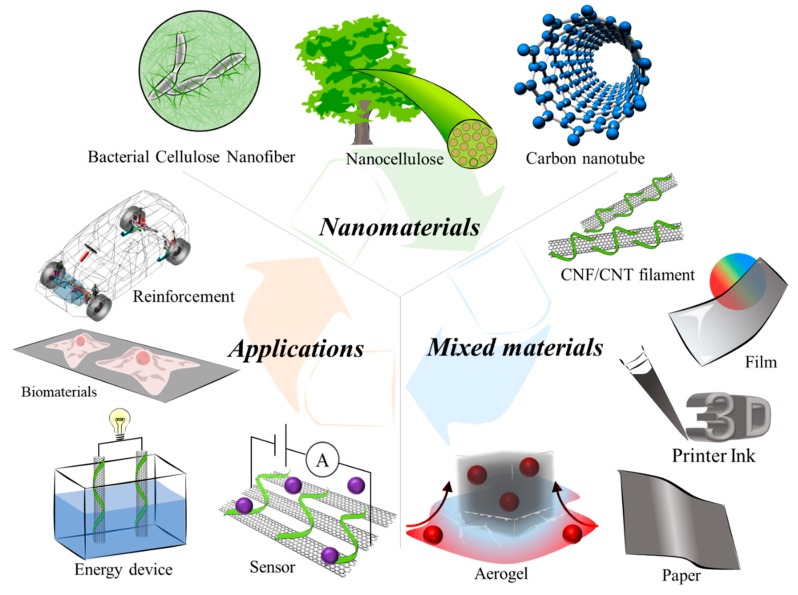
Carbon nanotubes (CNTs) have been extensively studied as one of the most interesting nanomaterials for over 25 years because they exhibit excellent mechanical, electrical, thermal, optical, and electrical properties. In the past decade, the number of publications and patents on cellulose and nanocellulose (NC) increased tenfold. Research on NC with excellent mechanical properties, flexibility, and transparency is accelerating due to the growing environmental problems surrounding us such as CO emissions, the accumulation of large amounts of plastic, and the depletion of energy resources such as oil. Research on mixed materials of cellulose, NC, and CNTs has been expanding because these materials exhibit various characteristics that can be controlled by varying the combination of cellulose, NC to CNTs while also being biodegradable and recyclable. An understanding of these mixed materials is required because these characteristics are diverse and are expected to solve various environmental problems. Thus far, many review papers on cellulose, NC or CNTs have been published. Although guidance for the suitable application of these mixed materials is necessary, there are few reviews summarizing them. Therefore, this review introduces the application and feature on mixed materials of cellulose, NC and CNTs.
25多年来,碳纳米管(CNTs)作为最有趣的纳米材料之一受到了广泛研究,因为它们具有优异的机械、电学、热学、光学和电学性能。在过去十年中,关于纤维素和纳米纤维素(NC)的出版物和专利数量增加了十倍。由于我们周围日益严重的环境问题,如二氧化碳排放、大量塑料的积累以及石油等能源资源的枯竭,对具有优异机械性能、柔韧性和透明度的纳米纤维素的研究正在加速。纤维素、纳米纤维素和碳纳米管混合材料的研究一直在扩展,因为这些材料表现出各种特性,通过改变纤维素、纳米纤维素与碳纳米管的组合可以对这些特性进行控制,同时它们还具有生物可降解和可回收的特点。由于这些特性多种多样且有望解决各种环境问题,因此需要对这些混合材料有所了解。到目前为止,已经发表了许多关于纤维素、纳米纤维素或碳纳米管的综述论文。虽然有必要对这些混合材料的合适应用提供指导,但很少有综述对它们进行总结。因此,本综述介绍了纤维素、纳米纤维素和碳纳米管混合材料的应用及特点。