Fraunhofer Institute for Wood Research (WKI), Bienroder Weg 54E, 38108 Braunschweig, Germany.
Molecules. 2019 Jul 31;24(15):2782. doi: 10.3390/molecules24152782.
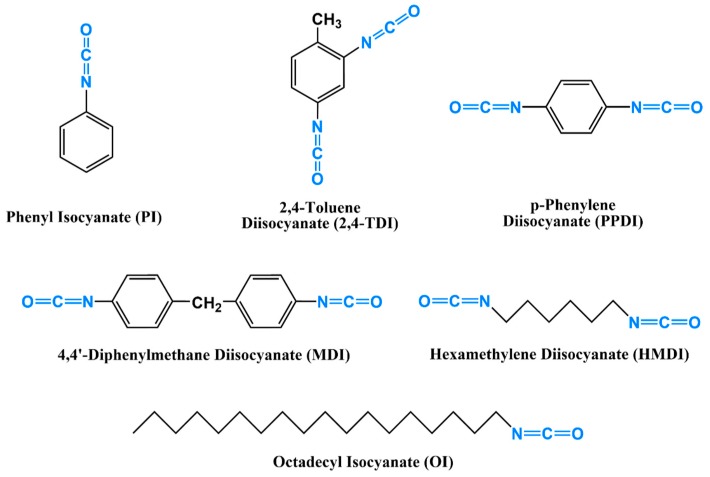
Nanocellulose has been subjected to a wide range of chemical modifications towards increasing its potential in certain fields of interest. These modifications either modulated the chemistry of the nanocellulose itself or introduced certain functional groups onto its surface, which varied from simple molecules to polymers. Among many, aliphatic and aromatic mono- and di-isocyanates are a group of chemicals that have been used for a century to modify cellulose. Despite only being used recently with nanocellulose, they have shown great potential as surface modifiers and chemical linkers to graft certain functional chemicals and polymers onto the nanocellulose surface. This review discusses the modification of cellulose and nanocellulose using isocyanates including phenyl isocyanate (PI), octadecyl isocyanate (OI), toluene diisocyanate (TDI), diphenylmethane diisocyanate (MDI), hexamethylene diisocyanate (HMDI), and their derivatives and polymers. It also presents the most commonly used nanocellulose modification strategies including their advantages and disadvantages. It finally discusses the challenges of using isocyanates, in general, for nanocellulose modification.
纳米纤维素已经经历了广泛的化学修饰,以提高其在某些感兴趣领域的潜力。这些修饰要么调节纳米纤维素本身的化学性质,要么在其表面引入某些官能团,这些官能团从简单的分子到聚合物不等。在众多化学物质中,脂肪族和芳香族的单异氰酸酯和二异氰酸酯是一组已经使用了一个世纪的化学物质,用于修饰纤维素。尽管最近才开始用于纳米纤维素,但它们作为表面修饰剂和化学连接剂具有很大的潜力,可以将某些官能团化学物质和聚合物接枝到纳米纤维素表面。这篇综述讨论了使用异氰酸酯(包括苯基异氰酸酯(PI)、十八烷基异氰酸酯(OI)、甲苯二异氰酸酯(TDI)、二苯基甲烷二异氰酸酯(MDI)、六亚甲基二异氰酸酯(HMDI)及其衍生物和聚合物)对纤维素和纳米纤维素的修饰。它还介绍了最常用的纳米纤维素修饰策略,包括它们的优点和缺点。最后,它讨论了使用异氰酸酯对纳米纤维素进行修饰的一般挑战。