Center for Adaptive Rationality, Max Planck Institute for Human Development, Lentzeallee 94, 14195 Berlin, Germany.
Leibniz Institute of Freshwater Ecology and Inland Fisheries, Müggelseedamm 310, 12587 Berlin, Germany.
Sci Adv. 2019 Nov 20;5(11):eaaw9011. doi: 10.1126/sciadv.aaw9011. eCollection 2019 Nov.
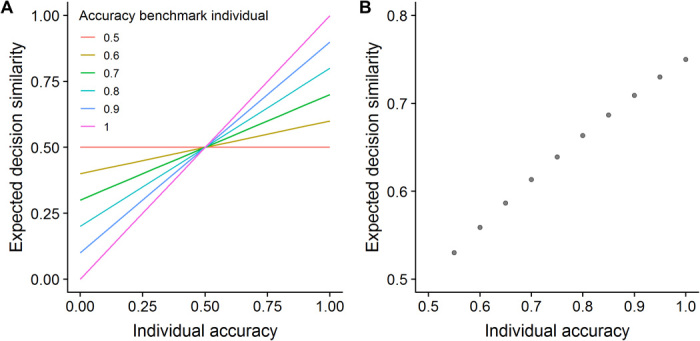
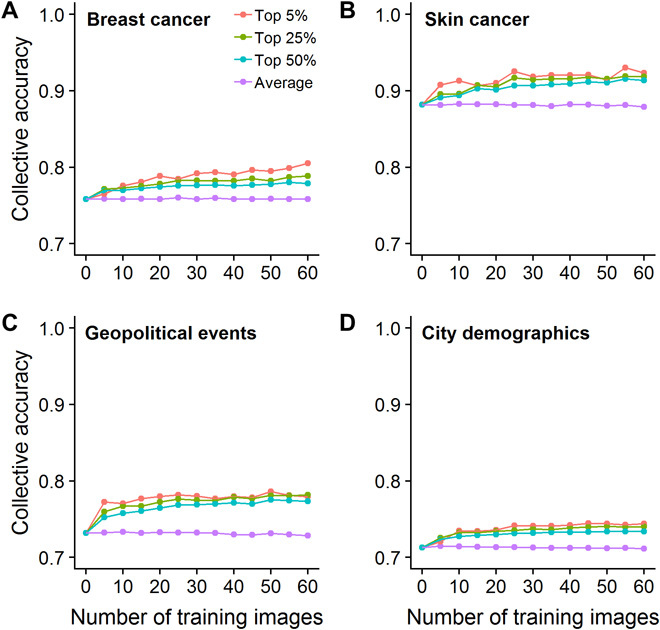
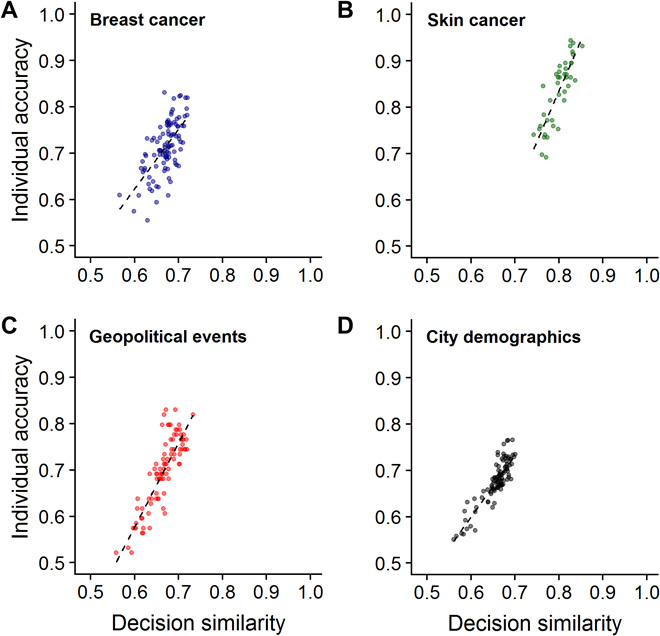
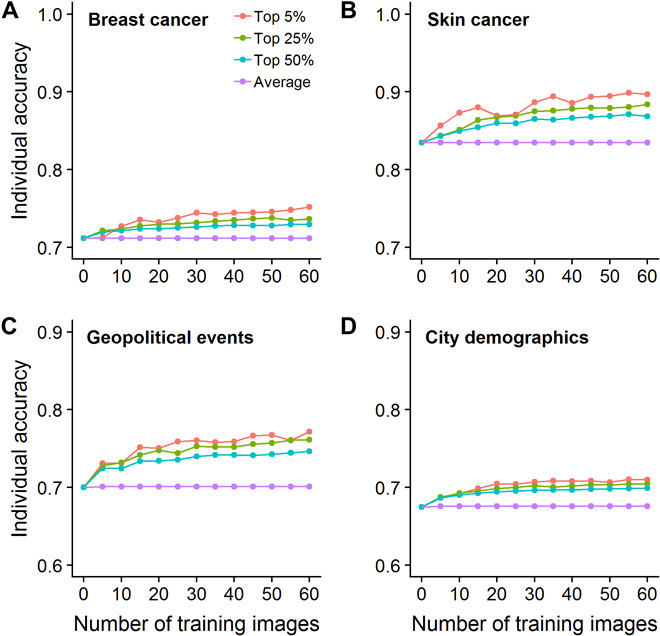
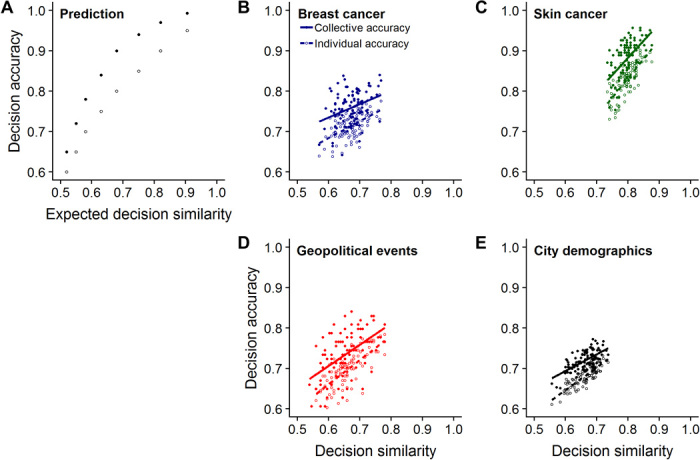
Distinguishing between high- and low-performing individuals and groups is of prime importance in a wide range of high-stakes contexts. While this is straightforward when accurate records of past performance exist, these records are unavailable in most real-world contexts. Focusing on the class of binary decision problems, we use a combined theoretical and empirical approach to develop and test a approach to this important problem. First, we use a general mathematical argument and numerical simulations to show that the similarity of an individual's decisions to others is a powerful predictor of that individual's decision accuracy. Second, testing this prediction with several large datasets on breast and skin cancer diagnostics, geopolitical forecasting, and a general knowledge task, we find that decision similarity robustly permits the identification of high-performing individuals and groups. Our findings offer a simple, yet broadly applicable, heuristic for improving real-world decision-making systems.
在广泛的高风险情境中,区分高绩效个体和群体至关重要。虽然当存在准确的过往绩效记录时,这很简单,但在大多数现实情境中,这些记录并不存在。我们专注于二分类决策问题,采用理论与实证相结合的方法来开发和测试一种解决这一重要问题的方法。首先,我们使用一般的数学论证和数值模拟来表明,个体决策与他人决策的相似性是预测该个体决策准确性的有力指标。其次,我们使用几个大型数据集在乳腺癌和皮肤癌诊断、地缘政治预测以及一般知识任务上进行测试,发现决策相似性可以稳健地识别高绩效的个体和群体。我们的研究结果为改进现实世界的决策系统提供了一种简单而广泛适用的启发式方法。