Department of Obstetrics and Gynecology, Research Facility, Medical University of Graz, Graz, Austria.
Int J Mol Sci. 2020 Jan 22;21(3):736. doi: 10.3390/ijms21030736.
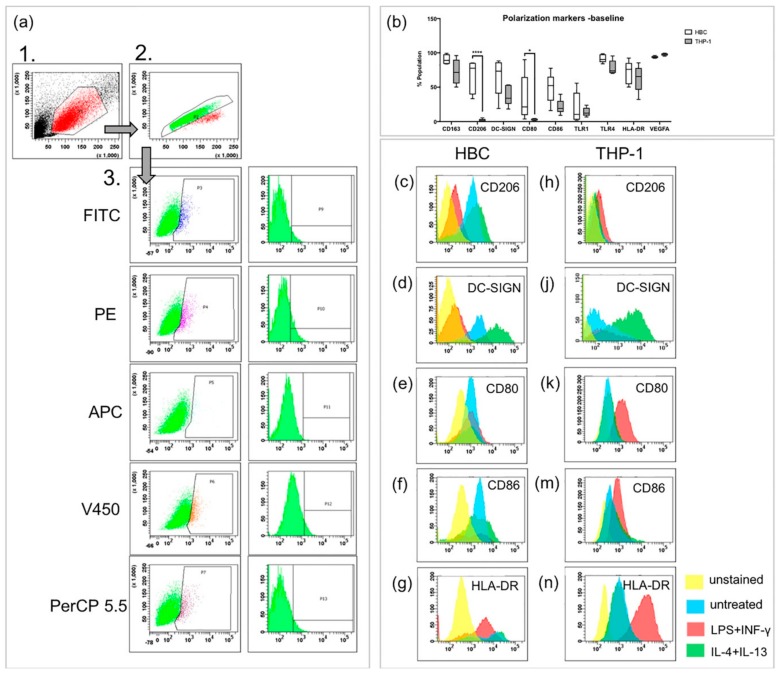
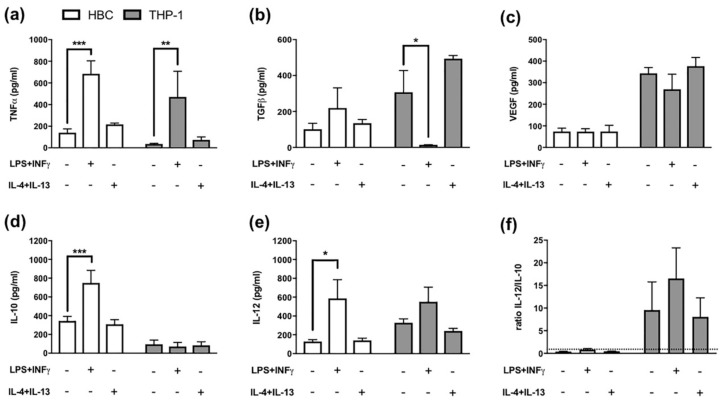
Feto-placental Hofbauer cells (HBCs) are macrophages residing in placental stroma. They are generally described as anti-inflammatory M2 polarized cells, promoting tolerance and tissue remodeling. In certain pathologies, however, a possible phenotypical switch towards pro-inflammatory M1 macrophages has been proposed. The study aimed to determine if HBCs can acquire an M1 phenotype under pro-inflammatory conditions in vitro. HBCs were isolated from healthy human term placentas. Cells were cultivated upon addition of LPS and INF-γ or IL-4 and IL-13 to induce the M1 and M2 phenotype, respectively. Specific cell polarization markers and cytokines, associated with respective phenotypes, were investigated by flow cytometry and ELISA. THP-1 macrophages served as positive control. Pro-inflammatory stimuli reduced M2 markers CD163 and DC-SIGN, but did not induce M1 markers. TNF-α release was increased, but at the same time TGF-β and IL-10 release was upregulated, resembling in part the M2b sub-phenotype. Anti-inflammatory stimuli had no effect on HBC polarization. HBCs maintain their M2 phenotype in vitro despite inflammatory stimuli, which might represent a state of adaption and tolerance to avoid rejection of the semiallogeneic feto-placental unit.
胎盘中的滋养层基质细胞(Hofbauer cells,HBCs)是一种存在于胎盘基质中的巨噬细胞。通常情况下,它们被描述为抗炎的 M2 极化细胞,能够促进机体的耐受和组织重塑。然而,在某些病理条件下,它们可能会向促炎的 M1 巨噬细胞表型发生表型转换。本研究旨在确定 HBCs 是否能够在体外的炎症条件下获得 M1 表型。我们从健康足月胎盘分离出 HBCs,分别在添加 LPS 和 INF-γ 或 IL-4 和 IL-13 的情况下培养细胞,以分别诱导 M1 和 M2 表型。通过流式细胞术和 ELISA 检测与相应表型相关的特定细胞极化标志物和细胞因子。THP-1 巨噬细胞作为阳性对照。促炎刺激物降低了 M2 标志物 CD163 和 DC-SIGN,但没有诱导 M1 标志物。TNF-α 的释放增加,但同时 TGF-β 和 IL-10 的释放也上调,部分类似于 M2b 亚表型。抗炎刺激对 HBC 极化没有影响。尽管存在炎症刺激,HBCs 仍能在体外维持其 M2 表型,这可能代表了一种适应和耐受的状态,以避免对半同种异体胎-胎盘单位的排斥。