• 文献检索
  • 文档翻译
  • 深度研究
  • 学术资讯
  • Suppr Zotero 插件Zotero 插件
  • 邀请有礼
  • 套餐&价格
  • 历史记录
应用&插件
Suppr Zotero 插件Zotero 插件浏览器插件Mac 客户端Windows 客户端微信小程序
定价
高级版会员购买积分包购买API积分包
服务
文献检索文档翻译深度研究API 文档MCP 服务
关于我们
关于 Suppr公司介绍联系我们用户协议隐私条款
关注我们

Suppr 超能文献

核心技术专利:CN118964589B侵权必究
粤ICP备2023148730 号-1Suppr @ 2026

文献检索

告别复杂PubMed语法,用中文像聊天一样搜索,搜遍4000万医学文献。AI智能推荐,让科研检索更轻松。

立即免费搜索

文件翻译

保留排版,准确专业,支持PDF/Word/PPT等文件格式,支持 12+语言互译。

免费翻译文档

深度研究

AI帮你快速写综述,25分钟生成高质量综述,智能提取关键信息,辅助科研写作。

立即免费体验

机器学习预测模型可提高阿尔茨海默病临床试验的疗效。

Machine Learning Predictive Models Can Improve Efficacy of Clinical Trials for Alzheimer's Disease.

作者信息

Ezzati Ali, Lipton Richard B

机构信息

Department of Neurology, Albert Einstein College of Medicine and Montefiore Medical Center, Bronx, NY, USA.

出版信息

J Alzheimers Dis. 2020;74(1):55-63. doi: 10.3233/JAD-190822.

DOI:10.3233/JAD-190822
PMID:31985462
原文链接:https://pmc.ncbi.nlm.nih.gov/articles/PMC7201366/
Abstract

BACKGROUND

The ideal participants for Alzheimer's disease (AD) clinical trials would show cognitive decline in the absence of treatment (i.e., placebo arm) and also would be responsive to the therapeutic intervention being studied (i.e., drug arm). One strategy to boost the power of trials is to enroll individuals who are more likely to progress targeted using data-driven predictive models.

OBJECTIVE

To investigate if machine learning (ML) models can effectively predict clinical disease progression (cognitive decline) in mild-to-moderate AD patients during the timeframe of a phase III clinical trial.

METHODS

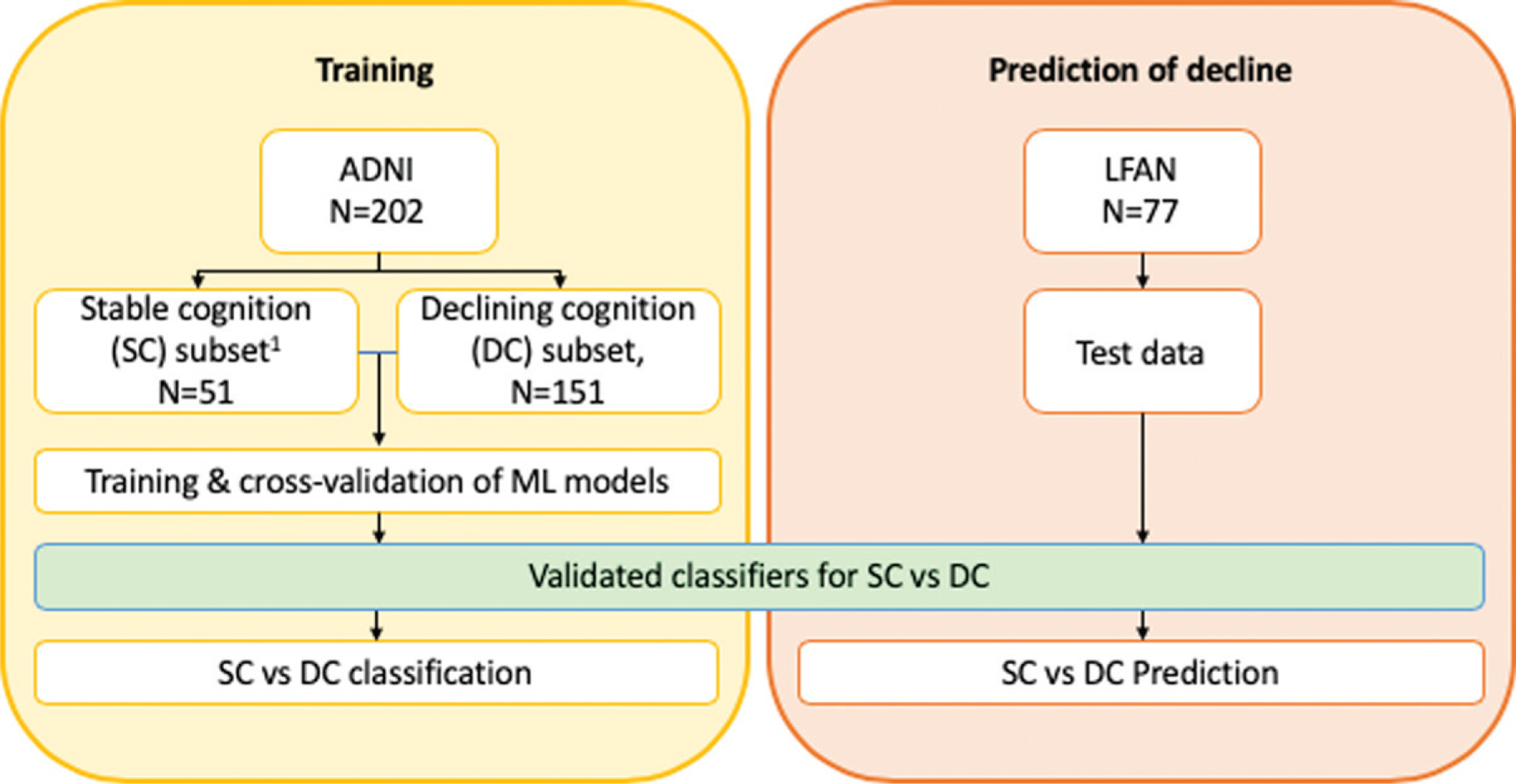
Data from 202 participants with a diagnosis of AD at baseline from the Alzheimer's Disease Neuroimaging Initiative (ADNI) was used to train ML classifiers that can differentiate between individuals who had declining cognitive function (DC) and individuals with stable cognitive function (SC). DC was defined as any downward change in the Alzheimer's Disease Assessment Scale cognitive subscale (ADAS-cog) score over 12 months of follow-up. SC was defined by the absence of decline in ADAS-cog. Trained models were applied to data from 77 participants from the placebo arm of the phase III trial of Semagacestat (LFAN study) to identify subgroups of SC versus DC.

RESULTS

Only 74.8% of ADNI participants and 63.6% of LFAN participants had cognitive decline after one year of follow up. K-nearest neighbors (kNN) classifier had an accuracy of 68.3%, sensitivity of 80.1%, and specificity of 33.3% for identifying decliners in ADNI (training sample). In LFAN (validation sample), the model showed an overall accuracy of 61.3%, sensitivity of 65.5%, and specificity of 47.0% in identifying decliners at the 12 months of follow-up. The model had a positive predictive value of 80.8%, which was 17.2% more than the base prevalence of decliners.

CONCLUSIONS

Machine learning predictive models can be effectively used to boost the power of clinical trials by reducing the sample size.

摘要

背景

阿尔茨海默病(AD)临床试验的理想参与者应在未接受治疗(即安慰剂组)时出现认知衰退,并且对所研究的治疗干预措施(即药物组)有反应。提高试验效力的一种策略是招募那些使用数据驱动的预测模型更有可能出现目标进展的个体。

目的

研究机器学习(ML)模型能否在III期临床试验期间有效预测轻度至中度AD患者的临床疾病进展(认知衰退)。

方法

来自阿尔茨海默病神经影像倡议(ADNI)的202名基线诊断为AD的参与者的数据用于训练ML分类器,该分类器可区分认知功能下降(DC)的个体和认知功能稳定(SC)的个体。DC定义为在12个月的随访期间阿尔茨海默病评估量表认知子量表(ADAS-cog)评分的任何下降变化。SC定义为ADAS-cog无下降。将训练好的模型应用于司美吉布(LFAN研究)III期试验安慰剂组的77名参与者的数据,以识别SC与DC的亚组。

结果

在随访一年后,只有74.8%的ADNI参与者和63.6%的LFAN参与者出现认知衰退。K近邻(kNN)分类器在识别ADNI(训练样本)中的衰退者时,准确率为68.3%,灵敏度为80.1%,特异性为33.3%。在LFAN(验证样本)中,该模型在随访12个月时识别衰退者的总体准确率为61.3%,灵敏度为65.5%,特异性为47.0%。该模型的阳性预测值为80.8%,比衰退者的基础患病率高17.2%。

结论

机器学习预测模型可通过减少样本量有效用于提高临床试验的效力。

https://cdn.ncbi.nlm.nih.gov/pmc/blobs/08e5/7201366/640376cdd1de/nihms-1580948-f0001.jpg

相似文献

1
Machine Learning Predictive Models Can Improve Efficacy of Clinical Trials for Alzheimer's Disease.机器学习预测模型可提高阿尔茨海默病临床试验的疗效。
J Alzheimers Dis. 2020;74(1):55-63. doi: 10.3233/JAD-190822.
2
Prediction of Cognitive Decline for Enrichment of Alzheimer's Disease Clinical Trials.预测认知能力下降,以丰富阿尔茨海默病临床试验。
J Prev Alzheimers Dis. 2022;9(3):400-409. doi: 10.14283/jpad.2022.49.
3
Optimizing Machine Learning Methods to Improve Predictive Models of Alzheimer's Disease.优化机器学习方法以提高阿尔茨海默病预测模型的性能。
J Alzheimers Dis. 2019;71(3):1027-1036. doi: 10.3233/JAD-190262.
4
Longitudinal Exposure-Response Modeling of Multiple Indicators of Alzheimer's Disease Progression.阿尔茨海默病进展多项指标的纵向暴露-反应建模。
J Prev Alzheimers Dis. 2023;10(2):212-222. doi: 10.14283/jpad.2023.13.
5
Application of predictive models in boosting power of Alzheimer's disease clinical trials: A post hoc analysis of phase 3 solanezumab trials.预测模型在增强阿尔茨海默病临床试验效能中的应用:3期solanezumab试验的事后分析
Alzheimers Dement (N Y). 2022 Mar 14;8(1):e12223. doi: 10.1002/trc2.12223. eCollection 2022.
6
Detecting Treatment Group Differences in Alzheimer's Disease Clinical Trials: A Comparison of Alzheimer's Disease Assessment Scale - Cognitive Subscale (ADAS-Cog) and the Clinical Dementia Rating - Sum of Boxes (CDR-SB).阿尔茨海默病临床试验中治疗组差异的检测:阿尔茨海默病评估量表-认知分量表(ADAS-Cog)与临床痴呆评定量表-总盒分(CDR-SB)的比较。
J Prev Alzheimers Dis. 2018;5(1):15-20. doi: 10.14283/jpad.2018.2.
7
Comparison of CSF markers and semi-quantitative amyloid PET in Alzheimer's disease diagnosis and in cognitive impairment prognosis using the ADNI-2 database.利用ADNI-2数据库比较脑脊液标志物和半定量淀粉样蛋白PET在阿尔茨海默病诊断及认知障碍预后中的应用
Alzheimers Res Ther. 2017 Apr 26;9(1):32. doi: 10.1186/s13195-017-0260-z.
8
Alzheimer's Disease Assessment Scale-Cognitive subscale variants in mild cognitive impairment and mild Alzheimer's disease: change over time and the effect of enrichment strategies.轻度认知障碍和轻度阿尔茨海默病中阿尔茨海默病评估量表-认知子量表变体:随时间的变化及强化策略的影响
Alzheimers Res Ther. 2016 Feb 12;8:8. doi: 10.1186/s13195-016-0170-5.
9
Using high-dimensional machine learning methods to estimate an anatomical risk factor for Alzheimer's disease across imaging databases.利用高维机器学习方法在影像数据库中估计阿尔茨海默病的解剖学风险因素。
Neuroimage. 2018 Dec;183:401-411. doi: 10.1016/j.neuroimage.2018.08.040. Epub 2018 Aug 18.
10
A parameter-efficient deep learning approach to predict conversion from mild cognitive impairment to Alzheimer's disease.一种参数高效的深度学习方法,用于预测轻度认知障碍向阿尔茨海默病的转化。
Neuroimage. 2019 Apr 1;189:276-287. doi: 10.1016/j.neuroimage.2019.01.031. Epub 2019 Jan 14.

引用本文的文献

1
Prediction-powered inference for clinical trials: application to linear covariate adjustment.临床试验的预测驱动推理:在线性协变量调整中的应用。
BMC Med Res Methodol. 2025 Aug 29;25(1):204. doi: 10.1186/s12874-025-02647-6.
2
A scoping review of artificial intelligence applications in clinical trial risk assessment.人工智能在临床试验风险评估中的应用范围综述。
NPJ Digit Med. 2025 Jul 30;8(1):486. doi: 10.1038/s41746-025-01886-7.
3
Identifying Alzheimer's Disease Progression Subphenotypes via a Graph-based Framework using Electronic Health Records.

本文引用的文献

1
Optimizing Machine Learning Methods to Improve Predictive Models of Alzheimer's Disease.优化机器学习方法以提高阿尔茨海默病预测模型的性能。
J Alzheimers Dis. 2019;71(3):1027-1036. doi: 10.3233/JAD-190262.
2
Detecting biological heterogeneity patterns in ADNI amnestic mild cognitive impairment based on volumetric MRI.基于容积 MRI 检测 ADNI 遗忘型轻度认知障碍的生物学异质性模式。
Brain Imaging Behav. 2020 Oct;14(5):1792-1804. doi: 10.1007/s11682-019-00115-6.
3
Subtypes Based on Neuropsychological Performance Predict Incident Dementia: Findings from the Rush Memory and Aging Project.
通过使用电子健康记录的基于图的框架识别阿尔茨海默病进展亚表型。
Res Sq. 2025 Apr 7:rs.3.rs-6257332. doi: 10.21203/rs.3.rs-6257332/v1.
4
Predicting conversion in cognitively normal and mild cognitive impairment individuals with machine learning: Is the CSF status still relevant?运用机器学习预测认知正常和轻度认知障碍个体的病情转化:脑脊液状态是否仍具有相关性?
Alzheimers Dement. 2025 Feb;21(2):e14398. doi: 10.1002/alz.14398. Epub 2025 Jan 30.
5
Prediction-powered Inference for Clinical Trials.临床试验的预测驱动推理
medRxiv. 2025 Jan 18:2025.01.15.25320578. doi: 10.1101/2025.01.15.25320578.
6
Machine learning applications in healthcare clinical practice and research.机器学习在医疗保健临床实践与研究中的应用。
World J Clin Cases. 2025 Jan 6;13(1):99744. doi: 10.12998/wjcc.v13.i1.99744.
7
The Potential of Disease Progression Modeling to Advance Clinical Development and Decision Making.疾病进展建模在推进临床开发和决策制定方面的潜力。
Clin Pharmacol Ther. 2025 Feb;117(2):343-352. doi: 10.1002/cpt.3467. Epub 2024 Oct 15.
8
Artificial intelligence for optimizing recruitment and retention in clinical trials: a scoping review.人工智能在临床试验中优化招募和保留的应用:范围综述。
J Am Med Inform Assoc. 2024 Nov 1;31(11):2749-2759. doi: 10.1093/jamia/ocae243.
9
Navigating Neural Landscapes: A Comprehensive Review of Magnetic Resonance Imaging (MRI) and Magnetic Resonance Spectroscopy (MRS) Applications in Epilepsy.探索神经领域:磁共振成像(MRI)和磁共振波谱(MRS)在癫痫中的应用综述
Cureus. 2024 Mar 25;16(3):e56927. doi: 10.7759/cureus.56927. eCollection 2024 Mar.
10
Cytokine expression patterns predict suppression of vulnerable neural circuits in a mouse model of Alzheimer's disease.细胞因子表达模式可预测阿尔茨海默病小鼠模型中易损神经回路的抑制情况。
bioRxiv. 2024 Mar 17:2024.03.17.585383. doi: 10.1101/2024.03.17.585383.
基于神经心理学表现的亚型预测痴呆事件:来自拉什记忆与衰老项目的发现。
J Alzheimers Dis. 2019;67(1):125-135. doi: 10.3233/JAD-180737.
4
Class-Specific Incidence of All-Cause Dementia and Alzheimer's Disease: A Latent Class Approach.特定类别人群的全因痴呆和阿尔茨海默病的发病率:一种潜在类别分析方法。
J Alzheimers Dis. 2018;66(1):347-357. doi: 10.3233/JAD-180604.
5
Big Data and Predictive Analytics: Recalibrating Expectations.大数据与预测分析:重新校准期望
JAMA. 2018 Jul 3;320(1):27-28. doi: 10.1001/jama.2018.5602.
6
Trial of Solanezumab for Mild Dementia Due to Alzheimer's Disease.用于阿尔茨海默病所致轻度痴呆的 Solanezumab 试验。
N Engl J Med. 2018 Jan 25;378(4):321-330. doi: 10.1056/NEJMoa1705971.
7
A review on neuroimaging-based classification studies and associated feature extraction methods for Alzheimer's disease and its prodromal stages.基于神经影像学的阿尔茨海默病及其前驱期分类研究及相关特征提取方法综述。
Neuroimage. 2017 Jul 15;155:530-548. doi: 10.1016/j.neuroimage.2017.03.057. Epub 2017 Apr 13.
8
The amyloid hypothesis of Alzheimer's disease at 25 years.阿尔茨海默病淀粉样蛋白假说25年回顾
EMBO Mol Med. 2016 Jun 1;8(6):595-608. doi: 10.15252/emmm.201606210. Print 2016 Jun.
9
Therapeutic strategies for Alzheimer's disease in clinical trials.临床试验中阿尔茨海默病的治疗策略。
Pharmacol Rep. 2016 Feb;68(1):127-38. doi: 10.1016/j.pharep.2015.07.006. Epub 2015 Aug 5.
10
Targeting Prodromal Alzheimer Disease With Avagacestat: A Randomized Clinical Trial.阿伐加他汀治疗前驱期阿尔茨海默病的随机临床试验。
JAMA Neurol. 2015 Nov;72(11):1324-33. doi: 10.1001/jamaneurol.2015.0607.