Saul B. Korey Department of Neurology, Albert Einstein College of Medicine, Bronx, NY, USA.
Einstein Aging Study, Albert Einstein College of Medicine, Bronx, NY, USA.
J Alzheimers Dis. 2019;67(1):125-135. doi: 10.3233/JAD-180737.
In a previous report, we used latent class analysis (LCA) to identify natural subgroups of older adults in the Einstein Aging Study (EAS) based on neuropsychological performance. These subgroups differed in demographics, genetic profile, and prognosis. Herein, we assess the generalizability of these findings to an independent sample, the Rush Memory and Aging Project (MAP), which used an overlapping, but distinct neuropsychological battery.
Our aim was to identify the association of natural subgroups based on neuropsychological performance in the MAP cohort with incident dementia and compare them with the associations identified in the EAS.
MAP is a community-dwelling cohort of older adults living in the northeastern Illinois, Chicago. Latent class models were applied to baseline scores of 10 neuropsychological measures across 1,662 dementia-free MAP participants. Results were compared to prior findings from the EAS.
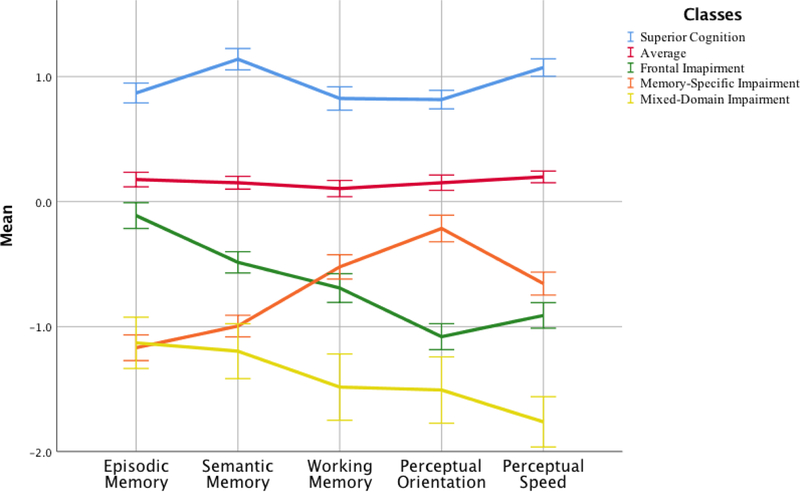
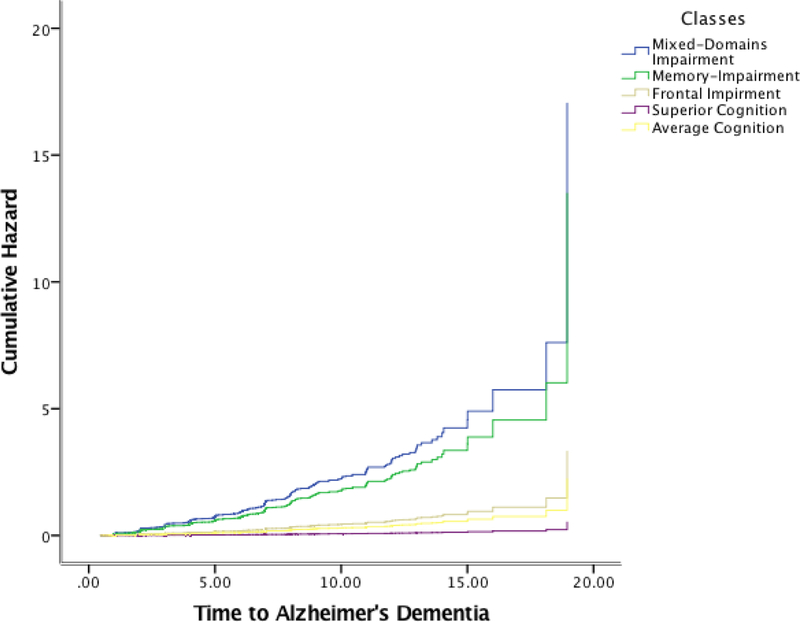
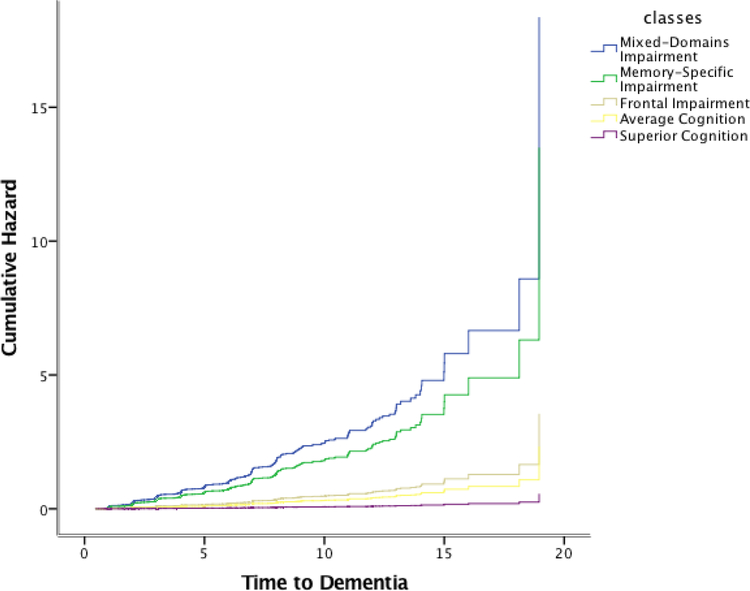
LCA resulted in a 5-class model: Mixed-Domain Impairment (n = 71, 4.3%), Memory-specific-Impairment (n = 274, 16.5%), Average (n = 767, 46.1%), Frontal Impairment (n = 222, 13.4%), and a class of Superior Cognition (n = 328, 19.7%). Similar to the EAS, the Mixed-Domain Impairment, the Memory-Specific Impairment, and the Frontal Impairment classes had higher risk of incident Alzheimer's disease when compared to the Average class. By contrast, the Superior Cognition had a lower risk of Alzheimer's disease when compared to the Average class.
Natural cognitive subgroups in MAP are similar to those identified in EAS. These similarities, despite study differences in geography, sampling strategy, and cognitive tests, suggest that LCA is capable of identifying classes that are not limited to a single sample or a set of cognitive tests.
在之前的报告中,我们使用潜在类别分析(LCA)根据神经心理学表现,将爱因斯坦老龄化研究(EAS)中的老年人分为自然亚组。这些亚组在人口统计学、遗传特征和预后方面存在差异。在此,我们评估这些发现对独立样本 Rush 记忆与老化项目(MAP)的泛化能力,该项目使用了重叠但不同的神经心理学测试组合。
我们的目的是根据 MAP 队列中神经心理学表现确定自然亚组与痴呆发病的关联,并将其与 EAS 中确定的关联进行比较。
MAP 是一个居住在伊利诺伊州东北部芝加哥地区的社区老年人队列。对 1662 名无痴呆 MAP 参与者的 10 项神经心理学测试的基线分数应用潜在类别模型。结果与之前 EAS 的发现进行了比较。
LCA 产生了一个 5 类模型:混合域损伤(n = 71,4.3%)、记忆特异性损伤(n = 274,16.5%)、平均(n = 767,46.1%)、额叶损伤(n = 222,13.4%)和认知卓越类(n = 328,19.7%)。与 EAS 相似,混合域损伤、记忆特异性损伤和额叶损伤亚组的阿尔茨海默病发病风险高于平均亚组。相比之下,认知卓越类的阿尔茨海默病发病风险低于平均亚组。
MAP 中的自然认知亚组与 EAS 中确定的亚组相似。尽管在地理位置、抽样策略和认知测试方面存在差异,但这些相似性表明 LCA 能够识别不仅限于单个样本或一组认知测试的类别。