
植物叶和茎来源的细胞外囊泡对小鼠黑色素瘤细胞和人类健康皮肤的抗黑色素生成作用
Anti-melanogenic effects of extracellular vesicles derived from plant leaves and stems in mouse melanoma cells and human healthy skin.
作者信息
Lee Ruri, Ko Hae Ju, Kim Kimin, Sohn Yehjoo, Min Seo Yun, Kim Jeong Ah, Na Dokyun, Yeon Ju Hun
机构信息
Department of Integrative Biosciences, University of Brain Education, Cheonan, Republic of Korea.
Biomedical Omics Group, Korea Basic Science Institute, Cheongju, Republic of Korea.
出版信息
J Extracell Vesicles. 2019 Dec 18;9(1):1703480. doi: 10.1080/20013078.2019.1703480. eCollection 2020.
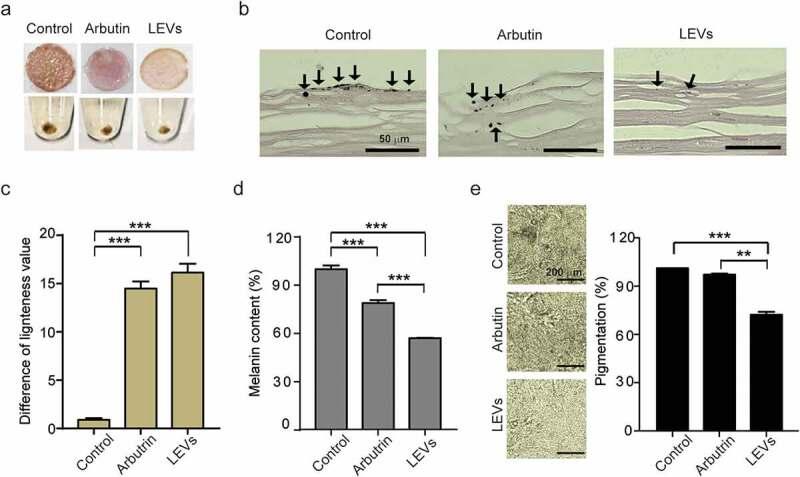
Consumer interest in cosmetic industry products that produce whitening effects has increased demand for agents that decrease melanin production. Many such anti-melanogenic agents are associated with side effects, such as contact dermatitis and high toxicity, and also exhibit poor skin penetration. Considerable recent research has focused on plant-derived products as alternatives to chemotherapeutic agents that possess fewer side effects. In the current study, we investigated the anti-melanogenic effects of extracellular vesicles (EVs) extracted from leaves and stems of . Using spectrophotometric and biochemical approaches, we found that leaf-derived extracellular vesicles (LEVs) and stem-derived extracellular vesicles (SEVs) reduced melanin content and tyrosinase (TYR) activity in the B16BL6 mouse melanoma cell line in a concentration-dependent manner. An electron microscopy analysis further confirmed that LEVs and SEVs induce a concentration-dependent decrease in melanin content in melanoma cells. Both LEVs and SEVs exerted a greater whitening effect on melanoma cells than arbutin, used as a positive control, with LEVs producing the greater effect. Notably, neither LEVs nor SEVs induced significant cytotoxicity. We also examined the effects of plant-derived EVs on the expression of tyrosinase-related proteins (TRPs) in melanoma cells. LEVs inhibited expression of melanogenesis-related genes and proteins, including microphthalmia-associated transcription factor (MITF), TYR, TRP-1 and TRP-2. In a human epidermis model, LEVs exerted a stronger inhibitory effect on melanin production than arbutin. Collectively, our data suggest that LEVs from may be a novel candidate natural substance for use as an anti-melanogenic agent in cosmeceutical formulations.
消费者对具有美白效果的化妆品行业产品的兴趣增加了对减少黑色素生成剂的需求。许多此类抗黑色素生成剂都伴有副作用,如接触性皮炎和高毒性,而且皮肤渗透性也很差。最近相当多的研究集中在植物衍生产品上,将其作为副作用较少的化学治疗剂的替代品。在本研究中,我们研究了从[植物名称]的叶子和茎中提取的细胞外囊泡(EVs)的抗黑色素生成作用。使用分光光度法和生化方法,我们发现叶源细胞外囊泡(LEVs)和茎源细胞外囊泡(SEVs)以浓度依赖的方式降低了B16BL6小鼠黑色素瘤细胞系中的黑色素含量和酪氨酸酶(TYR)活性。电子显微镜分析进一步证实,LEVs和SEVs可导致黑色素瘤细胞中黑色素含量呈浓度依赖性降低。与用作阳性对照的熊果苷相比,LEVs和SEVs对黑色素瘤细胞均具有更强的美白效果,其中LEVs的效果更佳。值得注意的是,LEVs和SEVs均未诱导明显的细胞毒性。我们还研究了植物衍生的EVs对黑色素瘤细胞中酪氨酸酶相关蛋白(TRPs)表达的影响。LEVs抑制了与黑色素生成相关的基因和蛋白的表达,包括小眼相关转录因子(MITF)、TYR、TRP-1和TRP-2。在人表皮模型中,LEVs对黑色素生成的抑制作用比熊果苷更强。总体而言,我们的数据表明,来自[植物名称]的LEVs可能是一种新型的天然物质,可作为化妆品配方中的抗黑色素生成剂。


 Zotero 插件