Nahrisah Putri, Somrongthong Ratana, Viriyautsahakul Napaphan, Viwattanakulvanid Pramon, Plianbangchang Samlee
College of Public Health Sciences, Chulalongkorn University, Pathumwan, Bangkok 10330, Thailand.
Health Office of Kota Langsa Municipality, Kota Langsa, Province of Aceh, Indonesia.
J Multidiscip Healthc. 2020 Jan 15;13:43-52. doi: 10.2147/JMDH.S213550. eCollection 2020.
To determine the effect of individual education through a pictorial handbook on anemia in conjunction with counseling on improving hemoglobin and hematocrit level, birth weight, knowledge, iron-rich food and iron-folic acid (IFA) intake.
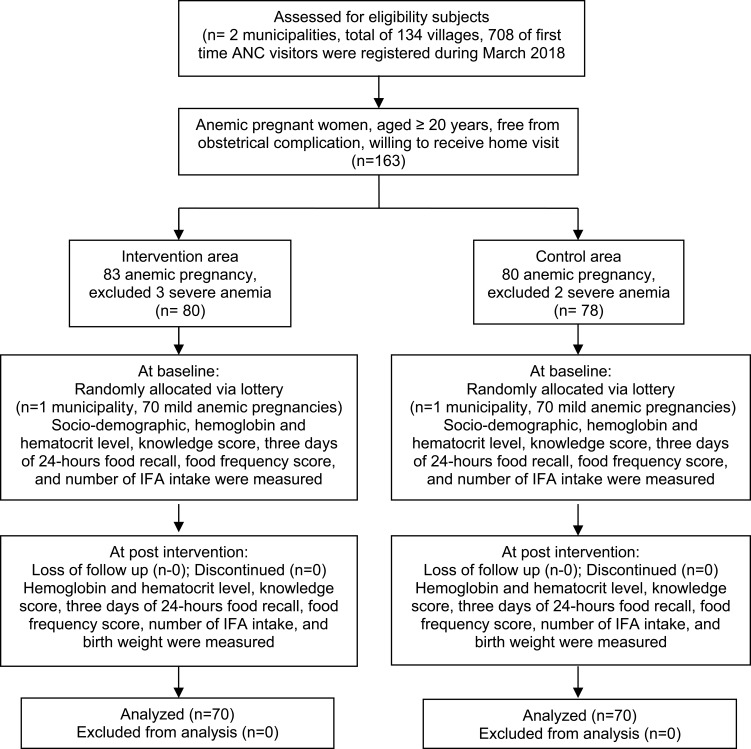
The study developed a pictorial handbook that was conceptualized based on the Health Belief Model and adjusted to some cultural and local contexts. A quasi-experimental pre-test-post-test control group design was used, purposefully conducted between two homogenous municipalities, each having a rate of anemic pregnancy that was 40% or greater. The sample consists of 140 anemic pregnant women randomly allocated via lottery into two groups; the intervention group (n=70), which received two home visits-one for education and another for a counseling session, and control group (n=70), which received routine antenatal care. A chi-square test and a Mann-Whitney -test were conducted to compare the baseline socio-demographics. An analysis of covariance (ANCOVA), controlling some possible confounders, was performed to analyze the effect of intervention.
The post-test means of hemoglobin F (1, 132) = 122, p-value <0.001, and hematocrit levels F (1, 132) = 373, p-value <0.001, were significantly different and higher in the intervention group compared to the control group. Similar results were found in knowledge, food frequency score, number of IFA intake (with p-value <0.001), birth weight and daily iron intake from food (with p-value <0.05). The intervention had a particularly large effect on food frequency score and number of IFA intake, and medium effect on hemoglobin and hematocrit levels.
Individual education through a pictorial handbook on anemia in conjunction with the counseling intervention program had a positive impact on hemoglobin and hematocrit levels for anemic pregnant women in their third trimester of pregnancy.
确定通过一本图文手册进行的个体化教育对贫血的影响,并结合咨询服务来提高血红蛋白和血细胞比容水平、出生体重、知识水平、富含铁食物的摄入量以及铁叶酸(IFA)的摄入量。
本研究编写了一本图文手册,该手册基于健康信念模型进行构思,并根据一些文化和当地情况进行了调整。采用了准实验性的前测-后测对照组设计,特意在两个同质的城市进行,每个城市的贫血妊娠率均为40%或更高。样本包括140名贫血孕妇,通过抽签随机分为两组;干预组(n = 70),接受两次家访——一次用于教育,另一次用于咨询,对照组(n = 70),接受常规产前护理。进行卡方检验和曼-惠特尼检验以比较基线社会人口统计学特征。进行协方差分析(ANCOVA),控制一些可能的混杂因素,以分析干预的效果。
干预组的血红蛋白F(1, 132)= 122,p值<0.001,血细胞比容水平F(1, 132)= 373,p值<0.001,后测均值与对照组相比有显著差异且更高。在知识、食物频率得分、IFA摄入量(p值<0.001)、出生体重和食物中铁的每日摄入量(p值<0.05)方面也发现了类似结果。干预对食物频率得分和IFA摄入量有特别大的影响,对血红蛋白和血细胞比容水平有中等影响。
通过一本关于贫血的图文手册进行个体化教育,并结合咨询干预项目,对妊娠晚期贫血孕妇的血红蛋白和血细胞比容水平产生了积极影响。