Ha Jihyun, Lee Seung Won, Yon Dong Keon
Department of Pediatrics, CHA Bundang Medical Center, CHA University School of Medicine, Seongnam, Korea.
Department of Data Science, Sejong University College of Software Convergence, Seoul, Korea.
Clin Exp Pediatr. 2020 Jul;63(7):278-283. doi: 10.3345/cep.2019.01291. Epub 2020 Jan 29.
Major questions remain regarding the age-stratified trends of allergic diseases and asthma in Korea.
To identify the estimated recent prevalence and 10- year trends in asthma, allergic rhinitis, and atopic dermatitis among the Korean population from 2008 to 2017.
This nationwide cross-sectional survey (Korean National Health and Nutrition Examination Survey) over 10 years (2008-2017) examined representative samples of the Korean population (n=85,006) including 2,131 infants, 4,352 preschool children, 12,919 school-age children, 44,200 adults, and 21,404 elderly adults.
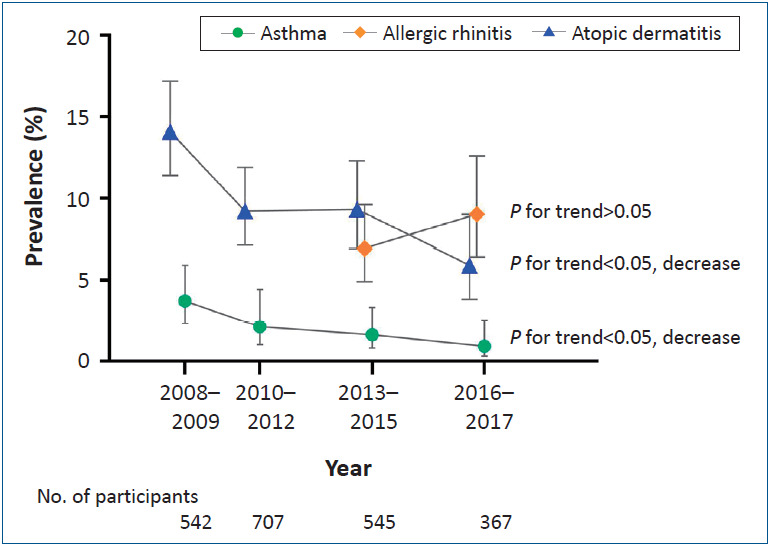
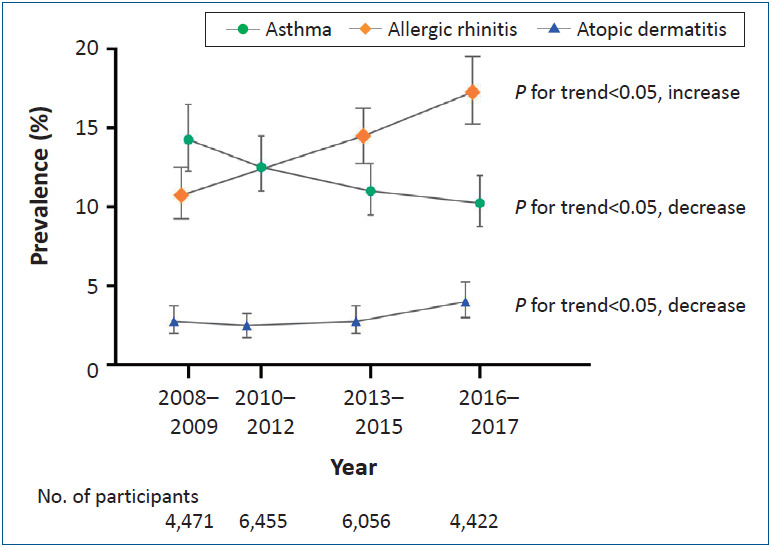
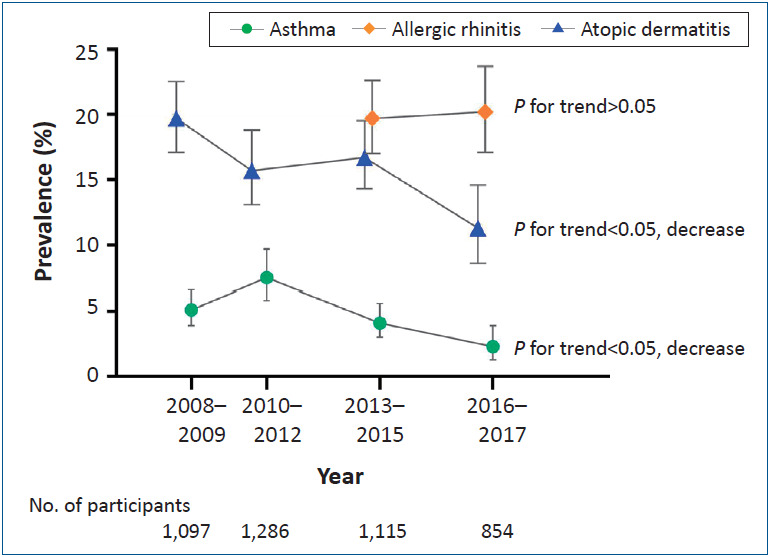
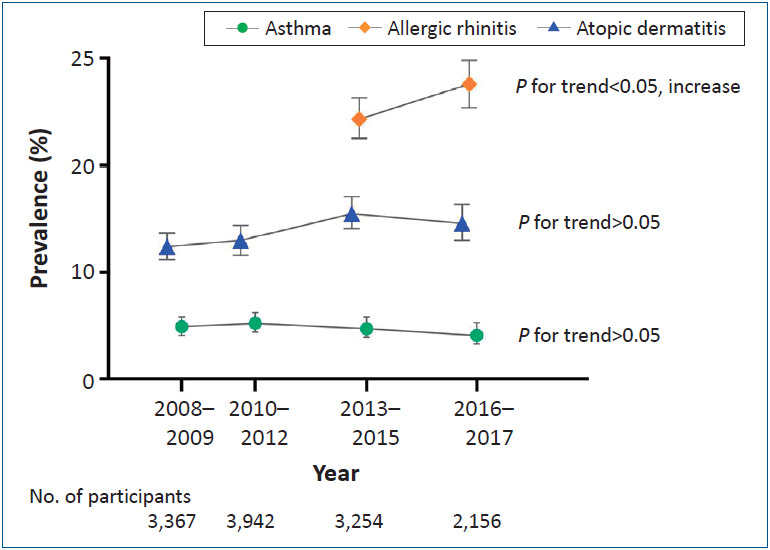
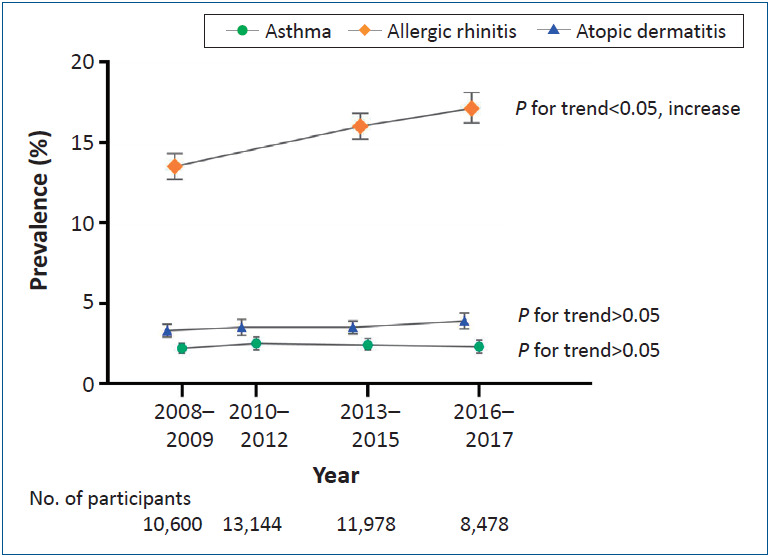
In the 2016 to 2017 population, the estimated prevalence of asthma was 0.9% in infants, 2.3% in preschool children, 4.1% in school-age children, 2.3% in adults, and 4.1% in the elderly. The estimated prevalence of allergic rhinitis was 9.0%, 20.2%, 27.6%, 17.1%, and 6.9%, respectively. The estimated prevalence of atopic dermatitis was 5.9%, 11.3%, 14.6%, 3.9%, and 1.6%, respectively. Ten-year trends revealed a significant decrease in asthma prevalence in infants, preschool children, and the elderly. and in atopic dermatitis prevalence in infants and preschool children (P<0.05 for all trends). Furthermore, 10-year trends demonstrated a significant increase in allergic rhinitis prevalence in school-age children, adults, and the elderly, and in atopic dermatitis prevalence in school-age children and the elderly (P<0.05 for all trends).
These results improve our understanding of the age-stratified epidemiology of allergic diseases in Korea and suggest the need for the development of tailored and precise strategies to prevent allergic diseases in different age groups.
韩国过敏性疾病和哮喘的年龄分层趋势仍存在重大问题。
确定2008年至2017年韩国人群中哮喘、过敏性鼻炎和特应性皮炎的近期估计患病率及10年趋势。
这项为期10年(2008 - 2017年)的全国性横断面调查(韩国国民健康与营养检查调查)对韩国人群的代表性样本(n = 85,006)进行了检查,包括2131名婴儿、4352名学龄前儿童、12919名学龄儿童、44200名成年人和21404名老年人。
在2016年至2017年的人群中,估计哮喘患病率在婴儿中为0.9%,学龄前儿童中为2.3%,学龄儿童中为4.1%,成年人中为2.3%,老年人中为4.1%。过敏性鼻炎的估计患病率分别为9.0%、20.2%、27.6%、17.1%和6.9%。特应性皮炎的估计患病率分别为5.9%、11.3%、14.6%、3.9%和1.6%。10年趋势显示婴儿、学龄前儿童和老年人的哮喘患病率显著下降,婴儿和学龄前儿童的特应性皮炎患病率也显著下降(所有趋势P<0.05)。此外,10年趋势表明学龄儿童、成年人和老年人的过敏性鼻炎患病率显著上升,学龄儿童和老年人的特应性皮炎患病率也显著上升(所有趋势P<0.05)。
这些结果增进了我们对韩国过敏性疾病年龄分层流行病学的理解,并表明需要制定针对性强且精确的策略来预防不同年龄组的过敏性疾病。