Center of Excellence in Genomics and Systems Biology, International Crops Research Institute for the Semi-Arid Tropics (ICRISAT), Patancheru, India.
Centre for Plant Molecular Biology and Biotechnology, Tamil Nadu Agricultural University (TNAU), Coimbatore, India.
Theor Appl Genet. 2020 May;133(5):1791-1810. doi: 10.1007/s00122-020-03560-w. Epub 2020 Feb 10.
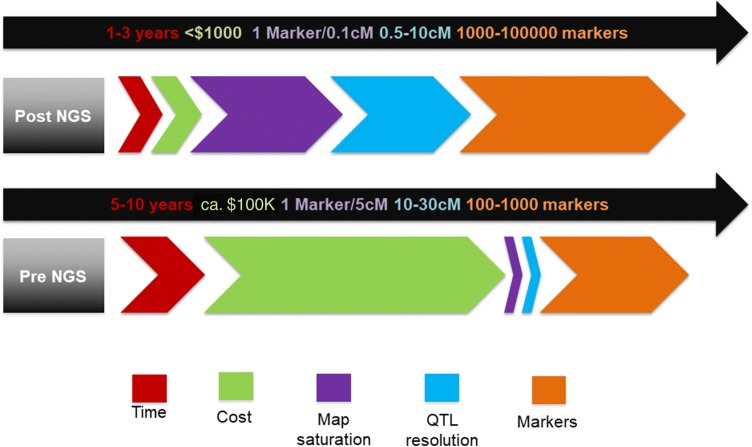
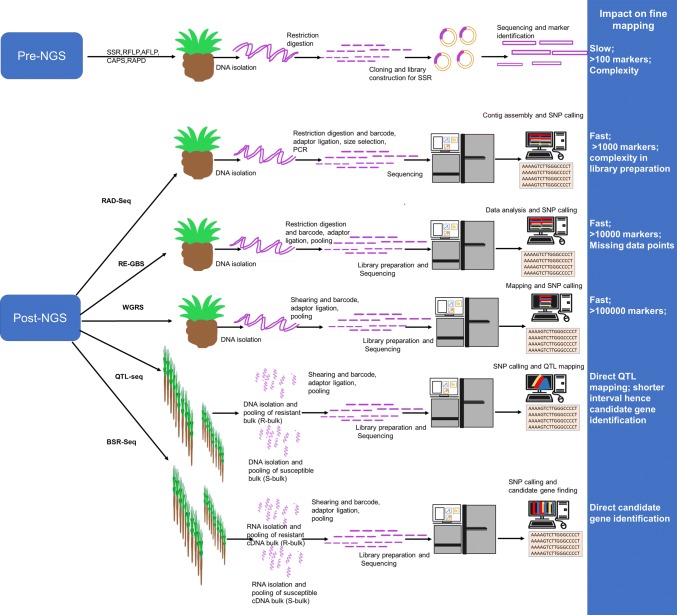
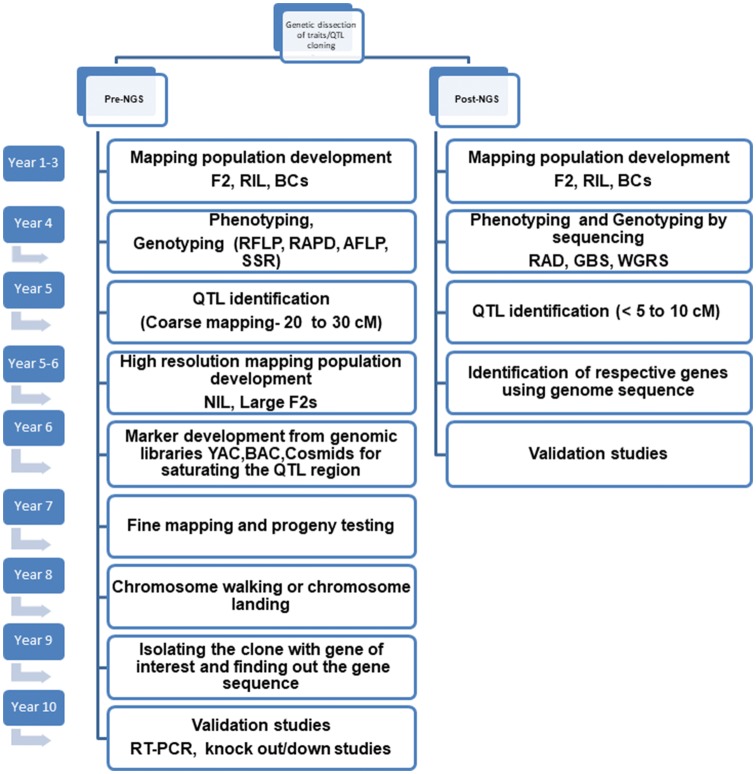
Improvement in traits of agronomic importance is the top breeding priority of crop improvement programs. Majority of these agronomic traits show complex quantitative inheritance. Identification of quantitative trait loci (QTLs) followed by fine mapping QTLs and cloning of candidate genes/QTLs is central to trait analysis. Advances in genomic technologies revolutionized our understanding of genetics of complex traits, and genomic regions associated with traits were employed in marker-assisted breeding or cloning of QTLs/genes. Next-generation sequencing (NGS) technologies have enabled genome-wide methodologies for the development of ultra-high-density genetic linkage maps in different crops, thus allowing placement of candidate loci within few kbs in genomes. In this review, we compare the marker systems used for fine mapping and QTL cloning in the pre- and post-NGS era. We then discuss how different NGS platforms in combination with advanced experimental designs have improved trait analysis and fine mapping. We opine that efficient genotyping/sequencing assays may circumvent the need for cumbersome procedures that were earlier used for fine mapping. A deeper understanding of the trait architectures of agricultural significance will be crucial to accelerate crop improvement.
提高农业重要性状是作物改良计划的首要育种目标。大多数这些农业性状表现为复杂的数量遗传。鉴定数量性状位点(QTL),然后精细定位 QTL 并克隆候选基因/QTL,是性状分析的核心。基因组技术的进步彻底改变了我们对复杂性状遗传的理解,与性状相关的基因组区域被用于标记辅助育种或 QTL/基因的克隆。下一代测序(NGS)技术使不同作物的全基因组方法能够开发超高密度遗传连锁图谱,从而能够在基因组内将候选基因定位在少数千碱基内。在这篇综述中,我们比较了在 NGS 前后时代用于精细定位和 QTL 克隆的标记系统。然后,我们讨论了不同的 NGS 平台如何与先进的实验设计相结合,以提高性状分析和精细定位。我们认为,高效的基因分型/测序分析可能会避免以前用于精细定位的繁琐程序的需要。深入了解具有农业重要意义的性状结构对于加速作物改良至关重要。