Sun Yat-sen University Cancer Center, State Key Laboratory of Oncology in South China, Collaborative Innovation Center for Cancer Medicine, Guangzhou, People's Republic of China.
Department of Molecular Diagnostics, Sun Yat-Sen University Cancer Center, Guangzhou, People's Republic of China.
Oncologist. 2020 Feb;25(2):e291-e301. doi: 10.1634/theoncologist.2019-0148. Epub 2019 Oct 2.
Primary vaginal melanomas are uncommon and aggressive tumors with poor prognosis, and the development of new targeted therapies is essential. This study aimed to identify the molecular markers occurring in these patients and potentially improve treatment strategies.
The clinicopathological characteristics of 36 patients with primary vaginal melanomas were reviewed. Oncogenic mutations in BRAF, KIT, NRAS, GNAQ and GNA11 and the promoter region of telomerase reverse transcriptase (TERT) were investigated using the Sanger sequencing. The expression and copy number of programmed death-ligand 1 (PD-L1) were also assessed.
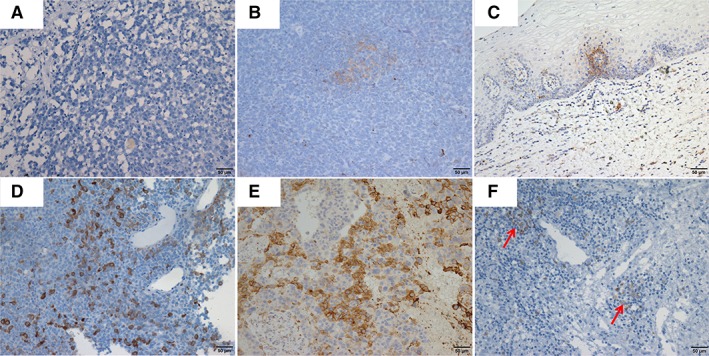
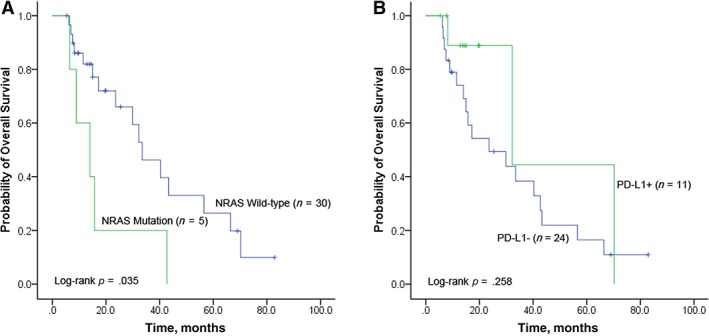
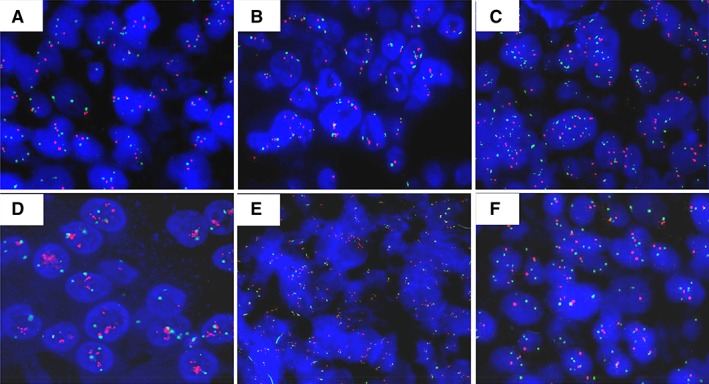
Mutations in NRAS, KIT, and TERT promoter were identified in 13.9% (5/36), 2.9% (1/34), and 5.6% (2/36) of the primary vaginal melanomas, respectively. PD-L1 expression and amplification were observed in 27.8% (10/36) and 5.6% (2/36) of cases, respectively. PD-L1 positive expression and/or amplification was associated with older patients (p = .008). Patients who had NRAS mutations had a poorer overall survival compared with those with a wild-type NRAS (33.5 vs. 14.0 months; hazard ratio [HR], 3.09; 95% CI, 1.08-8.83). Strikingly, two patients with/without PD-L1 expression receiving immune checkpoint inhibitors had a satisfying outcome. Multivariate analysis demonstrated that >10 mitoses per mm (HR, 2.96; 95% CI, 1.03-8.51) was an independent prognostic factor.
NRAS mutations and PD-L1 expression were most prevalent in our cohort of primary vaginal melanomas and can be potentially considered as therapeutic targets.
This study used the Sanger sequencing, immunohistochemistry, and fluorescence in situ hybridization methods to detect common genetic mutations and PD-L1 expression and copy number in 36 primary vaginal melanomas. NRAS mutations and PD-L1 expression were the most prevalent, but KIT and TERT mutations occurred at a lower occurrence in this rare malignancy. Two patients receiving immune checkpoint inhibitors had a satisfying outcome, signifying that the PD-L1 expression and amplification can be a possible predictive marker of clinical response. This study highlights the possible prospects of biomarkers that can be used for patient selection in clinical trials involving treatments with novel targeted therapies based on these molecular aberrations.
原发性阴道黑色素瘤是一种罕见且侵袭性强、预后不良的肿瘤,开发新的靶向治疗方法至关重要。本研究旨在确定这些患者中发生的分子标志物,并有可能改善治疗策略。
回顾了 36 例原发性阴道黑色素瘤患者的临床病理特征。使用 Sanger 测序法检测 BRAF、KIT、NRAS、GNAQ 和 GNA11 的致癌突变以及端粒酶逆转录酶(TERT)启动子区域。还评估了程序性死亡配体 1(PD-L1)的表达和拷贝数。
原发性阴道黑色素瘤中分别有 13.9%(5/36)、2.9%(1/34)和 5.6%(2/36)发生 NRAS、KIT 和 TERT 启动子突变。分别有 27.8%(10/36)和 5.6%(2/36)的病例出现 PD-L1 表达和扩增。PD-L1 阳性表达和/或扩增与老年患者相关(p=0.008)。与野生型 NRAS 相比,NRAS 突变患者的总生存期更差(33.5 个月 vs. 14.0 个月;风险比[HR],3.09;95%置信区间,1.08-8.83)。值得注意的是,两名接受免疫检查点抑制剂治疗的 PD-L1 表达/无表达患者的治疗结果令人满意。多变量分析表明,每平方毫米>10 个有丝分裂(HR,2.96;95%置信区间,1.03-8.51)是独立的预后因素。
在我们的原发性阴道黑色素瘤队列中,NRAS 突变和 PD-L1 表达最为常见,可能被视为潜在的治疗靶点。
本研究使用 Sanger 测序、免疫组织化学和荧光原位杂交方法检测了 36 例原发性阴道黑色素瘤中的常见基因突变和 PD-L1 表达和拷贝数。NRAS 突变和 PD-L1 表达最为常见,但在这种罕见的恶性肿瘤中,KIT 和 TERT 突变的发生率较低。两名接受免疫检查点抑制剂治疗的患者的治疗结果令人满意,这表明 PD-L1 表达和扩增可能是临床反应的一个可能预测标志物。本研究强调了基于这些分子异常,在涉及新型靶向治疗的临床试验中,可能可以使用生物标志物来选择患者。