Yang Lei, Fan Xiaoguang, Zhang Jing, Ju Jia
College of Chemistry, Chemical Engineering and Environmental Engineering, Liaoning Shihua University, Fushun 113001, China.
College of Engineering, Shenyang Agricultural University, Shenyang 110866, China.
Polymers (Basel). 2020 Feb 9;12(2):389. doi: 10.3390/polym12020389.
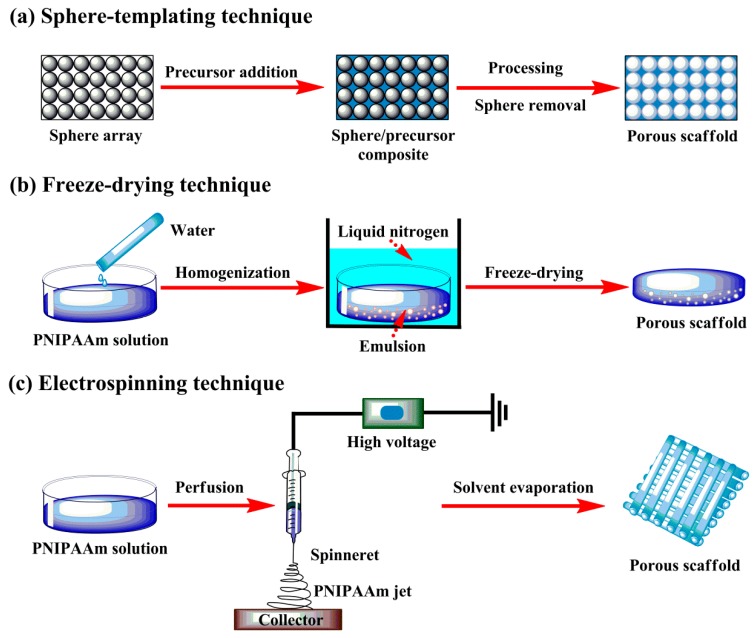
Poly(-isopropylacrylamide) (PNIPAAm) is a typical thermoresponsive polymer used widely and studied deeply in smart materials, which is attractive and valuable owing to its reversible and remote "on-off" behavior adjusted by temperature variation. PNIPAAm usually exhibits opposite solubility or wettability across lower critical solution temperature (LCST), and it is readily functionalized making it available in extensive applications. Cell culture is one of the most prospective and representative applications. Active attachment and spontaneous detachment of targeted cells are easily tunable by surface wettability changes and volume phase transitions of PNIPAAm modified substrates with respect to ambient temperature. The thermoresponsive culture platforms and matching thermal-liftoff method can effectively substitute for the traditional cell harvesting ways like enzymatic hydrolysis and mechanical scraping, and will improve the stable and high quality of recovered cells. Therefore, the establishment and detection on PNIPAAm based culture systems are of particular importance. This review covers the important developments and recommendations for future work of the preparation and characterization of temperature-responsive substrates based on PNIPAAm and analogues for cell culture applications.
聚(N-异丙基丙烯酰胺)(PNIPAAm)是一种典型的热响应性聚合物,在智能材料领域得到广泛应用和深入研究。由于其能通过温度变化实现可逆的远程“开-关”行为,因而具有吸引力和价值。PNIPAAm通常在低临界溶液温度(LCST)两侧表现出相反的溶解性或润湿性,并且易于功能化,使其可用于广泛的应用。细胞培养是最具前景和代表性的应用之一。通过PNIPAAm修饰的底物相对于环境温度的表面润湿性变化和体积相变,可以轻松调节靶向细胞的主动附着和自发脱离。热响应性培养平台和配套的热剥离方法可以有效替代传统的细胞收获方式,如酶解和机械刮擦,并提高回收细胞的稳定性和质量。因此,基于PNIPAAm的培养系统的建立和检测尤为重要。本综述涵盖了基于PNIPAAm及其类似物制备用于细胞培养应用的温度响应性底物的重要进展以及对未来工作的建议。