Department of Horticulture, Foshan University, Foshan, 528000, China.
CAS Key Laboratory of Tropical Plant Resources and Sustainable Use, Xishuangbanna Tropical Botanical Garden, Chinese Academy of Sciences, Mengla, 666303, China.
BMC Plant Biol. 2020 Feb 12;20(1):70. doi: 10.1186/s12870-020-2279-8.
Chenopodium quinoa Willd., a halophytic crop, shows great variability among different genotypes in response to salt. To investigate the salinity tolerance mechanisms, five contrasting quinoa cultivars belonging to highland ecotype were compared for their seed germination (under 0, 100 and 400 mM NaCl) and seedling's responses under five salinity levels (0, 100, 200, 300 and 400 mM NaCl).
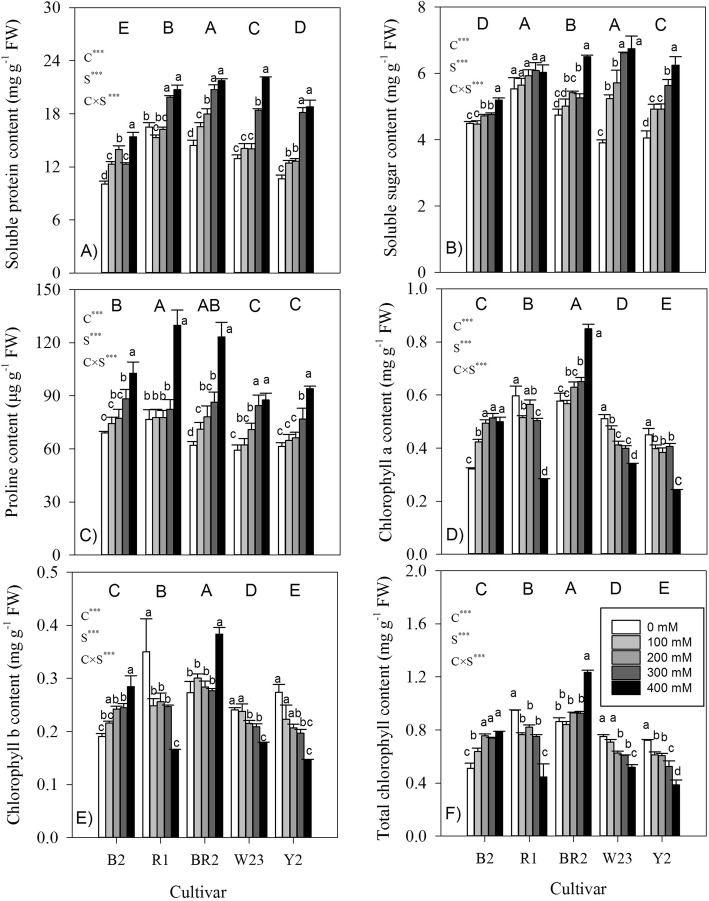
Substantial variations were found in plant size (biomass) and overall salinity tolerance (plant biomass in salt treatment as % of control) among the different quinoa cultivars. Plant salinity tolerance was negatively associated with plant size, especially at lower salinity levels (< 300 mM NaCl), but salt tolerance between seed germination and seedling growth was not closely correlated. Except for shoot/root ratio, all measured plant traits responded to salt in a genotype-specific way. Salt stress resulted in decreased plant height, leaf area, root length, and root/shoot ratio in each cultivar. With increasing salinity levels, leaf superoxide dismutase (SOD) activity and lipid peroxidation generally increased, but catalase (CAT) and peroxidase (POD) activities showed non-linear patterns. Organic solutes (soluble sugar, proline and protein) accumulated in leaves, whereas inorganic ion (Na and K) increased but K/Na decreased in both leaves and roots. Across different salinity levels and cultivars, without close relationships with antioxidant enzyme activities (SOD, POD, or CAT), salinity tolerance was significantly negatively correlated with organic solute and malondialdehyde contents in leaves and inorganic ion contents in leaves or roots (except for root K content), but positively correlated with K/Na ratio in leaves or roots.
Our results indicate that leaf osmoregulation, K retention, Na exclusion, and ion homeostasis are the main physiological mechanisms conferring salinity tolerance of these cultivars, rather than the regulations of leaf antioxidative ability. As an index of salinity tolerance, K/Na ratio in leaves or roots can be used for the selective breeding of highland quinoa cultivars.
藜麦(Chenopodium quinoa Willd.)是一种盐生作物,不同基因型对盐的反应存在很大差异。为了研究耐盐机制,比较了属于高地生态型的五个不同藜麦品种在 0、100 和 400 mM NaCl 下的种子萌发和五个盐度水平(0、100、200、300 和 400 mM NaCl)下幼苗的反应。
不同藜麦品种之间的植株大小(生物量)和整体耐盐性(盐处理下的植株生物量与对照相比的百分比)存在显著差异。植物耐盐性与植株大小呈负相关,特别是在较低的盐度水平(<300 mM NaCl)下,但种子萌发和幼苗生长之间的耐盐性相关性不大。除了根冠比外,所有测量的植物性状都以基因型特异性的方式对盐做出反应。盐胁迫导致每个品种的株高、叶面积、根长和根冠比降低。随着盐度水平的升高,叶片中超氧化物歧化酶(SOD)活性和脂质过氧化通常增加,但过氧化氢酶(CAT)和过氧化物酶(POD)活性呈非线性模式。有机溶质(可溶性糖、脯氨酸和蛋白质)在叶片中积累,而无机离子(Na 和 K)在叶片和根部增加,但 K/Na 降低。在不同的盐度水平和品种中,与抗氧化酶活性(SOD、POD 或 CAT)没有密切关系,耐盐性与叶片中有机溶质和丙二醛含量以及叶片或根部无机离子含量(根 K 含量除外)呈显著负相关,但与叶片或根部的 K/Na 比值呈正相关。
我们的结果表明,叶片渗透调节、K 保留、Na 排斥和离子稳态是赋予这些品种耐盐性的主要生理机制,而不是叶片抗氧化能力的调节。作为耐盐性的指标,叶片或根部的 K/Na 比值可用于高地藜麦品种的选择性育种。