Institute of Higher Education and Research in Healthcare, University of Lausanne and Lausanne University Hospital, Lausanne, Switzerland.
Palliative and Supportive Care Service, Lausanne University Hospital and University of Lausanne, Lausanne, Switzerland.
BMC Palliat Care. 2020 Feb 12;19(1):19. doi: 10.1186/s12904-020-0522-6.
Early identification of patients requiring palliative care is a major public health concern. A growing number of instruments exist to help professionals to identify these patients, however, thus far, none have been thoroughly assessed for criterion validity. In addition, no currently available instruments differentiate between patients in need of general vs. specialised palliative care, and most are primarily intended for use by physicians. This study aims to develop and rigorously validate a new interprofessional instrument allowing identification of patients in need of general vs specialised palliative care.
The instrument development involved four steps: i) literature review to determine the concept to measure; ii) generation of a set of items; iii) review of the initial set of items by experts to establish the content validity; iv) administration of the items to a sample of the target population to establish face validity. We conducted a Delphi process with experts in palliative care to accomplish step 3 and sent a questionnaire to nurses and physicians non-specialised in palliative care to complete step 4. The study was conducted in the French and Italian-speaking regions of Switzerland. An interdisciplinary committee of clinical experts supervised all steps.
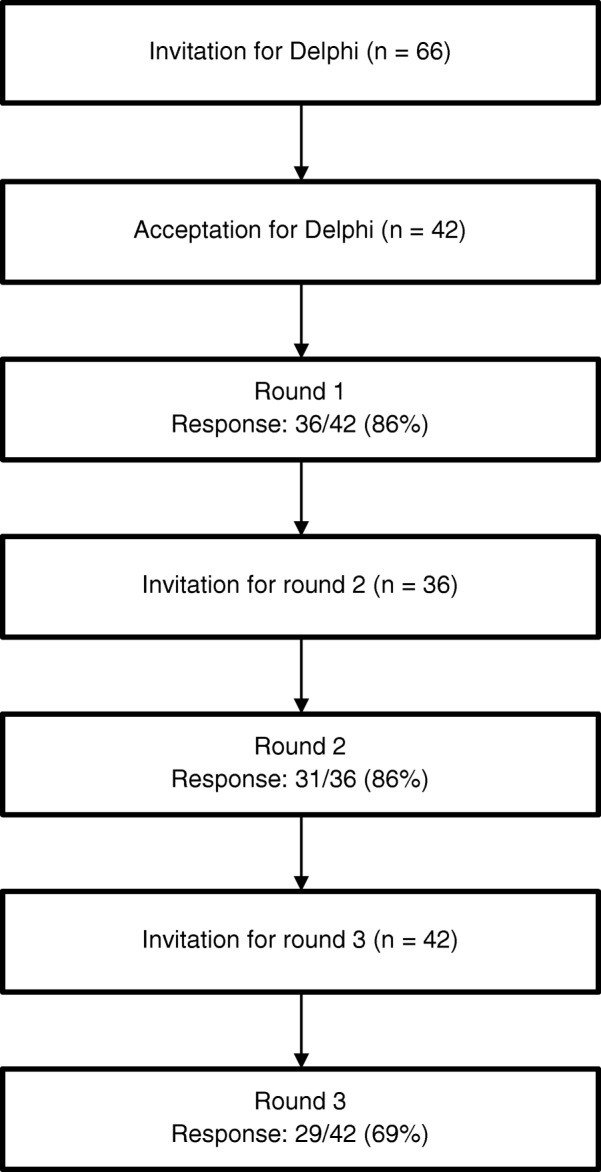
The literature review confirmed the necessity of distinguishing between general and specialised palliative care needs and of adapting clinical recommendations to these different needs. Thirty-six nurses and physicians participated in the Delphi process and 28 were involved in the face validity assessment. The Delphi process resulted in two lists: a 7-item list to identify patients in need of general PC and an 8-item list to identify specialised PC needs. The content and face validity were deemed to be acceptable by both the expert and target populations.
This instrument makes a significant contribution to the identification of patients with palliative care needs as it has been designed to differentiate between general and specialised palliative care needs. Moreover, diagnostic data is not fundamental to the use of the instrument, thus facilitating its use by healthcare professionals other than physicians, in particular nurses. Internal and criterion validity assessments are ongoing and essential before wider dissemination of the instrument.
早期识别需要姑息治疗的患者是一个主要的公共卫生关注点。有越来越多的工具可以帮助专业人员识别这些患者,但到目前为止,还没有一个工具经过严格的标准效度评估。此外,目前没有可用的工具可以区分需要一般姑息治疗和专门姑息治疗的患者,而且大多数工具主要供医生使用。本研究旨在开发和严格验证一种新的跨专业工具,以识别需要一般和专门姑息治疗的患者。
该工具的开发包括四个步骤:i)文献综述,以确定要测量的概念;ii)生成一组项目;iii)专家对初始项目集进行审查,以确定内容效度;iv)向目标人群样本发放项目,以确定表面效度。我们与姑息治疗专家进行了德尔菲法过程,以完成步骤 3,并向非姑息治疗专业的护士和医生发送了一份问卷,以完成步骤 4。该研究在瑞士的法语和意大利语区进行。一个跨学科的临床专家委员会监督了所有步骤。
文献综述证实了区分一般和专门姑息治疗需求以及根据这些不同需求调整临床建议的必要性。36 名护士和医生参加了德尔菲法过程,28 人参与了表面效度评估。德尔菲法产生了两个清单:一个 7 项清单,用于识别需要一般姑息治疗的患者;另一个 8 项清单,用于识别专门姑息治疗的需求。内容和表面效度均被专家和目标人群认为是可以接受的。
该工具在识别有姑息治疗需求的患者方面做出了重要贡献,因为它旨在区分一般和专门姑息治疗需求。此外,该工具的使用不需要诊断数据,从而便于除医生以外的医疗保健专业人员,特别是护士使用。正在进行内部和标准效度评估,在广泛传播该工具之前,这些评估至关重要。