Smith Abraham George, Petersen Jens, Selvan Raghavendra, Rasmussen Camilla Ruø
1Department of Plant and Environmental Sciences, University of Copenhagen, Højbakkegaard Allé 13, 2630 Taastrup, Denmark.
2Department of Computer Science, University of Copenhagen, Universitetsparken 1, 2100 Copenhagen Ø, Denmark.
Plant Methods. 2020 Feb 8;16:13. doi: 10.1186/s13007-020-0563-0. eCollection 2020.
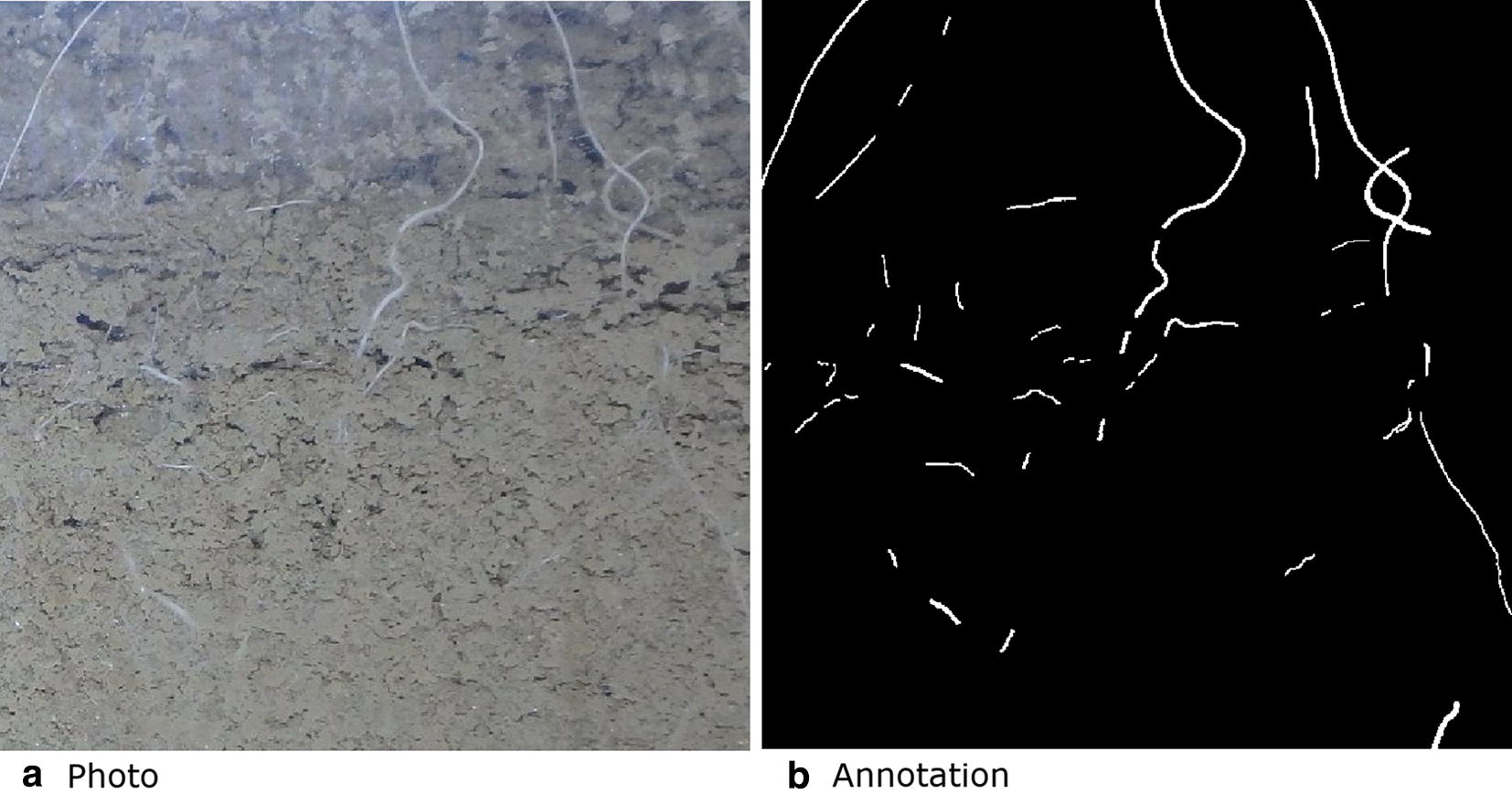
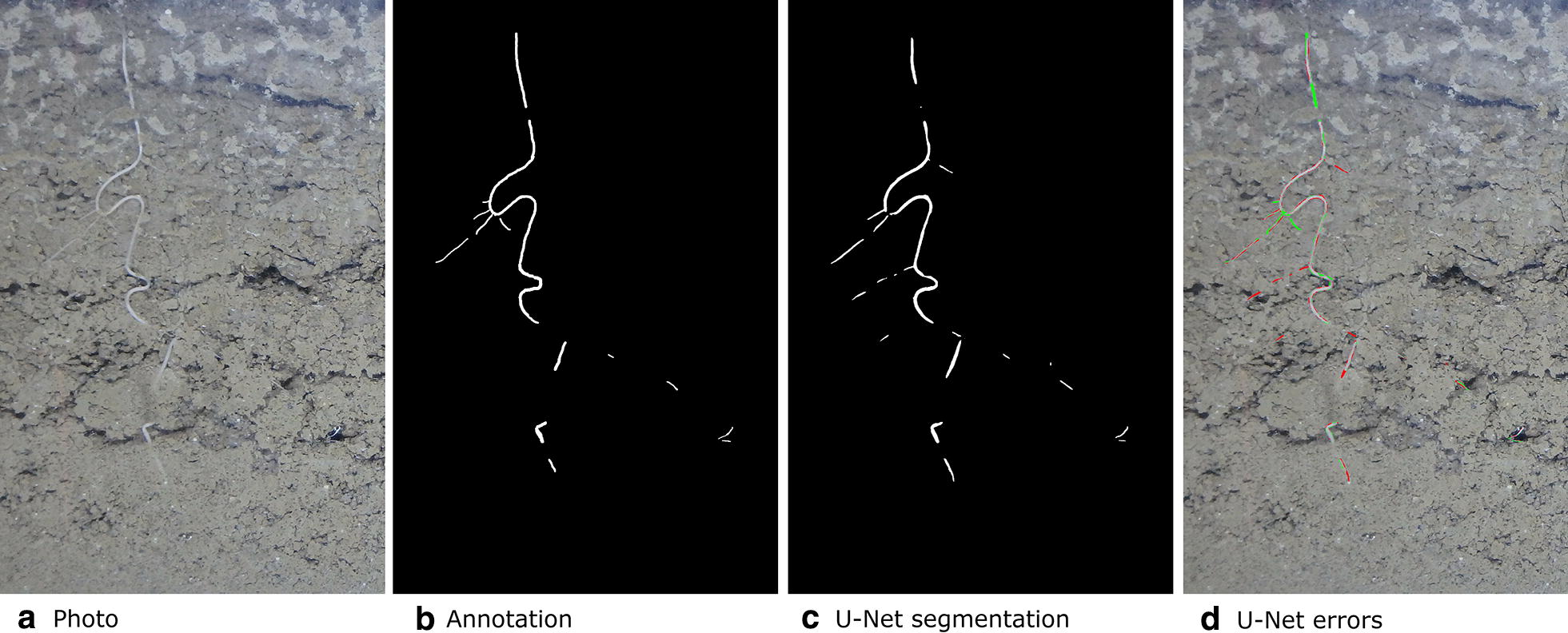
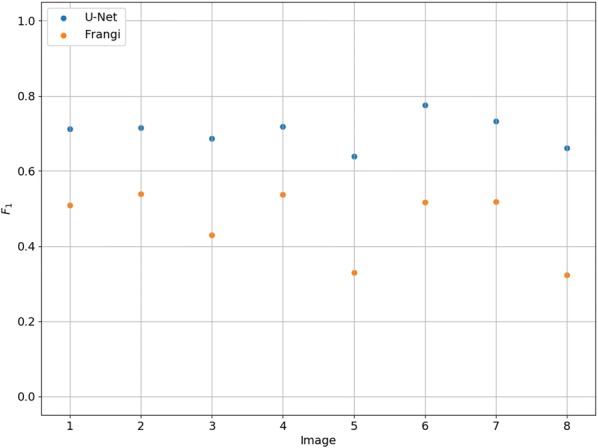
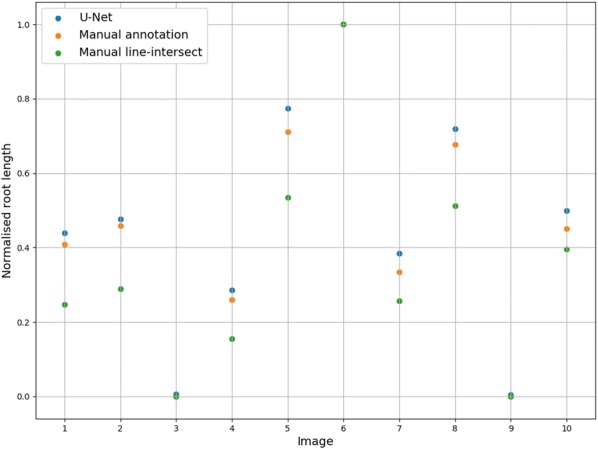
Plant root research can provide a way to attain stress-tolerant crops that produce greater yield in a diverse array of conditions. Phenotyping roots in soil is often challenging due to the roots being difficult to access and the use of time consuming manual methods. Rhizotrons allow visual inspection of root growth through transparent surfaces. Agronomists currently manually label photographs of roots obtained from rhizotrons using a line-intersect method to obtain root length density and rooting depth measurements which are essential for their experiments. We investigate the effectiveness of an automated image segmentation method based on the U-Net Convolutional Neural Network (CNN) architecture to enable such measurements. We design a data-set of 50 annotated chicory ( L.) root images which we use to train, validate and test the system and compare against a baseline built using the Frangi vesselness filter. We obtain metrics using manual annotations and line-intersect counts.
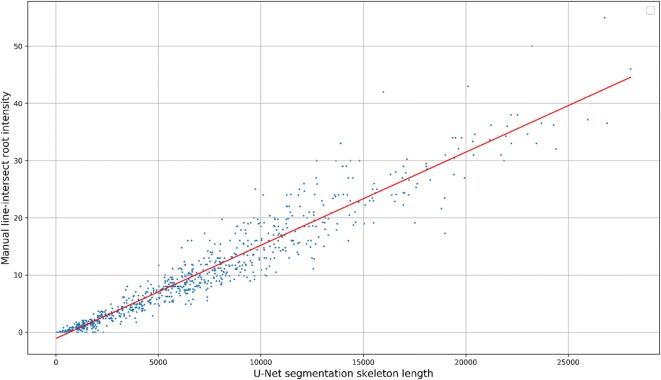
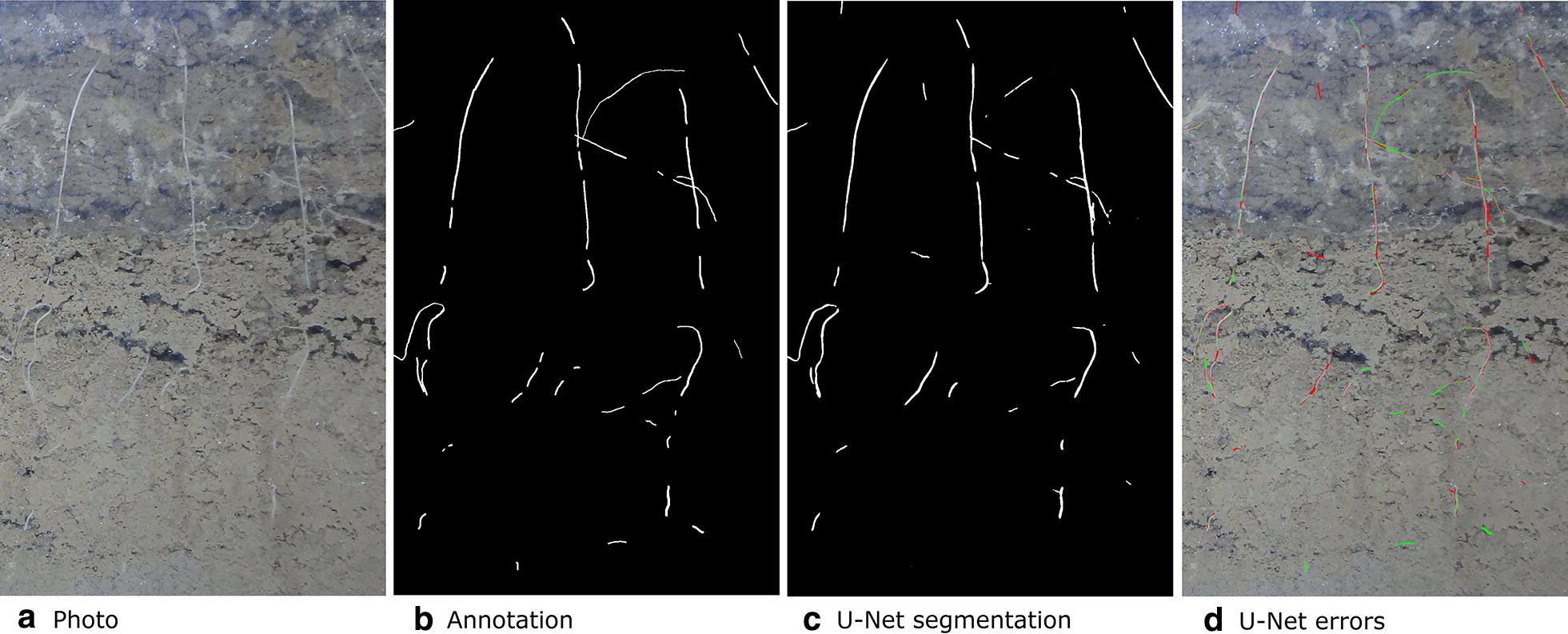
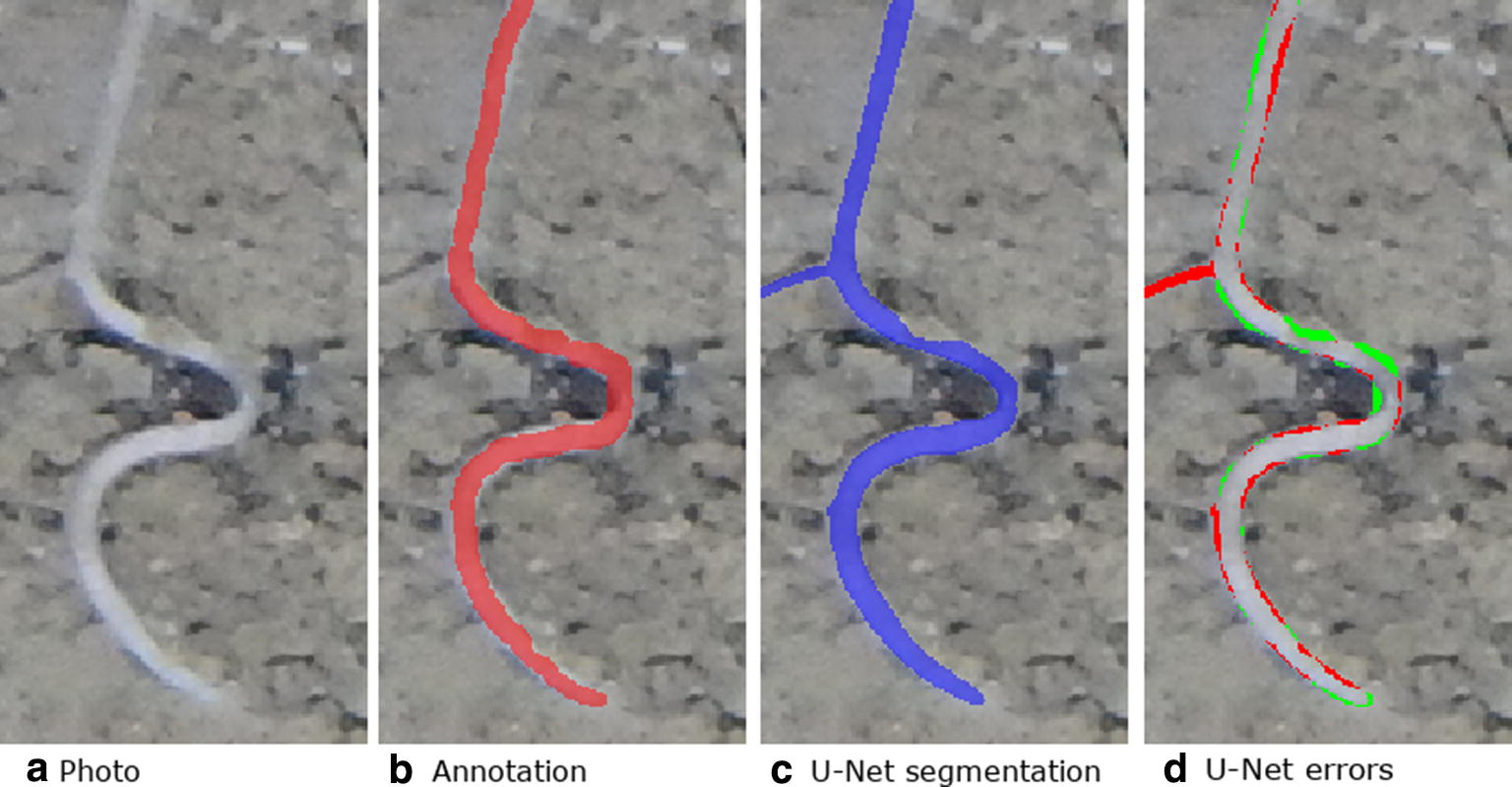
Our results on the held out data show our proposed automated segmentation system to be a viable solution for detecting and quantifying roots. We evaluate our system using 867 images for which we have obtained line-intersect counts, attaining a Spearman rank correlation of 0.9748 and an of 0.9217. We also achieve an of 0.7 when comparing the automated segmentation to the manual annotations, with our automated segmentation system producing segmentations with higher quality than the manual annotations for large portions of the image.
We have demonstrated the feasibility of a U-Net based CNN system for segmenting images of roots in soil and for replacing the manual line-intersect method. The success of our approach is also a demonstration of the feasibility of deep learning in practice for small research groups needing to create their own custom labelled dataset from scratch.
植物根系研究可为培育在多种条件下产量更高的耐逆作物提供途径。由于根系难以触及且使用耗时的人工方法,对土壤中的根系进行表型分析往往具有挑战性。根箱可通过透明表面直观观察根系生长。农学家目前使用线交法对手从根箱获取的根系照片进行人工标记,以获得根系长度密度和生根深度测量值,这些测量值对他们的实验至关重要。我们研究了基于U-Net卷积神经网络(CNN)架构的自动图像分割方法在此类测量中的有效性。我们设计了一个包含50张带注释的菊苣(L.)根系图像的数据集,用于训练、验证和测试该系统,并与使用Frangi血管造影滤波器构建的基线进行比较。我们使用人工注释和线交计数来获取指标。
我们在留出数据上的结果表明,我们提出的自动分割系统是检测和量化根系的可行解决方案。我们使用867张已获得线交计数的图像评估我们的系统,斯皮尔曼等级相关性达到0.9748, 为0.9217。将自动分割与人工注释进行比较时,我们也达到了0.7的 ,我们的自动分割系统在图像的大部分区域生成的分割质量高于人工注释。
我们证明了基于U-Net的CNN系统用于分割土壤中根系图像和替代人工线交法的可行性。我们方法的成功也证明了深度学习在实践中对于需要从零开始创建自己的自定义标记数据集的小型研究团队的可行性。