Centre de simulation LabForSIMS, Faculté de médecine Paris Saclay, 94275, Le Kremlin Bicêtre, France.
Département d'Anesthésie-Réanimation, CHU Bicêtre, 78, rue du Général Leclerc, 94275, Le Kremlin Bicêtre, France.
BMC Med Educ. 2020 Feb 19;20(1):53. doi: 10.1186/s12909-020-1939-6.
Early detection and response to patient deterioration influence patient prognosis. Nursing education is therefore essential. The objective of this randomized controlled trial was to compare the respective educational value of simulation by gaming (SG) and a traditional teaching (TT) method to improve clinical reasoning (CR) skills necessary to detect patient deterioration.
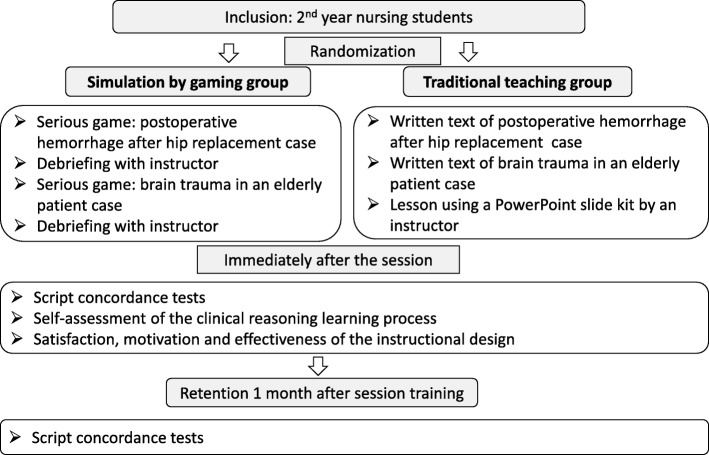
In a prospective multicenter study, and after consent, 2nd year nursing students were randomized into two groups: Simulation by gaming "SG": the student played individually with a serious game consisting of 2 cases followed by a common debriefing with an instructor;Traditional Teaching "TT": the student worked on the same cases in text paper format followed by a traditional teaching course with a PowerPoint presentation by an instructor. CR skill was measured by script concordance tests (80 SCTs, score 0-100) immediately after the session (primary outcome) and on month later. Other outcomes included students' satisfaction, motivation and professional impact.
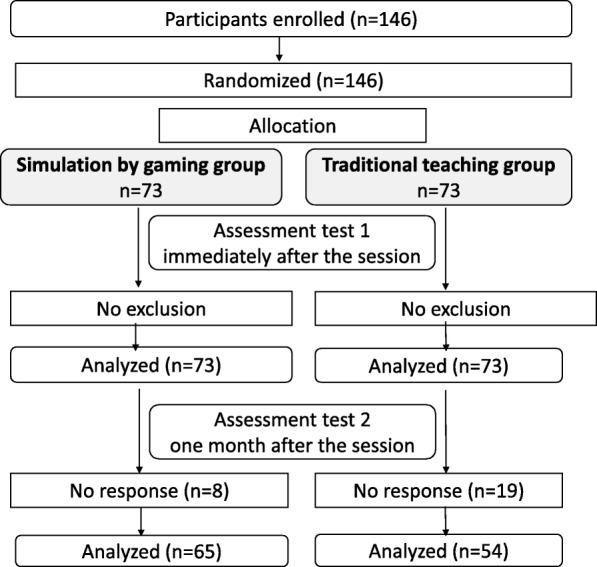
One hundred forty-six students were randomized. Immediately after training, the SCTs scores were 59 ± 9 in SG group (n = 73) and 58 ± 8 in TT group (n = 73) (p = 0.43). One month later, the SCTs scores were 59 ± 10 in SG group (n = 65) and 58 ± 8 in TT group (n = 54) (p = 0.77). Global satisfaction and motivation were highly valued in both groups although significantly greater in the SG group (p < 0.05). The students declared that the training course would have a positive professional impact, with no difference between groups.
In this study assessing nursing student CR to detect patient deterioration, no significant educational difference (SCT), neither immediate nor 1 month later, was observed between training by SG and the TT course. However, satisfaction and motivation were found to be greater with the use of SG.
ClinicalTrials.gov; NCT03428269. Registered 30 january 2018.
早期发现和应对患者病情恶化会影响患者预后。因此,护理教育至关重要。本随机对照试验的目的是比较游戏模拟 (SG) 和传统教学 (TT) 方法在提高识别患者恶化所需的临床推理 (CR) 技能方面的各自教育价值。
在一项前瞻性多中心研究中,在获得同意后,将二年级护理学生随机分为两组:游戏模拟“SG”:学生单独使用一款包含 2 个案例的严肃游戏进行游戏,然后与教员进行共同讨论;传统教学“TT”:学生以纸质格式处理相同的案例,然后由教员使用 PowerPoint 演示进行传统教学课程。CR 技能通过脚本一致性测试 (80 个 SCT,得分 0-100) 进行测量,分别在课程结束后(主要结局)和 1 个月后进行。其他结果包括学生的满意度、动机和专业影响。
共有 146 名学生被随机分组。培训后立即,SG 组的 SCT 分数为 59±9(n=73),TT 组为 58±8(n=73)(p=0.43)。1 个月后,SG 组的 SCT 分数为 59±10(n=65),TT 组为 58±8(n=54)(p=0.77)。尽管 SG 组的满意度和动机明显更高(p<0.05),但两组学生都非常重视这两项。学生们表示,培训课程将对他们的专业产生积极影响,两组之间没有差异。
在这项评估护理学生识别患者恶化的 CR 的研究中,SG 培训与 TT 课程之间,无论是即时还是 1 个月后,都没有观察到明显的教育差异(SCT)。然而,使用 SG 时,满意度和动机更高。
ClinicalTrials.gov;NCT03428269。于 2018 年 1 月 30 日注册。