Liang Bin, Tian Yuan, Chen Xinyuan, Yan Hui, Yan Lingling, Zhang Tao, Zhou Zongmei, Wang Lvhua, Dai Jianrong
Department of Radiation Oncology, National Cancer Center/National Clinical Research Center for Cancer/Cancer Hospital, Chinese Academy of Medical Sciences and Peking Union Medical College, Beijing, China.
Front Oncol. 2020 Jan 31;9:1500. doi: 10.3389/fonc.2019.01500. eCollection 2019.
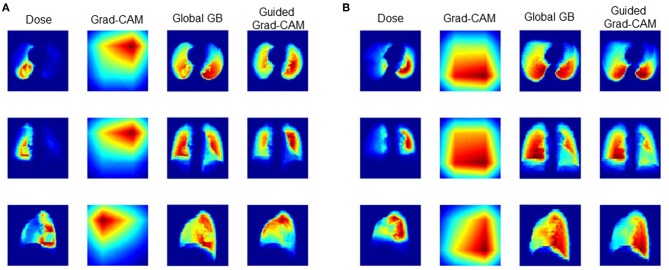
Radiation pneumonitis (RP) is one of the major side effects of thoracic radiotherapy. The aim of this study is to build a dose distribution based prediction model, and investigate the correlation of RP incidence and high-order features of dose distribution. A convolution 3D (C3D) neural network was used to construct the prediction model. The C3D network was pre-trained for action recognition. The dose distribution was used as input of the prediction model. With the C3D network, the convolution operation was performed in 3D space. The guided gradient-weighted class activation map (grad-CAM) was utilized to locate the regions of dose distribution which were strongly correlated with grade≥2 and grade<2 RP cases, respectively. The features learned by the convolution filters were generated with gradient ascend to understand the deep network. The performance of the C3D prediction model was evaluated by comparing with three multivariate logistic regression (LR) prediction models, which used the dosimetric, normal tissue complication probability (NTCP) or dosiomics factors as input, respectively. All the prediction models were validated using 70 non-small cell lung cancer (NSCLC) patients treated with volumetric modulated arc therapy (VMAT). The area under curve (AUC) of C3D prediction model was 0.842. While the AUC of the three LR models were 0.676, 0.744 and 0.782, respectively. The guided grad-CAM indicated that the low-dose region of contralateral lung and high-dose region of ipsilateral lung were strongly correlated with the grade≥2 and grade<2 RP cases, respectively. The features learned by shallow filters were simple and globally consistent, and of monotonous color. The features of deeper filters displayed more complicated pattern, which was hard or impossible to give strict mathematical definition. In conclusion, we built a C3D model for thoracic radiotherapy toxicity prediction. The results demonstrate its performance is superior over the classical LR models. In addition, CNN also offers a new perspective to further understand RP incidence.
放射性肺炎(RP)是胸部放疗的主要副作用之一。本研究的目的是建立一个基于剂量分布的预测模型,并研究RP发生率与剂量分布高阶特征的相关性。使用卷积3D(C3D)神经网络构建预测模型。C3D网络针对动作识别进行了预训练。剂量分布用作预测模型的输入。利用C3D网络在三维空间中进行卷积操作。使用引导梯度加权类激活映射(grad-CAM)分别定位与≥2级和<2级RP病例密切相关的剂量分布区域。通过梯度上升生成卷积滤波器学习到的特征,以理解深度网络。通过与分别使用剂量学、正常组织并发症概率(NTCP)或剂量组学因素作为输入的三个多变量逻辑回归(LR)预测模型进行比较,评估C3D预测模型的性能。所有预测模型均使用70例接受容积调强弧形放疗(VMAT)的非小细胞肺癌(NSCLC)患者进行验证。C3D预测模型的曲线下面积(AUC)为0.842。而三个LR模型的AUC分别为0.676、0.744和0.782。引导grad-CAM表明,对侧肺的低剂量区域和同侧肺的高剂量区域分别与≥2级和<2级RP病例密切相关。浅层滤波器学习到的特征简单且全局一致,颜色单调。深层滤波器的特征显示出更复杂的模式,难以或无法给出严格的数学定义。总之,我们建立了一个用于胸部放疗毒性预测的C3D模型。结果表明其性能优于经典的LR模型。此外,卷积神经网络还为进一步理解RP发生率提供了一个新的视角。