Institute for Health and Sport, Victoria University, Melbourne, Australia.
Sport Performance Optimisation Research Team, School of Human Life Sciences, University of Tasmania, Launceston, Australia.
J Physiol. 2020 Apr;598(8):1523-1536. doi: 10.1113/JP278828. Epub 2020 Mar 11.
Sleep restriction has previously been associated with the loss of muscle mass in both human and animal models. The rate of myofibrillar protein synthesis (MyoPS) is a key variable in regulating skeletal muscle mass and can be increased by performing high-intensity interval exercise (HIIE), although the effect of sleep restriction on MyoPS is unknown. In the present study, we demonstrate that participants undergoing a sleep restriction protocol (five nights, with 4 h in bed each night) had lower rates of skeletal muscle MyoPS; however, rates of MyoPS were maintained at control levels by performing HIIE during this period. Our data suggest that the lower rates of MyoPS in the sleep restriction group may contribute to the detrimental effects of sleep loss on muscle mass and that HIIE may be used as an intervention to counteract these effects.
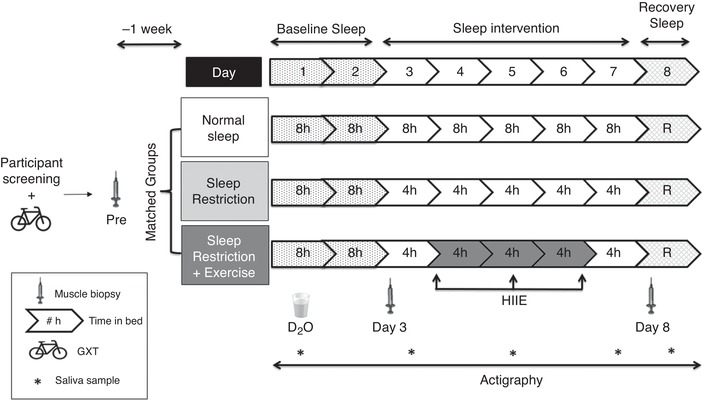
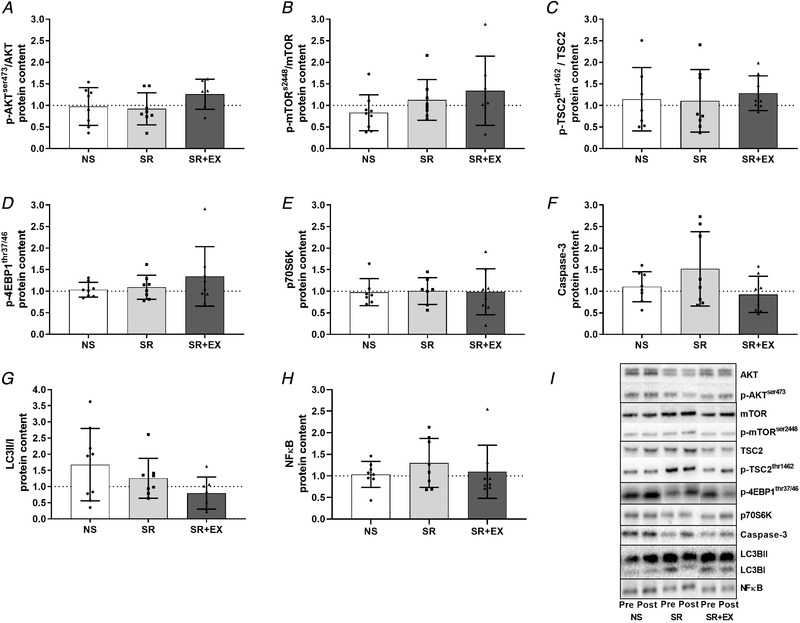
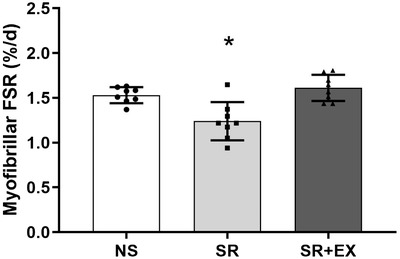
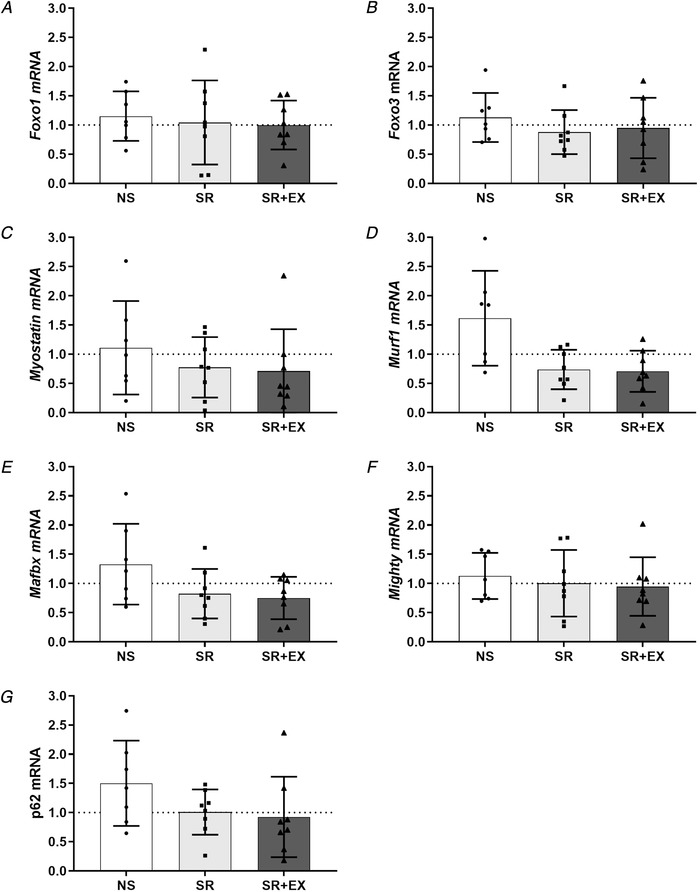
The present study aimed to investigate the effect of sleep restriction, with or without high-intensity interval exercise (HIIE), on the potential mechanisms underpinning previously-reported sleep-loss-induced reductions to muscle mass. Twenty-four healthy, young men underwent a protocol consisting of two nights of controlled baseline sleep and a five-night intervention period. Participants were allocated into one of three parallel groups, matched for age, , body mass index and habitual sleep duration; a normal sleep (NS) group [8 h time in bed (TIB) each night], a sleep restriction (SR) group (4 h TIB each night), and a sleep restriction and exercise group (SR+EX, 4 h TIB each night, with three sessions of HIIE). Deuterium oxide was ingested prior to commencing the study and muscle biopsies obtained pre- and post-intervention were used to assess myofibrillar protein synthesis (MyoPS) and molecular markers of protein synthesis and degradation signalling pathways. MyoPS was lower in the SR group [fractional synthetic rate (% day ), mean ± SD, 1.24 ± 0.21] compared to both the NS (1.53 ± 0.09) and SR+EX groups (1.61 ± 0.14) (P < 0.05). However, there were no changes in the purported regulators of protein synthesis (i.e. p-AKT and p-mTOR ) and degradation (i.e. Foxo1/3 mRNA and LC3 protein) in any group. These data suggest that MyoPS is acutely reduced by sleep restriction, although MyoPS can be maintained by performing HIIE. These findings may explain the sleep-loss-induced reductions in muscle mass previously reported and also highlight the potential therapeutic benefit of HIIE to maintain myofibrillar remodelling in this context.
先前的研究表明,睡眠限制会导致人体和动物模型中的肌肉质量减少。肌原纤维蛋白合成(MyoPS)的速率是调节骨骼肌质量的关键变量,高强度间歇训练(HIIE)可以增加肌原纤维蛋白合成的速率,尽管睡眠限制对 MyoPS 的影响尚不清楚。在本研究中,我们证明了进行睡眠限制方案(五晚,每晚卧床 4 小时)的参与者的骨骼肌 MyoPS 速率较低;然而,在此期间进行 HIIE 可以将 MyoPS 速率维持在对照水平。我们的数据表明,睡眠限制组中较低的 MyoPS 速率可能导致睡眠不足对肌肉质量的不利影响,并且 HIIE 可作为一种干预措施来抵消这些影响。
本研究旨在探讨睡眠限制(伴有或不伴有高强度间歇训练(HIIE))对先前报道的睡眠剥夺引起的肌肉减少的潜在机制的影响。24 名健康年轻男性接受了一项包括两晚对照性基础睡眠和五晚干预期的方案。参与者被分为三组平行组,按年龄、 、体重指数和习惯性睡眠时间匹配;正常睡眠(NS)组[每晚 8 小时卧床时间(TIB)]、睡眠限制(SR)组(每晚 4 小时 TIB)和睡眠限制和运动组(SR+EX,每晚 4 小时 TIB,进行三次 HIIE)。在开始研究之前摄入氘水,并在干预前后获取肌肉活检,以评估肌原纤维蛋白合成(MyoPS)和蛋白合成和降解信号通路的分子标记物。与 NS 组(1.53±0.09)和 SR+EX 组(1.61±0.14)相比,SR 组的 MyoPS 较低[分数合成率(%日),平均值±标准差,1.24±0.21](P<0.05)。然而,在任何组中,蛋白合成的假定调节剂(即 p-AKT 和 p-mTOR)和降解(即 Foxo1/3mRNA 和 LC3 蛋白)均未发生变化。这些数据表明,睡眠限制会急性降低 MyoPS,尽管进行 HIIE 可以维持 MyoPS。这些发现可能解释了先前报道的睡眠不足引起的肌肉减少,并强调了 HIIE 在这种情况下维持肌原纤维重塑的潜在治疗益处。