Department of Chemistry, Korea Advanced Institute of Science and Technology (KAIST), Daejeon 34141, Korea.
Center for Multiscale Chiral Architectures (CMCA), Daejeon 34141, Korea.
Biomolecules. 2020 Feb 17;10(2):313. doi: 10.3390/biom10020313.
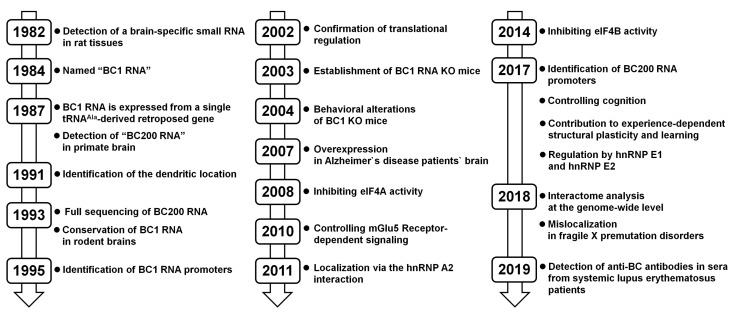
Flexibility in signal transmission is essential for high-level brain function. This flexibility is achieved through strict spatial and temporal control of gene expression in neurons. Given the key regulatory roles of a variety of noncoding RNAs (ncRNAs) in neurons, studying neuron-specific ncRNAs provides an important basis for understanding molecular principles of brain function. This approach will have wide use in understanding the pathogenesis of brain diseases and in the development of therapeutic agents in the future. Brain cytoplasmic RNAs (BC RNAs) are a leading paradigm for research on neuronal ncRNAs. Since the first confirmation of brain-specific expression of BC RNAs in 1982, their investigation has been an area of active research. In this review, we summarize key studies on the characteristics and functions of BC RNAs in neurons.
信号传输的灵活性对于高级脑功能至关重要。这种灵活性是通过神经元中基因表达的严格时空控制实现的。鉴于各种非编码 RNA(ncRNA)在神经元中发挥的关键调节作用,研究神经元特异性 ncRNA 为理解大脑功能的分子原理提供了重要基础。这种方法将广泛用于理解脑疾病的发病机制,并为未来治疗药物的开发提供重要基础。脑细胞质 RNA(BC RNA)是神经元 ncRNA 研究的主要范例。自 1982 年首次证实 BC RNA 具有脑特异性表达以来,对其的研究一直是一个活跃的研究领域。在这篇综述中,我们总结了关于神经元中 BC RNA 的特征和功能的关键研究。